Tether’s 800M AI Agent Beats Models 2.5x Its Size on Everyday Phone Tasks
tether.io
28 m
In Tether’s testing across six agentic benchmarks, the QVAC BotPsy-0.8B outperformed larger models up to 2.5x its size while roughly doubling the tool-use scores of its base architecture, proving specialized on-device AI can surpass larger generalist systems.
11 November, 2026 – Tether AI Research* announced QVAC BotPsy, an open-weight AI model setting a state-of-the-art benchmark for sub-1B parameter models across key tests of how effectively AI agents use APIs and tools. The release advances Tether’s push to bring personal assistants capable of managing everyday tasks to hardware controlled by their users.
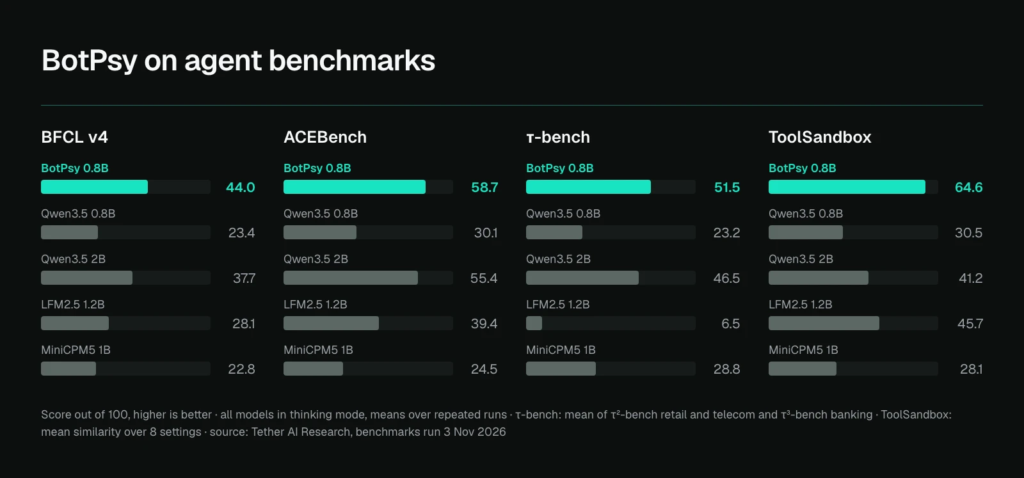
BotPsy has 0.8 billion parameters, establishing a new level of efficiency for ultra-compact on-device deployment. In Tether’s testing across six agentic benchmarks, BFCL v4, ACEBench, τ-bench, Claw-Eval, BrowseComp-Plus and ToolSandbox, the model demonstrated class-leading tool-use capability against comparable architectures. It also roughly doubled the agentic capability of its underlying Qwen3.5-0.8B-Think model on key evaluations, with scores on BFCL v4 rising from 23.4 to 44.0, ACEBench from 30.1 to 58.7, τ-bench from 23.2 to 51.5, and ToolSandbox from 30.5 to 64.6.
BotPsy reflects a broader shift toward developing more capable AI for personal devices. Rather than relying on increasingly large general-purpose models, developers can specialize smaller models for specific tasks, improving performance while working within the memory and computing constraints of personal hardware. BotPsy is built on Alibaba’s open-source Qwen3.5 architecture and demonstrates how further specialization can improve performance on specific agentic tasks.
Know when your coins move
Alerts, real-time prices, and market news — all in one app
Point your phone camera to install
4.8 based on 40K reviews in the App Store and Google Play
BotPsy turns requests into actions
AI assistants are increasingly being asked to act on people’s behalf, whether booking trips, rescheduling meetings, or managing everyday tasks. To do that, they need access to personal information such as emails, calendars, contacts, and travel plans. Today, that often means sending this information to servers operated by a handful of technology companies.
BotPsy is small enough to run on a personal device, allowing requests to be processed and turned into tool calls locally. In one ACEBench task, a message failed to send because Wi-Fi was turned off and the inbox was full. BotPsy responded by turning Wi-Fi on and freeing up inbox space before sending the message. Its base model, by contrast, kept retrying the same failed action. BotPsy can also recognize when none of the available tools are appropriate for a request, rather than inventing a tool call. A request such as “move my meeting to tomorrow and remind me to call Alex” may require an assistant to check calendar availability, resolve a scheduling conflict, update an appointment, and create a reminder. BotPsy moves us towards allowing developers to build these interactions around an AI assistant, with their applications providing the service connections, permissions and execution controls.
BotPsy’s compact size reduces the memory needed to store its weights compared with larger models, making it suitable for exploring local deployment. Its open weights give access to the model itself, allowing researchers to adapt and deploy it within their own systems further advancing the state of the art.
BotPsy adds an action-focused model to Tether’s QVAC ecosystem, alongside VisionPsy for vision language, TranscribePsy for speech, MedPsy for health-related tasks, and TranslatePsy for translation. Together, these releases support a broader strategy to bring specialized AI capabilities onto user-controlled hardware. The longer-term ambition is for personal AI systems to interpret information and carry out useful tasks through these complementary capabilities. Future development will explore how the models can work together.
Taking on larger models
BotPsy is a 0.8B-parameter model built to take actions. Give it a request and the tools an app offers, and it turns the request into the right tool calls, over several steps when one is not enough. Across six evaluated tool-use and agent benchmarks, it beats every other model tested at 1.2B parameters or fewer.
On four primary agentic evaluations, BFCL v4, ACEBench, τ-bench, and ToolSandbox, BotPsy roughly doubles the scores of its base model and outperforms Alibaba’s Qwen3.5-2B-Think, a model 2.5 times its size.
Figure 1: Benchmark accuracy across four core agentic evaluations. Scores represent percentage accuracy (higher is better). Full evaluation data across all six benchmarks, including Claw-Eval and BrowseComp-Plus, is available in the technical documentation.
The largest gap in BotPsy’s development results was in BFCL’s multi-turn tool-calling, which evaluates tool use across successive user interactions. This tests a capability important to everyday assistants: continuing a task as new information arrives. Rescheduling a meeting, for example, may require checking availability, responding to a conflict and using the calendar tool again once another time is agreed.
BotPsy scored 46.1 on this test, compared with 23.8 for Qwen3.5-2B-Think, nearly twice the score despite having 60% fewer parameters. The underlying base model from which BotPsy was developed scored only 7.5.
BotPsy also scored 82.5 on τ-bench telecom, where an agent guides a user through a troubleshooting task over multiple turns. It scored ahead of Qwen3.5-2B-Think (69.3) and MiniCPM5-1B-Think (74.0). It also performed well on BFCL v4’s hallucination tests, which assess whether a model knows when not to call a tool because no appropriate tool is available. BotPsy scored 86.1, the highest among the models tested.
Together, these results show how specialization can improve a smaller model’s ability to handle agentic tasks. This creates more options for building assistants within the memory and computing constraints of personal hardware.
Personal AI under the user’s control
“An assistant that manages your calendar, messages and documents needs access to some of your most personal information,” said Paolo Ardoino, CEO of Tether. “Running AI locally can reduce the need to send that information to centralized providers, giving people greater control over how it is processed. Users should decide what their assistant can access and which external services it can connect to, and developers should have the freedom to run and adapt models without depending on a single company’s servers or continued permission. BotPsy advances the tool-use capabilities that can make that freedom useful in everyday life.”
Tether’s longer-term vision is for BotPsy to power a personal AI companion within QVAC, with a smartphone serving as the everyday interface and a home PC or trusted peer-to-peer (P2P) nodes taking on more demanding tasks. Whether on Android or iPhone, the phone would remain an always-on companion, handing off complex requests, such as analyzing a document or organizing a complicated travel schedule, to a home computer for processing. The computer would then send the resulting actions back to the phone. Web searches could work in a similar way, with queries routed through encrypted P2P connections rather than corporate clouds or third-party servers. This approach is designed to give users greater control over their data and online activity, without relying on centralized services to process their requests.
BotPsy’s model weights, technical documentation, and evaluation details are available at
https://huggingface.co/qvac/BotPsy-0.8B and https://huggingface.co/qvac/BotPsy-0.8B-GGUFs
*References to Tether AI Research mean Tether Data, S.A. de C.V.
About QVAC
QVAC is Tether Data’s advanced AI research initiative dedicated to building open, decentralized, and adaptive intelligence systems. Its mission is Local AI and Infinite Intelligence. It is guided by an uncompromising vision of a world where AI lives and learns on any device, empowering individuals and communities rather than concentrating power in corporate data centers. For more information, visit https://qvac.tether.io/.
About Tether Data
Tether Data, S.A. de C.V. (“Tether Data”) is part of Tether’s broader vision to advance freedom, transparency, and innovation through technology. Its mission is to enable people and organizations to connect and share information directly, without unnecessary intermediaries. By creating secure, peer-to-peer systems, Tether Data gives users greater control over their data, communications, and digital interactions. Tether Data aims to redefine how information flows across networks by replacing centralized models with decentralized infrastructure designed for privacy, efficiency, and resilience. The company’s goal is to make global connectivity faster, safer, and more private, empowering individuals and institutions alike to exchange information freely and securely.

 tether.io