Visa Adds Monad to Stablecoin Settlement Without Naming a Single Issuer
blockchainreporter.net
3 h
At 10:47 a.m. Eastern on November 10, the Monad Foundation published a release with a headline that will be quoted for months: Visa, it said, had added Monad as a stablecoin settlement network. The document runs to seven paragraphs, carries two quotations, and lists the network’s specifications down to block times. It does not name a single stablecoin. It does not name a single issuer or acquirer. It does not say that one dollar has settled on Monad through Visa’s rails.
That gap is the story. Visa has spent two years turning stablecoins into a settlement layer it controls, and the Monad Foundation’s announcement is the latest addition to that layer. What it is not is evidence that anyone is using it yet.
What the Monad Foundation Said, and What It Left Out
Settlement is the unglamorous half of card payments. When a cardholder buys coffee, the issuer owes Visa, and the two sides square up later. For decades that squaring up has run on a five-business-day banking calendar. Settlement on a blockchain compresses the calendar and removes the weekend gap: funds can move on a Saturday, and an acquirer gets its money without waiting for Monday.
Know when your coins move
Alerts, real-time prices, and market news — all in one app
Point your phone camera to install
4.8 based on 40K reviews in the App Store and Google Play
The release describes exactly that, applied to Monad. Participating issuers and acquirers gain another way to settle with Visa in stablecoins, and the operative word is another. This is an option on a menu, not a migration.
“Our goal is to give our partners the flexibility to settle on the blockchain networks that best meet their needs,” said Dan Roesbery, Visa’s vice president of global onchain partnerships and go-to-market. “Adding support for Monad expands the options available to our partners and is another step toward building a multi-chain settlement infrastructure for stablecoin-enabled payments.”
The engineering case in the document is narrow and specific. Monad is EVM-compatible, so an issuer already running Ethereum-based custody, wallet and compliance stacks can extend those integrations to Monad rather than build new ones. Monad’s own documentation puts block time at 400 milliseconds and finality at 800 milliseconds, with fees close to zero; the release repeats those figures and adds a claim of 10,000 transactions per second. Those are the network’s claims about itself, not measurements.
What the release omits matters more than what it includes. There is no list of stablecoins eligible to settle on Monad. There is no first partner, no date for a first settlement, and no volume figure. For a payments rail, those three details are what separate an integration from a business. The announcement also came from the Monad Foundation rather than from Visa’s own newsroom: the quotations attributed to Visa’s executive appear inside Monad’s release.
A $25 Billion Number That Predates Monad
The only hard figures in the document belong to Visa, and they are not new. As of September 2026, the release states, Visa reported a $25 billion annualized stablecoin settlement run rate, up roughly tenfold year over year, alongside more than 225 stablecoin-linked card programs live globally. Visa disclosed those numbers on October 27 in its fiscal fourth-quarter results, and we broke down what the run rate does and does not measure in our coverage of that disclosure.
On the same earnings call, chief executive Ryan McInerney was precise about the network count: “We can now support 10 blockchains, more than doubling from last year and are operating in all 5 regions.” Ten blockchains, as of October 27. Monad arrives after that date, which makes it the eleventh rail by simple sequencing, or possibly a replacement for one that quietly left the list. Neither company published an updated count, so describing Monad as “the tenth” chain, as some coverage did, asserts something neither party said. The defensible statement is narrower: the list grew and nobody published the new total.
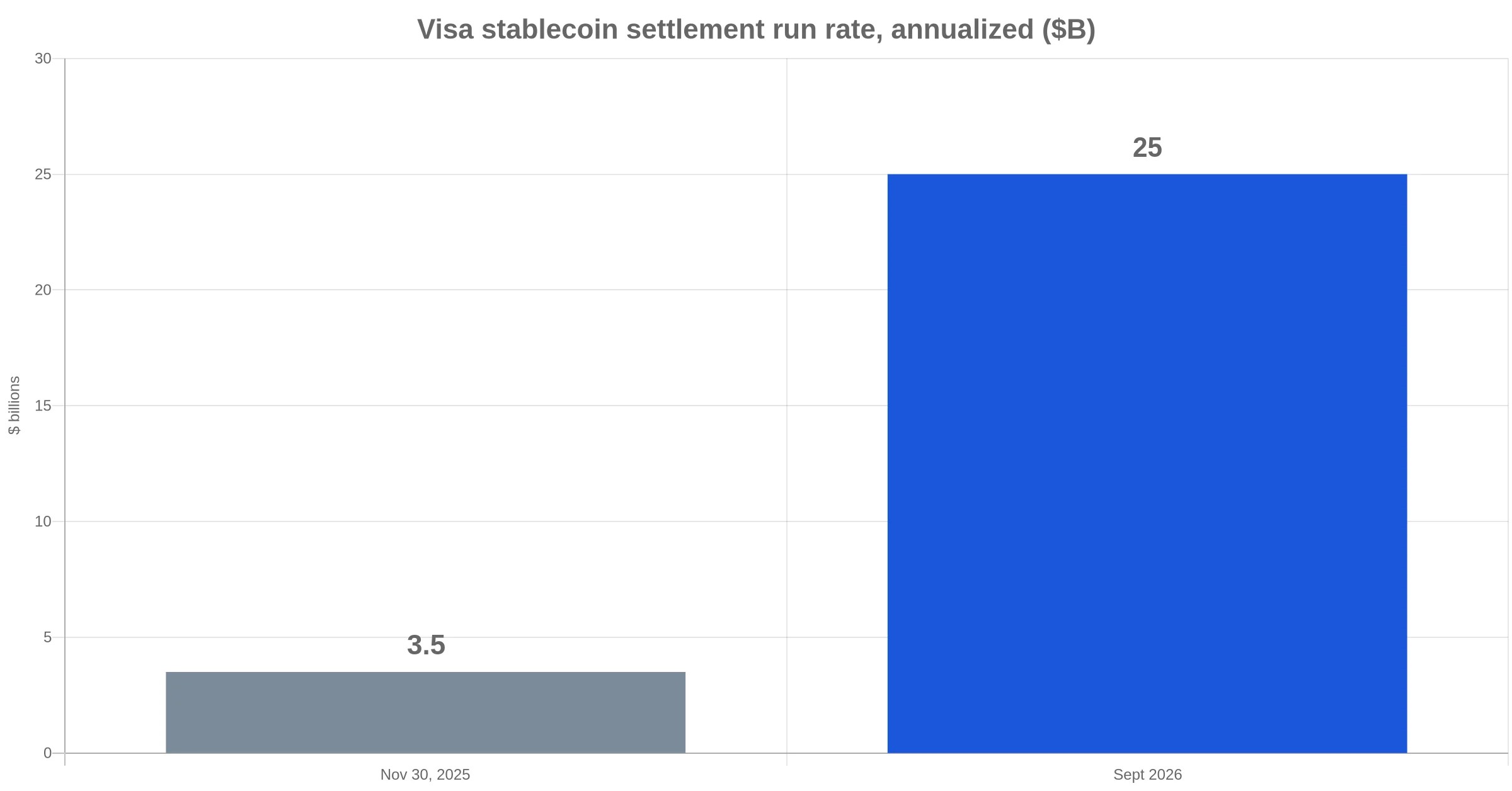
Visa stablecoin settlement, annualized run rate, from Visa disclosures of November 30, 2025 and September 2026. Chart: BlockchainReporter.
The trajectory holds up against Visa’s own earlier numbers. In December 2025, when Visa launched USDC settlement in the United States, it put the run rate at “more than $3.5B in annualized stablecoin settlement volume” as of November 30, 2025. Twenty-five billion against $3.5 billion is 7.1x in roughly ten months. Compounded across twelve months, that pace annualizes to about 10.6x, which is close to the “roughly 10x” Visa used for a year-over-year comparison. Two official figures, two different baselines, one direction of travel.
Why Confidentiality, Not Speed, Is the Gate
The release gives its longest paragraph to privacy, which is a tell. For a bank, settling on a public chain means publishing its payment flows to competitors, and a treasury desk treats commercial payment data the way it treats a client list.
“Stablecoins are increasingly becoming part of the infrastructure that institutions use to move money, and settlement is where the benefits of always available onchain infrastructure become especially clear,” said Keone Hon, co-founder and general manager of the Monad Foundation. “The next phase will be defined by whether institutions can keep sensitive flows confidential without leaving open networks, and the addition of Monad to Visa’s stablecoin settlement program, together with the privacy functionality being developed on Monad, represents a meaningful step in that direction.”
Being developed is the load-bearing phrase. Monad’s Private Settlement is not live. The release says institutions will benefit from privacy functionality “in coming months” and describes the feature as designed to run on the network so that private activity stays connected to the same liquidity as everything else. Until it ships, a bank choosing Monad today is choosing a transparent rail with a privacy promise attached to it.
Visa is hedging that bet rather than making it. It already serves as a super validator on Canton, a network built around confidential settlement between institutions, and holds validator roles on other chains, including Circle’s Arc and Tempo. The shift of Visa’s stablecoin work from pilot to production was never a bet on one chain, and adding Monad does not change that posture.
The Arithmetic of 225 Card Programs
Divide $25 billion by 365 and the run rate averages $68.5 million a day. Spread that across the 225-plus card programs Visa counted in September and each program accounts for roughly $111 million a year, or about $304,000 a day. These are averages rather than disclosures: Visa has never published a per-program, per-chain or per-stablecoin breakdown, and it does not report stablecoin revenue as a separate line.
The per-second number is smaller than the marketing around these integrations suggests. Twenty-five billion dollars a year is $793 a second. If the average settlement transfer were $1,000, that would be 0.79 transfers every second across every chain in the program. Monad’s headline claim is 10,000 transactions per second. The ceiling is not the constraint here; demand is.
Finality is where the technology argument actually lands. Monad promises irreversibility in 800 milliseconds. A five-business-day banking cycle is 432 million milliseconds, so the finality window is 540,000 times shorter. Finality is not the same thing as a settlement cycle, one being the moment a transfer becomes irreversible and the other the moment funds must be in place, but the direction of the change is not in dispute.
Monad Gets the Logo Before the Volume
The market did not treat the announcement as a repricing event. MON traded at $0.0165 with a market capitalization near $195 million at 00:38 UTC on November 11, down 0.8% over 24 hours while bitcoin fell 1.8% and ether 3.3%, according to CoinGecko. A card network’s name is a sales asset. It is not a revenue line, and the token behaved as though it knew the difference.
Monad’s pitch to institutions rests on claims it makes about itself: 10,000 transactions per second, 400-millisecond blocks, 800-millisecond finality, near-zero fees, no specialised hardware, and more than 200 independently operated validators across 30-plus countries. Each of those is checkable in principle. None of them is verified by a press release, and none of them tells a payments executive whether a single bank will route a single settlement through the network.
What the Visa listing does add is a reference of a specific kind: a card network willing to let its name sit beside Monad’s in a document that bank treasury teams will read. In enterprise sales that reference has value before it has volume, and the Monad Foundation is entitled to bank it as such.
What Would Turn a Rail Listing Into a Volume Story
Four disclosures would move this from a menu addition to a business. A named issuer or acquirer settling on Monad. The stablecoin or stablecoins eligible on that route. A volume figure for the chain, even a rounded one. And a shipping date for Private Settlement rather than “in coming months.”
Visa’s incentive to publish none of them is straightforward. It sells neutrality, and neutrality is easier to sell when no chain is named a winner. McInerney put the position in six words on the October call: “We are stablecoin-agnostic. We are blockchain-agnostic.”
The same logic explains why the run rate keeps appearing in third-party releases. It is the one number in the stablecoin settlement business that Visa publishes, it is growing, and any partner announcing an integration can borrow it without asking for more. Borrowed numbers age, though: the $25 billion figure is now more than six weeks old, tied to September, and it says nothing about which chains carried it.
For readers tracking the build-out, the next verifiable marker is not another chain added to the list. It is the first named institution on Monad, and the first number attached to it. Until both exist, Monad has a place on Visa’s settlement menu and no evidence that anyone has ordered from it.
Data: CoinGecko (prices, 11 November 2026, 00:38 UTC); Visa fiscal fourth-quarter 2026 results as cited in the Monad Foundation release of 10 November 2026.
Disclosure: This article does not represent investment advice. The content and materials featured on this page are for educational purposes only.

 blockchainreporter.net