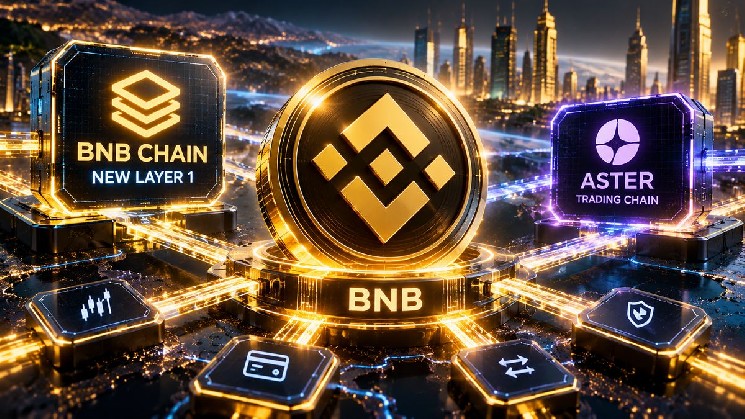
Binance co-founder Changpeng Zhao (CZ) commented on the initiative with the phrase “Multiple chains, one coin,” referring to the possibility of using the same asset across different networks.
Multiple chains, one coins. https://t.co/uwjbQ72v5D
— CZ 🔶 $BNB (@cz_binance) October 25, 2026
$BNB Chain to Use $BNB on Its New Layer 1
According to the technical documentation, the new blockchain will support applications such as high-frequency trading, on-chain order books, and real-time payments.
Unlike projects that create a separate token for each network, the proposal establishes that $BNB will remain the native asset used to pay transaction fees and participate in staking.
The new Layer 1 will coexist with $BNB Smart Chain. Its launch is not intended to replace the existing infrastructure, but to introduce a specialized network for applications requiring faster transaction processing.
The development roadmap calls for a public testnet by late 2026 and a mainnet launch in early 2027.
Aster Chain Already Operates a Trading-Focused Blockchain
The new project is aligned with the development of Aster Chain, a Layer 1 backed by YZi Labs, the investment firm formerly known as Binance Labs.
Aster launched its mainnet on March 17, 2026, focusing on on-chain trading, particularly derivatives and privacy features designed to protect information about orders and positions.
According to its specifications, the blockchain targets more than 100,000 transactions per second, with median block times of 50 milliseconds.
Although both networks are associated with projects connected to CZ, they serve different purposes. $BNB Chain aims to support a range of financial applications, while Aster is developing infrastructure focused on trade execution and trader privacy.

YZi Labs provides financial backing to Aster, but that relationship does not mean CZ directly controls its operations.
The coexistence of several specialized networks also presents challenges for liquidity distribution and developer activity.
For $BNB Chain’s new Layer 1, using $BNB as a shared asset will allow the same token to serve transaction fee and staking functions, although demand will depend on the activity each network manages to attract.

 crypto-economy.com