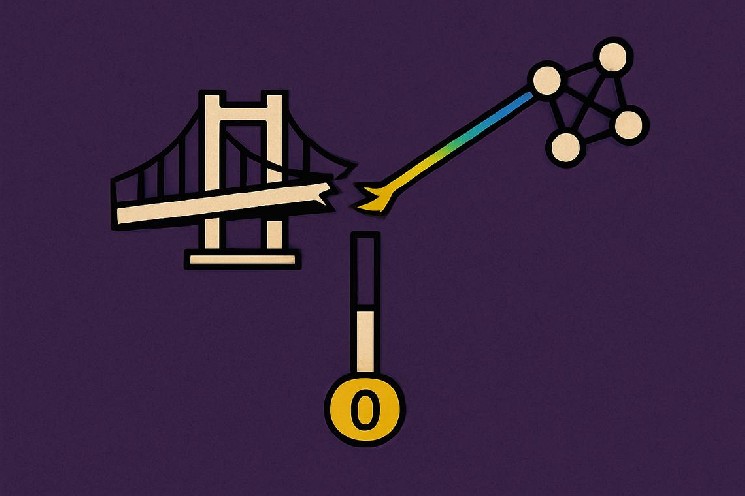
Arc essentially faces a distribution challenge, and this addresses it: by being included as a supported withdrawal network on a regulated crypto wealth management platform, the protocol reaches users who would otherwise be unlikely to ever interact with a bridge interface directly. SwissBorg’s user base leans heavily toward European retail investors, a group that tends to prioritize simplicity over technical tinkering, and that lines up well with Arc’s pitch of a straightforward stablecoin environment.
How the integration eliminates costly bridge fees
Before this integration, moving $USDC onto Arc meant relying on third-party bridges, and that came at a price. PlaygroundBridge, one of the primary pathways available, charged a dynamic “launch premium” that ranged anywhere from 3% to 25% on inbound transfers.
That’s not a flat fee. It fluctuated based on demand, which meant users had little way of knowing what they’d actually pay until the transfer went through. At the high end of that range, a quarter of a transfer’s value could disappear before the funds even landed. For anyone moving a serious sum, that kind of unpredictability made bridging feel like a gamble rather than a routine transaction.
SwissBorg’s direct deposit integration removes that intermediary altogether. It’s worth noting this isn’t a first for the company: SwissBorg had previously rolled out multi-chain $USDC deposits and withdrawals across seven major networks, so extending the same functionality to Arc fits an existing pattern rather than marking a brand-new capability.
Arc Network’s stablecoin-native design and multi-stablecoin support
Arc isn’t just another EVM-compatible chain chasing the same DeFi crowd. It’s built as a stablecoin-native network, and that shows up most clearly in how it handles gas: $USDC itself serves as the gas token, so there’s no separate volatile coin users need to buy, hold, or track just to pay for transactions.
Most blockchains force users into a dual-token setup, one asset for fees and another for whatever they actually want to do on-chain. That structure creates constant exposure to price swings on the gas side, even for people who only want to move stable-value funds. Arc’s design sidesteps that problem entirely by making $USDC do double duty as both the transactional asset and the fee token.
Beyond $USDC, Arc also natively supports $EURC, a euro-denominated stablecoin, along with USYC, positioning the network as a fiat-stable, yield-oriented environment. On the technical side, Arc supports ERC-4337 account abstraction, the standard behind smart wallet functionality, which lets the network tap into existing Ethereum infrastructure for features like gasless transactions and session keys.
User benefits and strategic implications of the partnership
This integration matters most for the people who never wanted to deal with bridge interfaces in the first place. SwissBorg’s $USDC integration with Arc means those users get direct access to a stablecoin-native chain through a platform they already trust, without needing to understand what a “launch premium” even is.
For Arc, the strategic value is distribution rather than technology. Being listed as a supported withdrawal network on a regulated wealth management platform opens a channel to users who would otherwise never discover the chain. Combined with the removal of volatile gas fees and the addition of euro-denominated and yield-bearing stablecoins, Arc is positioning itself as an accessible entry point for stablecoin activity, rather than a niche DeFi playground requiring bridge expertise.
Whether that accessibility translates into meaningful volume on Arc is a separate question from the fee savings themselves. But removing a 3% to 25% cost barrier on inbound transfers is the kind of change that tends to show up quickly in usage data, simply because it removes a very obvious deterrent.
FAQ
What is the main benefit of SwissBorg’s $USDC integration with Arc Network?
It allows users to deposit $USDC directly on Arc Network without using third-party bridges, avoiding costly fees.
How did PlaygroundBridge’s fee structure impact $USDC transfers to Arc Network before this integration?
PlaygroundBridge charged dynamic fees ranging from 3% to 25%, creating unpredictably high costs.
What makes Arc Network different from many other blockchains in terms of gas fees?
Arc Network uses $USDC as its gas token, eliminating exposure to volatile native gas tokens.
Which stablecoins are supported natively on Arc Network besides $USDC?
Arc Network also supports the euro-denominated stablecoin $EURC and USYC.
Article produced with the assistance of artificial intelligence and reviewed by the editorial team.

 en.cryptonomist.ch