
 en.cryptonomist.ch
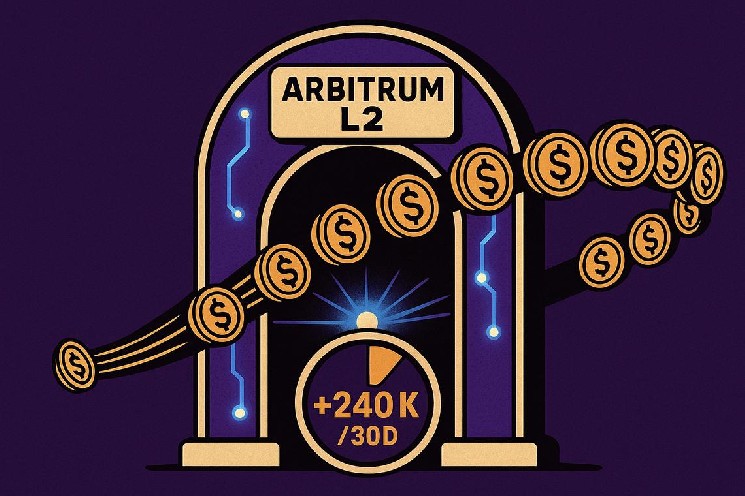
Robinhood Chain has added 240,000 new stock token holders in just 30 days — more than any other blockchain over the same period. The announcement came on July 21st, 2026, and it signals that Arbitrum tokenization growth is becoming a measurable force, not just a talking point.
Key takeaways
- Robinhood Chain added 240,000 stock token holders in 30 days, more than any other blockchain in that period.
- Robinhood Chain is built as an Ethereum Layer-2 on Arbitrum, designed primarily for tokenized real-world assets like stocks and ETFs.
- The surge signals broader acceptance of blockchain technology within traditional finance, according to Arbitrum’s announcement on July 21st, 2026.
- Despite the holder growth, Robinhood Chain’s tokenized real-world asset market cap sits at just $12.66 million, with early on-chain activity still dominated by memecoin trading.
- Arbitrum positions itself as a leader in Layer-2 scaling solutions for Ethereum, with tokenization and decentralized finance as its strategic core.
Robinhood Chain Drives Token Holder Growth
The raw number is striking on its own. But the context makes it more interesting: Robinhood Chain was built as a Layer-2 on Arbitrum, specifically engineered to bring tokenized stocks and ETFs onchain for retail investors. The 240,000 new holders represent significant growth that Arbitrum was quick to highlight.
What makes this growth meaningful is who it’s coming from. Robinhood brings more than 27.6 million funded customers to the table, according to Robinhood’s investor reports, a retail base with no prior onchain experience. The strategy, as Seong Seog Lee, Head of Product at Robinhood Crypto, told CoinDesk, is explicit: “Our opportunity isn’t to take volume from existing crypto traders. Most people have never touched a perpetuals contract, not necessarily because they don’t want exposure, but because the on-ramps have never been there. We’re changing that.”
That framing reframes the holder growth entirely. These aren’t crypto-native users migrating from another chain. Many are first-time onchain participants — exactly the demographic that tokenization advocates have long argued would unlock the next phase of blockchain adoption.
Comparative Growth Among Blockchains
No other blockchain added more stock token holders over the same 30-day window. That comparative claim, tied to the July 21st announcement, gives Arbitrum a concrete data point it can use to anchor its positioning as the infrastructure layer for real-world asset tokenization. The significance reflects genuine demand for tokenized financial products at the retail level, a segment that institutional-focused tokenization projects have struggled to reach.
Arbitrum’s Layer-2 Platform and the Tokenization Bet
Arbitrum operates as a Layer-2 scaling solution for Ethereum, built to handle higher transaction throughput at lower cost than Ethereum’s base layer. Its strategic focus on tokenization and decentralized finance has made it the infrastructure of choice for projects trying to bridge traditional financial assets and blockchain rails. Robinhood Chain’s decision to build on Arbitrum was deliberate — the network launched officially to the public in July 2026, following months of testing that began in February, according to CoinDesk.
The design intent was clear from the start: tokenized real-world assets, specifically stocks and ETFs, traded around the clock. That vision aligns directly with Arbitrum’s broader positioning as the Layer-2 network most oriented toward institutional and retail tokenization use cases.
Where the Vision Meets Reality
Here’s the tension that matters. Despite the holder surge, Robinhood Chain’s tokenized real-world asset market cap stands at just $12.66 million, according to CoinDesk. Early on-chain activity has been dominated by memecoin speculation — most notably CASHCAT, a cat-themed token that briefly reached a $156 million market cap, roughly 12 times the size of the chain’s entire tokenized real-world asset market. Of the $734 million bridged onto the chain, only $211 million is actually deployed in lending or yield products.
This gap between the tokenization narrative and the current on-chain reality is the central analytical tension in the story. A high holder count signals intent and distribution reach. Actual capital deployment into tokenized stocks and yield products would signal something deeper: genuine behavioral change. Right now, Robinhood Chain has demonstrated the former more clearly than the latter.
Broader Blockchain Acceptance in Traditional Finance
Still, the holder growth carries weight as a directional signal. The increase in stock token holders points to a broader acceptance of blockchain technology within traditional finance — a shift that has been anticipated for years but rarely backed by user-level data at this scale. When a platform with Robinhood’s retail reach reports this kind of growth on a tokenized asset chain, it becomes evidence rather than aspiration.
The comparison to Coinbase’s Base chain is instructive. Base launched in 2023 with a similar institutional pitch before memecoins drove it to genuine scale. Base eventually evolved into a broad consumer chain with real developer activity. Whether Robinhood Chain follows that path — or whether speculative activity fades before the tokenization use case matures — remains the open question.
What the Growth Means for Arbitrum’s Market Position
For Arbitrum, Robinhood Chain’s holder milestone is validation of a strategic bet. By positioning itself as the Layer-2 infrastructure for tokenized real-world assets, Arbitrum has attracted one of the most distribution-rich platforms in retail finance. 240,000 new holders in 30 days is the kind of growth metric that signals ecosystem health to developers, institutional partners, and potential users weighing which network to build on or interact with.
The implications extend beyond raw numbers. Increased user engagement in tokenized assets could attract additional projects to Arbitrum’s ecosystem, strengthen the case for further technical investment in tokenization infrastructure, and position Arbitrum as the de facto Layer-2 for real-world asset use cases. None of that is guaranteed, but the Robinhood Chain data point gives Arbitrum a concrete competitive reference that few Layer-2 networks can currently match in the tokenization space.
Lee’s stated ambition captures the long arc: “We’re looking forward to users discovering everything Robinhood Chain makes possible with bringing real-world assets onchain, including 24/7 stock token trading, onchain lending, and more.” The infrastructure is live. The users are arriving. Whether they stay — and whether they eventually trade stocks rather than memecoins — is the question that will define Arbitrum tokenization growth over the next twelve months.
FAQ
How many new stock token holders did Robinhood Chain gain recently?
Robinhood Chain added 240,000 new stock token holders in the past 30 days, as announced on July 21st, 2026.
Why is Robinhood Chain’s token holder growth significant for Arbitrum?
This growth represents more stock token holders added than any other blockchain in the same period, highlighting strong tokenization momentum on Arbitrum and reinforcing its position as a leading Layer-2 infrastructure for real-world asset use cases.
What is Arbitrum’s main focus as a platform?
Arbitrum is a Layer-2 Ethereum solution focused on tokenization and decentralized finance, designed to offer faster and cheaper transactions than Ethereum’s base layer while supporting tokenized real-world assets.
What does the increase in stock token holders indicate about blockchain adoption?
It signals broader acceptance of blockchain technology within traditional finance, particularly as a large retail-focused platform like Robinhood drives first-time onchain users into tokenized asset markets.
Article produced with the assistance of artificial intelligence and reviewed by the editorial team.