South Korea's KB Financial completes stablecoin pilot for offline payments
cointelegraph.com
18 May 2026 17:22, UTC
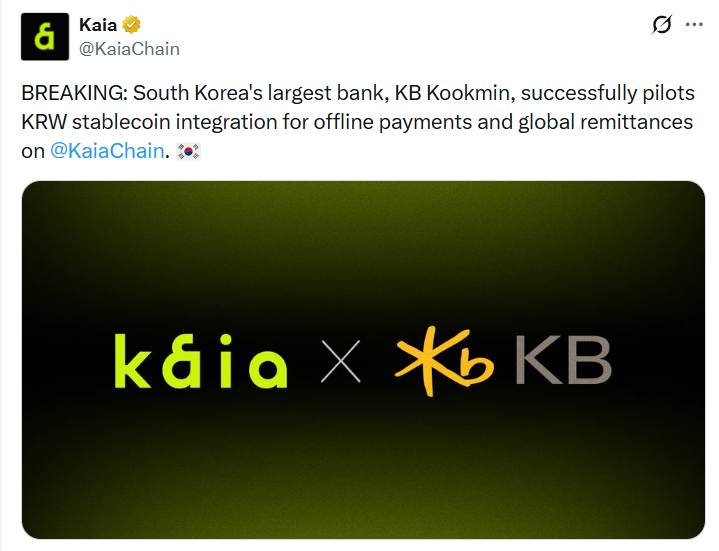
KB Financial Group, the parent company of South Korea's largest bank, KB Kookmin, completed a stablecoin pilot for offline payments and cross-border remittances through the Kaia blockchain.
KB tested the lifecycle of a South Korean won-denominated stablecoin, including issuance, merchant settlement and remittances, with Kaia, electronic payments company KG Inicis and fintech firm OpenAsset, local outlet Yonhap reported.
The stablecoin pilot adds to the growing list of legacy financial institutions in South Korea experimenting with stablecoins. In late April, one of the nation's largest credit card providers, Shinhan Card, signed a memorandum of understanding with the Solana Foundation to test stablecoin payments.
Know when your coins move
Alerts, real-time prices, and market news — all in one app
4.8 based on 40K reviews in the App Store and Google Play
KB Kookmin is South Korea’s largest bank with over 584.9 trillion won ($266.7 billion) in total assets, according to the bank’s factbook for the fourth quarter of 2025.
Source: Kaia
Stablecoin test reduced remittance fees by 87%
As part of KB Financial’s experiment, a won stablecoin was converted into a US dollar stablecoin and delivered to a bank account in Vietnam.
The full transfer was completed in under 3 minutes, with an 87% fee reduction compared to the same transaction executed through the SWIFT network, a Kaia spokesperson told Cointelegraph in an email.
The SWIFT network is the messaging network for international payments used by thousands of banks and financial institutions worldwide.
The offline payment test was executed through Seoul-based coffee franchise Hollys, enabling users to pay through QR codes, without needing to install a cryptocurrency wallet.
KB plans stablecoin services launch after regulations take effect
KB is reportedly preparing to launch stablecoin services once digital asset regulations are established in the country.
But the country’s proposed Digital Asset Basic Act has repeatedly stalled due to disagreements between regulators over who should be allowed to issue stablecoins.
The Bank of Korea, the nation’s central bank, has argued that banks should retain majority ownership of stablecoin issuers, while the Financial Services Commission warned that strict limitations could slow innovation.
Formal deliberations are unlikely to resume before South Korea’s June local elections.
Magazine: Singapore isn’t a ‘crypto hub’ — it’s something better: StraitsX CEO

 cointelegraph.com