
 bsc.news
Table of Contents
$BNB Chain is quietly putting up some of the strongest onchain numbers across all Layer 1 blockchains in early 2026. While Solana grabs headlines for speculation and Ethereum dominates institutional narratives, $BNB has been steadily climbing the ranks in daily active users, stablecoin transfers, and real-world asset adoption. The data paints a picture of a chain that is not just surviving the multi-chain era but thriving in it.
So what exactly is driving $BNB Chain's momentum, and how does it stack up against the competition?
What Do the Numbers Actually Look Like?
The raw metrics tell a compelling story. $BNB Chain is averaging 2.5 to 3 million daily active addresses on its smart chain alone in early 2026, with single-day peaks pushing above 3 million during high-activity periods. Including opBNB, the combined figure reaches 4 to 5 million. That puts $BNB Chain comfortably ahead of Ethereum's roughly 1.8 million, though Solana still leads on raw active address counts.
Transaction volume has been consistently strong, averaging 11 to 14 million per day in recent weeks. That is down from the all-time high of 31 million hit on October 5, 2025, but still reflects sustained usage well above 2024 levels. Messari's Q4 2025 report recorded an average of 17.3 million daily transactions for the quarter, up 30.4% from Q3.
Total value locked sits at roughly $5.66 billion per DefiLlama as of late February, down from $6.6 billion at the end of Q4 2025. That decline mirrors broader market corrections rather than any chain-specific weakness. $BNB Chain ranks third among L1s by TVL, behind Ethereum and Solana. Protocols like PancakeSwap ($2.2 billion TVL), Lista DAO, and Venus continue to anchor the DeFi ecosystem.
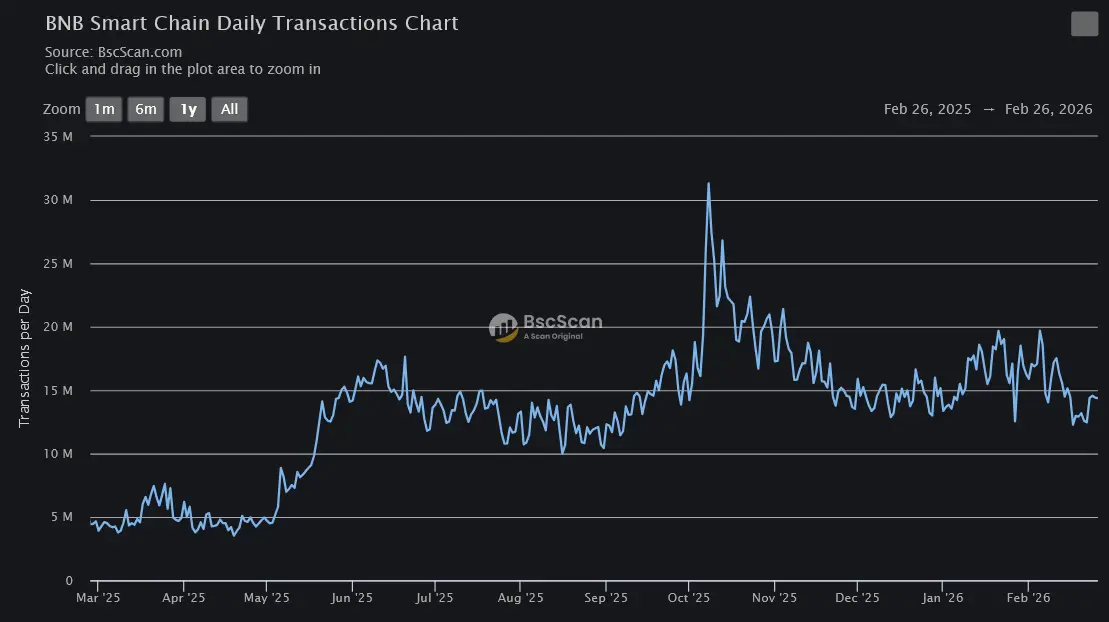 $BNB Chain Daily Transactions Chart BscScan">
Where Is $BNB Chain Actually Winning?
Stablecoins
This is arguably $BNB Chain's strongest story right now. Stablecoin market cap on the network currently sits at $13.76 billion per DefiLlama, having pulled back alongside broader market conditions after peaking above $15 billion in late 2025. Year-over-year growth still exceeds 120%, according to Messari's Q4 2025 report.
$BNB Chain represents roughly 25% of global stablecoin active addresses, ahead of Tron at around 20% and well above Ethereum and Solana at roughly 10% each. In January 2026 alone, the network recorded approximately 13.7 million stablecoin active addresses. Initiatives like the 0 Fee Carnival, which has covered over $4.5 million in user gas fees and been extended through February 28, 2026, have been a major driver. The program eliminates gas costs for USDC, USD1, and U transactions across nine participating exchanges.
Real-World Assets
RWA has been $BNB Chain's breakout category. Total onchain RWA market cap currently sits at $2.56 billion per DefiLlama, up from $2 billion at the end of Q4 2025 and a staggering 555% year-over-year. That makes $BNB Chain the second-largest RWA network behind Ethereum, with 48 asset issuers across 22 asset classes now active on the chain.
The growth is driven by a small number of large institutional deployments. USYC accounts for $1.4 billion (about 70% of total RWA value), while BlackRock's BUIDL fund holds roughly $503 million. CMB International launched a $3.8 billion tokenized money market fund on the chain in October 2025, and Ondo Global Markets added over 100 tokenized U.S. stocks and ETFs shortly after.
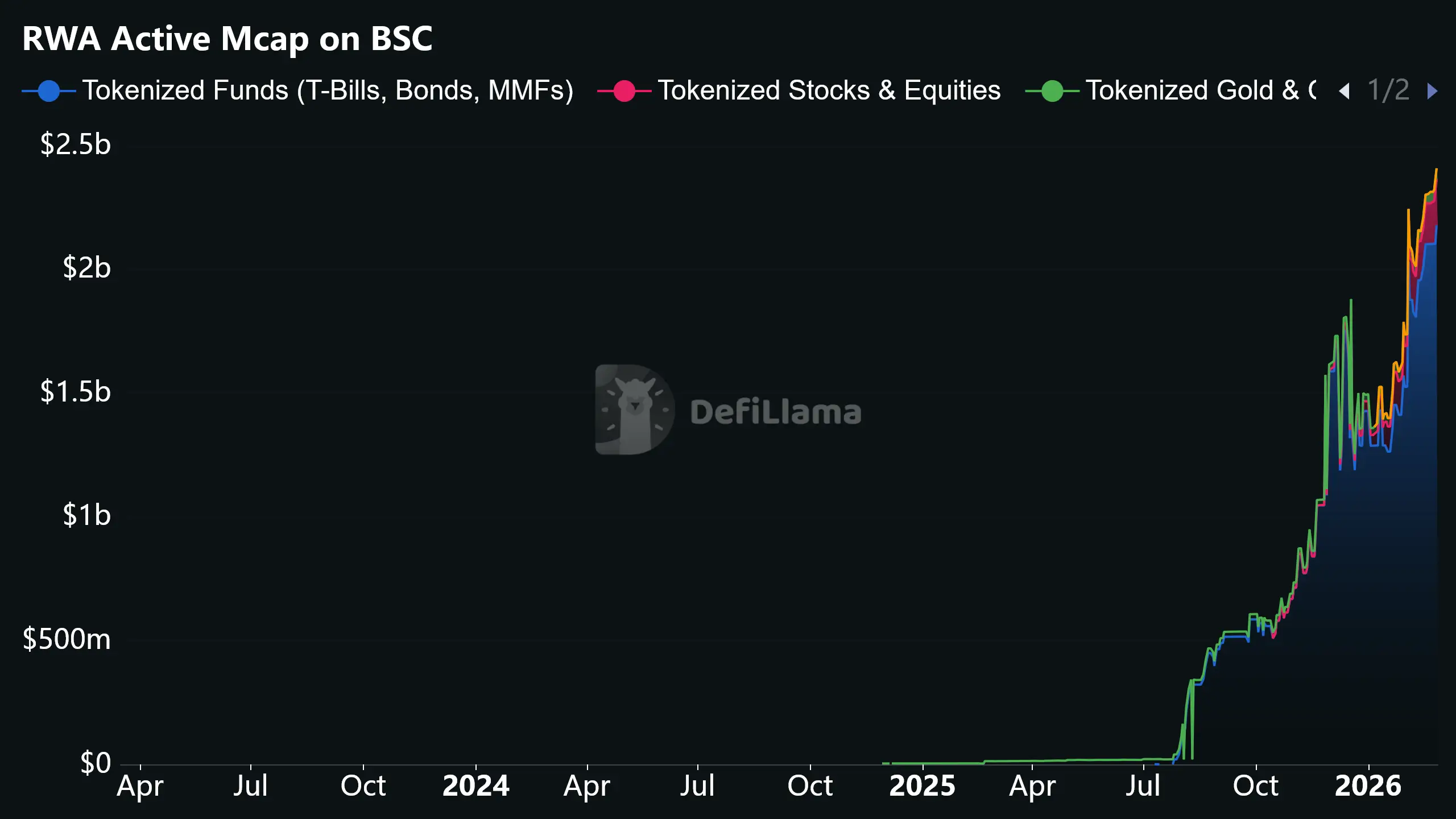 $BNB Chain RWA Market Cap chart Defillama">
How Does $BNB Compare to Other Major L1s?
Active Users and Transactions
As noted above, $BNB Chain's 2.5 to 3 million daily active addresses beat Ethereum but trail Solana. On the transaction side, 11 to 14 million daily puts $BNB well above Ethereum's 1 to 2 million on L1 while Solana handles higher throughput. Avalanche trails the group at roughly 1 to 2 million daily.
DEX Volume
Average daily DEX volume on $BNB Chain hit $2.7 billion during Q4 2025 per Messari, up 12.5% from Q3, though volumes have since cooled alongside broader market conditions. PancakeSwap handles the lion's share, though its market dominance has dipped as Uniswap grew to roughly 20% share on the network. Annual DEX volume more than doubled in 2025, and $BNB Chain captured nearly 30% of total DEX market share during peak periods.
Solana still leads in raw monthly DEX volume, and Ethereum maintains strong institutional flow, but $BNB is firmly in the conversation.
Fees
Average transaction fees on $BNB Chain sit at roughly $0.01, down significantly after gas prices dropped about 20x over the course of 2025 (from 1 Gwei to 0.05 Gwei). That keeps it highly competitive among EVM chains, though Solana still edges everyone out at around $0.002.
What Is Fueling the Growth?
Four major hard forks in 2025 laid the groundwork for the current performance. Pascal, Lorentz, and Maxwell progressively reduced block times, and the Fermi hard fork, which went live on January 14, 2026, brought them down to 0.45 seconds. Finality improved from 7.5 seconds to 1.125 seconds, and network bandwidth doubled to 133 million gas per second.
Since these upgrades, the chain has consistently handled up to 5 trillion gas per day, equivalent to roughly 238 million native transfers. That throughput, combined with near-zero fees, makes $BNB Chain a natural fit for high-frequency retail activity like memecoin swaps and stablecoin payments.
EVM compatibility continues to draw developers who want fast time-to-market without learning a new stack. And on the tokenomics side, $BNB's supply remains deflationary. The 33rd $BNB Burn in October 2025 removed 1.4 million $BNB from circulation (roughly $1.7 billion at the time), pushing the annualized deflation rate to 4.3%.
What Comes Next?
The 2026 tech roadmap targets 20,000 transactions per second with sub-second finality, along with further gas fee reductions. A new Rust-based client built on a modified version of Ethereum's Reth architecture is already in alpha. The goal is to establish $BNB Chain as what the team calls a "highly optimized EVM trading chain."
Looking further out, $BNB Chain's 2026 to 2028 roadmap outlines a next-generation trading chain targeting roughly 1 million TPS with a best-case confirmation time of 150 milliseconds. The architecture would use a hybrid off-chain and onchain compute model with execution proofs, designed to support advanced use cases across AI, payments, privacy, and RWAs.
Challenges remain. The chain still faces criticism over centralization due to its 45-validator set. The broader L1 landscape is shifting as L2s capture more value. And $BNB's token price has pulled back significantly from its October 2025 all-time high of $1,370, trading in the $600 to $700 range through early 2026.
But on the metrics that matter for onchain adoption, $BNB Chain is putting up numbers that are hard to dismiss. Fastest-growing stablecoin ecosystem among major L1s. Second-largest RWA network. Consistently among the top chains for daily active users. In a cycle where most L1s are fighting for relevance, $BNB Chain keeps building its case.
Sources:
- Messari — State of $BNB Chain Q4 2025 — Comprehensive quarterly report covering TVL, transactions, RWA, stablecoins, and fee data
- $BNB Chain Tech Roadmap 2026 — Official 2026 roadmap with 2025 performance benchmarks and upgrade history
- $BNB Chain Blog — Weekly ecosystem snapshots including DAU and transaction data
- DefiLlama — BSC — Real-time TVL, stablecoin, and protocol-level data
- DefiLlama — BSC RWA — Real-world asset onchain market cap and issuer data
- DL News — Stablecoins on $BNB Chain — In-depth stablecoin analysis with Visa Onchain Analytics and Artemis data
- $BNB Chain — Fermi Hard Fork — Official Fermi upgrade details and activation confirmation