
 coindesk.com
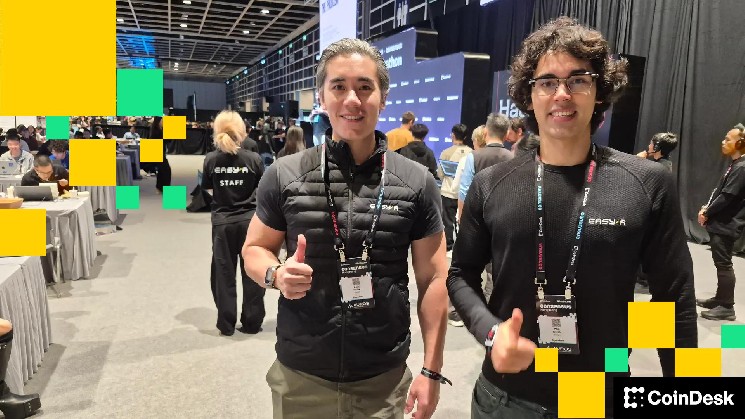
As the curtain falls on Consensus Hong Kong 2026, the focus has shifted from the corporate boardrooms to the show floor. While institutional talk dominated the main stages, nearly 1,000 developers spent the week in the trenches of the EasyA x Consensus Hackathon, signaling a definitive pivot in the industry: the "Year of the Application Layer."
The competition, which has become a staple of Consensus by CoinDesk’s flagship events, saw over 30 projects pitch on demo day. The quality of builds, aided significantly by generative AI, clearly demonstrated that the barrier between a "proof of concept" and a "market-ready product" has effectively been removed.
A rising bar: From infrastructure to intent
The evolution of the developer talent at Consensus has grown gradually. In previous years, hackathon submissions were often deeply technical, building faster consensus mechanisms or niche scaling solutions that remained out of reach for the average user.
This year, however, the bar has been set to a new level. Developers have evolved into product builders, shifting their focus from the backend to the user.
"The big thing that we've seen right now is that developers are actually building things that real people can actually use," said Phil Kwok, co-founder of EasyA. "We've seen a big increase in the application layer. This is the year of the horse in Asia, but it's the year of the application layer in blockchain."
This shift toward User Experience (UX) was evident in the sophisticated use of "passkeys", technologies from iOS and Android that allow users to log into Web3 apps without the friction of 24-word seed phrases, Kwok said. By removing these traditional "clicks" and barriers, developers are finally making products that feel like the apps people use every day.
The Winners’ Circle
The judges awarded top honors to projects that prioritized automation, security, and risk management, three pillars essential for the next wave of retail adoption, Kwok explained.
First place: FoundrAI ($2,500)
Taking the top spot was FoundrAI, an autonomous AI agent designed to act as a "startup in a box." The platform doesn't just launch tokens; it manages the entire lifecycle of a project, including hiring human developers to build out the product. It represents a provocative look at the future of decentralized labor.
Second place: SentinelFi ($1,750)
Addressing the industry's persistent "rug-pull" problem, SentinelFi provides real-time safety scores for crypto traders. By performing six-category on-chain analysis, the tool helps users sniff out scam tokens before they commit capital—a critical utility as token launch volumes explode.
Third Place: PumpStop ($1,000)
PumpStop rounded out the top three with a non-custodial trading layer focused on risk mitigation. Using state-channel instant execution, it allows traders to set stop-loss orders with on-chain proofs, bringing professional-grade trading tools to a decentralized environment without sacrificing custody.
The ‘show floor’ evolution
The growth of the hackathon reflects a broader shift in the Consensus ethos. Once a strictly corporate affair, the event has increasingly integrated the "builder" culture into its DNA. Dom Kwok, co-founder of EasyA, noted that the hackathon has moved from side rooms to the center of the show floor.
"Typically every hackathon that we host gets bigger and bigger," Dom said. "It's taking up more and more of the conference floor every year. We had someone flying in from San Diego just to see what was getting built."
Despite the "depressing" macro environment often reflected in token prices, the sentiment on the ground in Hong Kong remained stubbornly bullish. Organizers pointed out that while interest rates and Fed policy drive the charts, the builders are focused on the 93% of the world that doesn't yet own crypto. The path to that next billion users, it seems, is being paved by developers who finally realize that usability is the ultimate feature, Dom said.
Phil and Dom said they can’t wait for Consensus Miami 2026 to see how much more the bar is raised and how many more developers participate with surprisingly great new ideas.