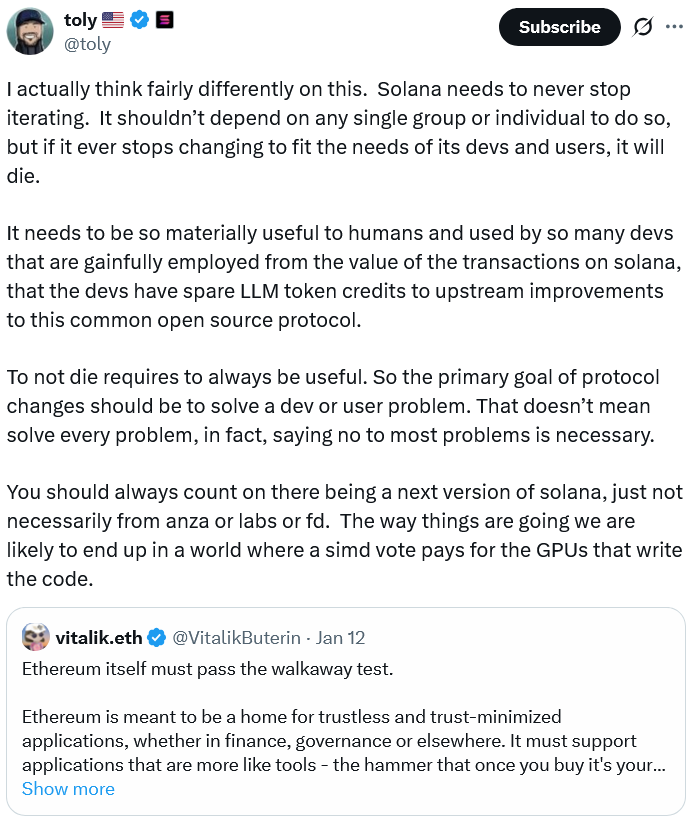
Source: Anatoly Yakovenko
Ethereum and Solana are two of the leading blockchains in a sea of layer 1 competitors.
Ethereum is by far the most decentralized smart contract layer 1 blockchain and dominates stablecoin and real-world asset tokenization activity, while Solana is one of the speedier networks that is arguably more popular for consumer apps and earns more fees.
Their planned paths to success, however, could not be more different.
Buterin wants to maximize decentralization, privacy and self-sovereignty on Ethereum — even at the cost of mainstream adoption — while Yakovenko wants Solana to be an evolving ecosystem that introduces new features to adapt to real-world needs.
Supporters of Buterin’s approach argue that adding too many features increases the risk of bugs, security flaws, and unintended protocol consequences, while expanding the attack surface for centralization.
Those aligned with Yakovenko’s “adapt or die” mentality, however, think a hands-off approach leads to slower innovation and potentially being overtaken by faster-moving competitors.
AI could update Solana in the future: Yakovenko
Yakovenko, however, said protocol updates should come from a diverse community of contributors rather than a few development teams.
He even pointed to a future where Solana network fees could fund AI-assisted development to write and improve Solana’s codebase.
“You should always count on there being a next version of Solana,” Yakovenko said.
Ethereum is not self-sustainable yet
Meanwhile, Buterin said there is still a lot of work to be done before Ethereum can adopt the hands-off approach.
Quantum resistance features, more scalable architecture, and a better block-building model that resists centralization pressures were among the main improvements Buterin said Ethereum needs to have to pass the test of time.

 cointelegraph.com