
 crypto-news-flash.com

- A collaboration between Hedera and DIFC Courts would provide security, transparency, and legal recognition for critical documents, including wills.
- Hedera’s involvement would provide predictable cost, advanced security standards, and compliance.
The Dubai International Financial Centre (DIFC) Courts are reported to have given a thumbs up for digital trust, as their Notary Services issue documents as Non-Fungible Tokens (NFT) on Hedera. According to Hedera (HBAR), its partnership with DIFC would ensure that institutions and individuals seamlessly safeguard critical documents and digital assets with legal recognition, transparency, and security.
The Problem Identified by DIFC and the Solution with Hedera
In a post published by Hedera, the DIFC was highlighted for identifying the challenges associated with storing, transferring, and verifying important documents and assets. The existing traditional storage and legal processes are said to be fragmented and slow. Not just that. They are vulnerable to fraud, loss, and tampering, according to the post.
To address this challenge, the DIFC has launched a global digital vault, known as Tejouri to safeguard critical documents, including wills and title deeds. According to the report, the implementation of its blockchain-based digital asset Wills and notary services implies it is transforming how digital documentation and legal management are handled.
Using Hedera, it is leveraging its high speed, low cost, and energy-efficient architecture to sustain this initiative. The blockchain would also provide predictable cost, compliance, and advanced security standards.
Commenting on this, the director at DIFC Courts, Justice Omar Al Mheiri, highlighted that this initiative is one of the UAE’s most progressive government legal services, and it is supported by smart technology implementation.
Detailing this collaboration, deep researcher Marco Salzmann highlighted that DIFC has built its initiative for immutability, authenticity, and cross-border verification. According to him, cross-border fails because trust does not exist. DIFC and Hedera’s initiative ensures that verification and validation start directly at the source.
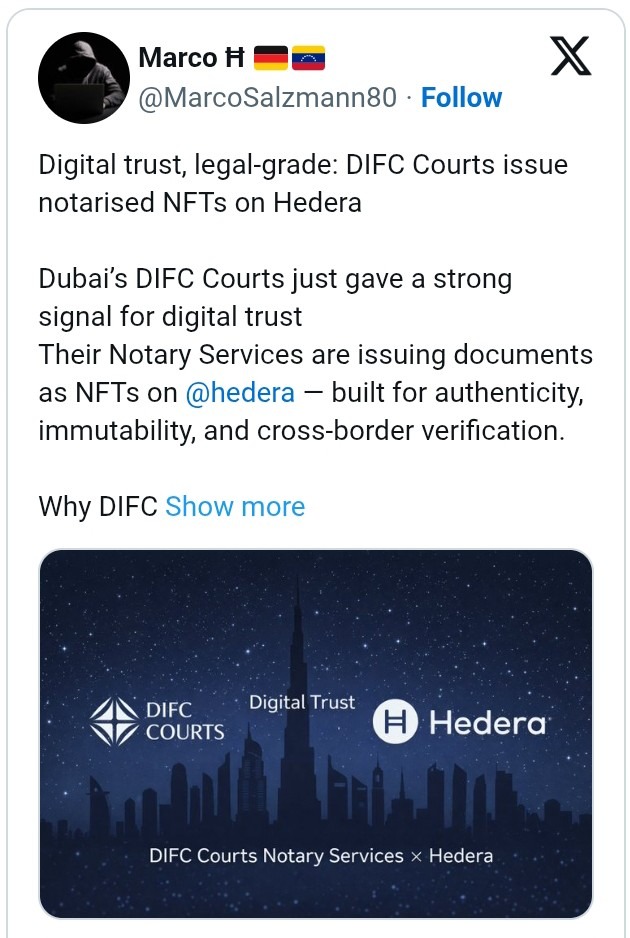
To him, this reduces the fraud vector and improves confidence for onboarding or compliance checks, international business processes, and credential and document validation. Apart from the fast finality, Hedera supports this with enterprise-grade governance.
This is what real adoption looks like. Not hype—infrastructure: regulated environments, legal processes, and verifiable trust rails going digital. If more courts/notary frameworks follow this model, we’re looking at a scalable blueprint for digital identity and document integrity, powered by Hedera.
According to a report, this collaboration with DIFC Courts also includes Tejouri, The Hashgraph Association, and Deca4 Advisory. In the long run, this is expected to make Dubai a leader in smart legal tech innovation.