How the Structure Works
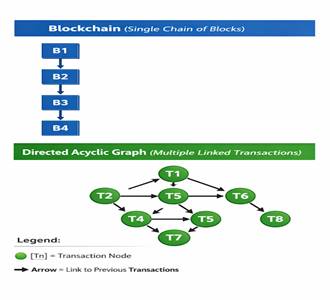
At every step towards understanding DAG, one does need information about the blockchain technology as well because that’s what DAG claims to improve or replace. A blockchain works on the basis of blocks that carry data of one or more transactions. It groups many transactions together in order to be space efficient. Every block is added and verified by miners or validators.
Contrarily, every transaction in DAG structure stands on its own without being grouped into blocks. Neither does this structure need any miners or validators, nor is it sequential like blockchain structure. Before a transaction is added, the user’s device does a very small amount of work to prove it is genuine. This small effort helps prevent spam and also helps confirm earlier transactions, keeping the network secure and orderly.
Every new transaction in DAG structure must connect to an earlier unconfirmed transaction, or if all previous transactions are already confirmed, the new transaction merely needs to reference the last one. This structure refers to a previous unconfirmed transaction as a “tip”. When you propose a transaction to the network, it connects to a few previous tips which are automatically confirmed consequent upon your reference. Yours will be confirmed only one someone else builds on it.
Advantages of DAG Structure
No Delay
In blockchains, your transaction has to wait until a block is created. If too many transactions are sent at once, they form a queue, and wait for a long time or pay a higher fee. But you can get your transaction processed at once in DAG networks provided that you confirm the previous unconfirmed transactions. Your wallet automatically checks the transaction that it is going to confirm by tracing it to the very first transaction on the network. Therefore, it is highly unlikely that you accidentally confirm an invalid transaction.
NO scalability Issues
Think of a blockchain as an expressway, which can be crowded at times, so it needs a few extra lanes added. These extra lanes are the scalability solutions. Since there is no such issue as a waiting time for blocks, DAG can process many more transactions on its own, without needing any scalability solutions.
No Miners, No Validators, No Fees
DAG structure does not work on any consensus mechanism, so there are no miners or validators. That’s why transactions are processed free of cost. However, there are a few special nodes that charge a very tiny fee, to secure the network.
Disadvantages of DAG
Centralization poses a serious risk in DAG’s way to progress. Certain special nodes and coordinator nodes run by corporations tend to have an upper hand. This carries a potential danger of scams and attacks in future. Moreover, DAG is 8 years younger than the blockchain technology is it is not as time tested yet.
Bottom Line
Both blockchain and Directed Acyclic Graph technology aim to enable decentralized and secure transactions, but they approach the problem in very different ways. While blockchain remains the more mature and widely adopted solution, DAG introduces notable improvements in speed, scalability, and transaction costs. However, concerns around centralization and its relatively short track record still limit broader adoption. As innovation accelerates in 2026, DAG is likely to complement rather than fully replace blockchain, with each technology serving use cases where its strengths are most effective.
Frequently Asked Questions
What is the main difference between DAG and blockchain technology?
Blockchain records transactions in sequential blocks, while DAG processes individual transactions in a web-like structure, allowing faster and more scalable validation.
Is DAG more scalable than blockchain?
Yes, DAG can handle higher transaction volumes without relying on block creation, reducing congestion and scalability issues.
Does DAG require miners or validators?
No, DAG networks do not rely on traditional miners or validators. Each new transaction helps validate previous ones, keeping the network operational.
Can DAG replace blockchain in the future?
DAG is unlikely to fully replace blockchain but may complement it by powering applications that require high speed, low fees, and scalability.

 blockchainreporter.net