A small team will oversee the transition and release a new node binary to ensure network continuity without the foundation's operational involvement.
The Kadena blockchain itself will continue to operate, the team noted, because it is maintained by independent miners and community developers. More than 566 million KDA remain allocated for mining rewards until 2139, and 83.7 million tokens are still set to unlock by 2029.
Still, the loss of the core development team effectively leaves the chain’s future in the hands of its community and independent ecosystem projects, making a precarious position for a network once backed by prominent early investors and marketed as a hybrid public-private chain.
Kadena, founded by former JPMorgan blockchain engineers Stuart Popejoy and Will Martino, launched in 2019 with the promise of scaling proof-of-work networks through a unique multichain “braided” architecture. It combined traditional mining with smart-contract functionality and its own programming language, Pact.
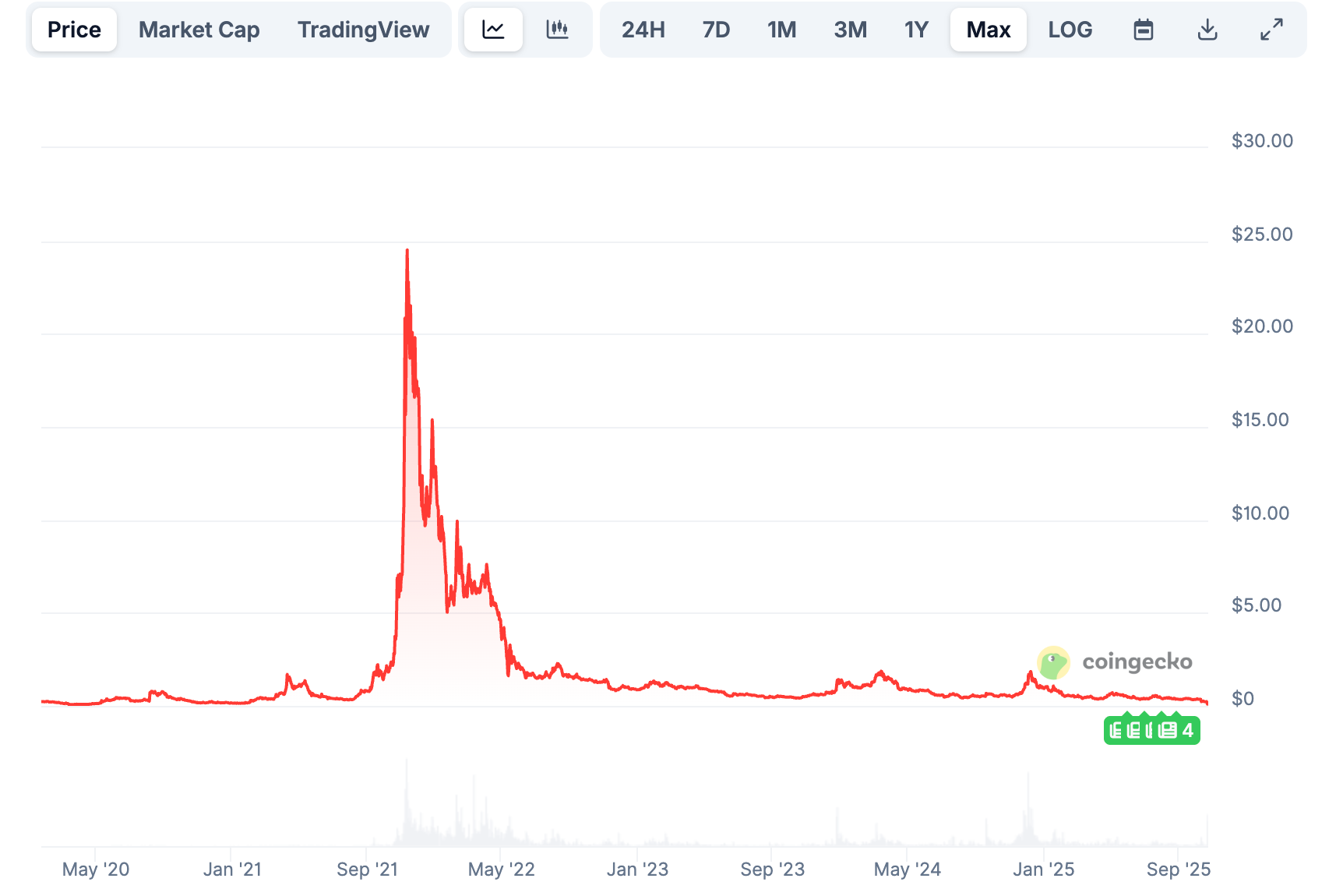
At its 2021 peak, KDA traded above $25 and the project reached a $25 billion valuation, driven by speculative enthusiasm for alternatives to Ethereum’s high fees. Activity and developer participation have dwindled in recent years as newer proof-of-stake and modular blockchains dominated funding and user attention.

 coindesk.com