Lebbar claims network effects drive L2’s accelerated growth
Mehdi Lebbar, co-founder of YO Protocol, claimed that network effects drove the L2 blockchain’s accelerated growth. Having many small projects made up the difference between its DeFi deposits and Tron’s. Lebbar also pointed out that Coinbase’s large community provided the foundation for a thriving marketplace, explaining why YO launched on Base.
Coinbase also drove users to the L2 blockchain through its dedicated mobile app, a rebrand of the crypto exchange’s wallet. The exchange’s spokesperson mentioned it drove large volumes to Morpho when it launched the Base app in July. However, the spokesperson added that the launch of CEX-backed blockchains was not unique to Coinbase. Binance launched BNB Chain in 2017, the third-largest blockchain with a TVL of $9.3 billion, according to DeFiLlama.
As previously reported by Cryptopolitan, Hsiao-Wei Wang, the co-director of the Ethereum Foundation, disclosed in late April that Base had received Phase 1 status for its decentralized network. Ethereum’s founder, Vitalik Buterin, stated that the Phase 1 status was crucial, and he would only track such chains in 2025. The upgrade made L2 one of the most valuable DeFi and perpetual DEX trading chains.
Base celebrates second anniversary with significant gains
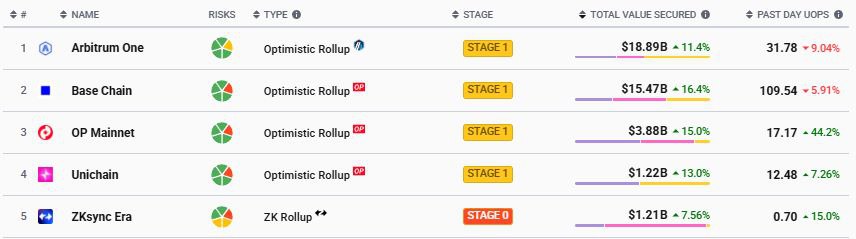
Base only trails Arbitrum One in Ethereum rollups. Source: L2BEAT
Last week, the protocol celebrated its second anniversary in style, ranking second behind Arbitrum among Ethereum rollups. The on-chain observer also showed that the L2’s TVL in its smart contracts surged 8781% YoY, reaching approximately $4.46 billion.
Active users also increased by 1280% to 1.25 million over the same period. The highest number of daily users was 3.59 million, which was recorded in June. Transactions also went up by over 2000%, with the average number of daily transactions reaching 7.5 million.
On-chain data confirmed that Base’s network fees decreased by nearly 50% compared to the same time last year. The fees dropped to $0.005 and went below $0.001 at certain times. However, the L2’s infrastructure had problems on August 5, causing the protocol to stop producing blocks for more than 30 minutes. The protocol’s developers vowed to implement fixes to prevent that from happening again.
The L2’s team promised to revamp its infrastructure following the network outage. They fixed the issue that caused the primary sequencer to lag due to high network activity. A configuration error prevented the system from transferring control to a backup; thus, blocks could not be created. The network completely shut down as the faulty sequencer could not initiate a retry of the control transfer. Engineers had to disable the Conductor system manually to prevent automatic switching.

 cryptopolitan.com