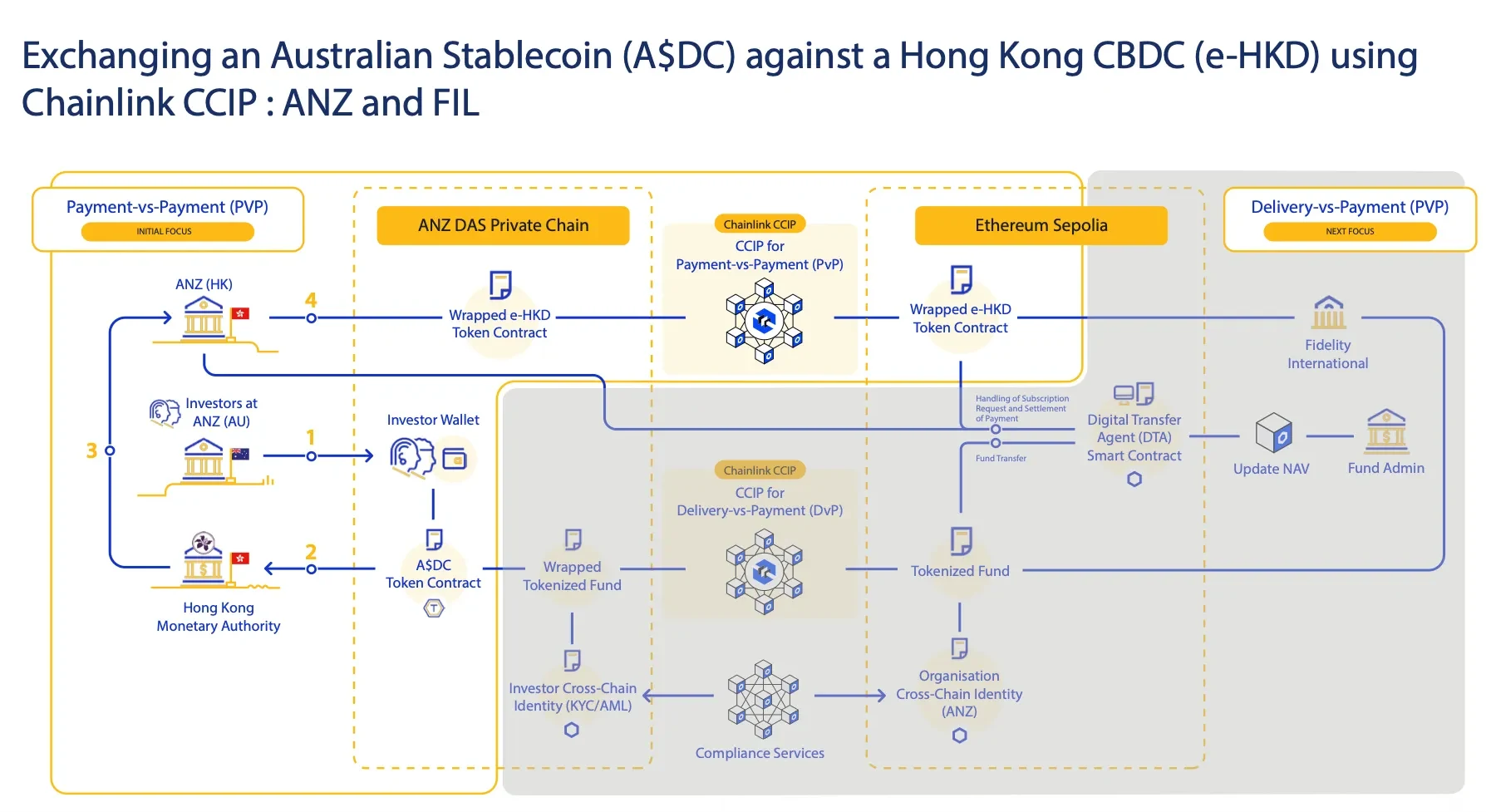
Chainlink's CCIP is not simply a messaging protocol but the glue that enables value and data to flow between blockchains in a secure manner. In this pilot, it enabled the settlement to be a true "payment-versus-payment" (PvP) where both parties to this transaction made simultaneously and eliminated the risk of settlement. The system also employed Chainlink's DTA in enforcing compliance with automatic transfers of funds across jurisdictions.
The HKMA wasn't alone. Visa, ANZ, ChinaAMC, and Fidelity International all joined in, each contributing payment, asset management, or tokenization expertise. The pilot not only tried the technical rails, but also the actual business logic: can tokenized assets and digital currencies settle instantly, without borders, with low friction and high transparency?
The architecture was crafted to test the interaction of permissioned blockchains, which are deployed by banks and regulators for compliance, privacy, and identity verification, with permissionless blockchains, where anyone can participate and through which all transactions are globally visible. The pilot used the Ethereum Sepolia testnet for the public leg and ANZ's private DASchain for the permissioned side.
Other interoperability and oracle solutions considered include hash time-locked contracts or central mint/burn models, but Chainlink CCIP was preferred because of the security and decentralization infused into the solution and its verified history in securing more than $21 trillion value through over 50 blockchains. The pilot already stirred renewed interest in LINK, the native token for Chainlink, whose price shot up with the news of the trial.
Will Hong Kong's Pilot Change CBDCs Forever?
The implications of this pilot extend far beyond Hong Kong. If successful, it could provide a blueprint for cross-chain settlement of digital currencies—enabling not just CBDCs, but also stablecoins and tokenized assets, to move freely across networks and jurisdictions. Such interoperability could lower costs, reduce settlement times from days to seconds, and open the door to programmable, atomic swaps between any two forms of digital money.
“We’re excited to share that Chainlink is facilitating the secure exchange of a Hong Kong CBDC and an Australian dollar stablecoin as part of an ongoing use case in Phase 2 of the e-HKD+ Pilot Program.”
— @chainlink, X
Visa’s own report on the pilot highlights the potential for tokenized assets to reach a $10 trillion market by 2030, with stablecoins and CBDCs forming the backbone of a new, interoperable financial system.
And before the end of 2025, the result shall be published by HKMA and its partners. Will Chainlink's CCIP be the standard for the interoperability of the CBDC? The pilot is set to turn Hong Kong into a model for Asia-Pacific's digital money and farther afield.

 coinpaper.com