Read more: What is fully homomorphic encryption and how will it change blockchain?
“Once considered impossible, FHE coprocessors solve the challenge of analyzing large data sets on Ethereum without compromising on-chain performance,” Fhenix CEO Guy Itzhaki said in a press release reviewed by Blockworks.
Itzhaki notes that FHE coprocessors will enable a more efficient way to process encrypted data without exposing personal information, unlocking new use cases on the blockchain.
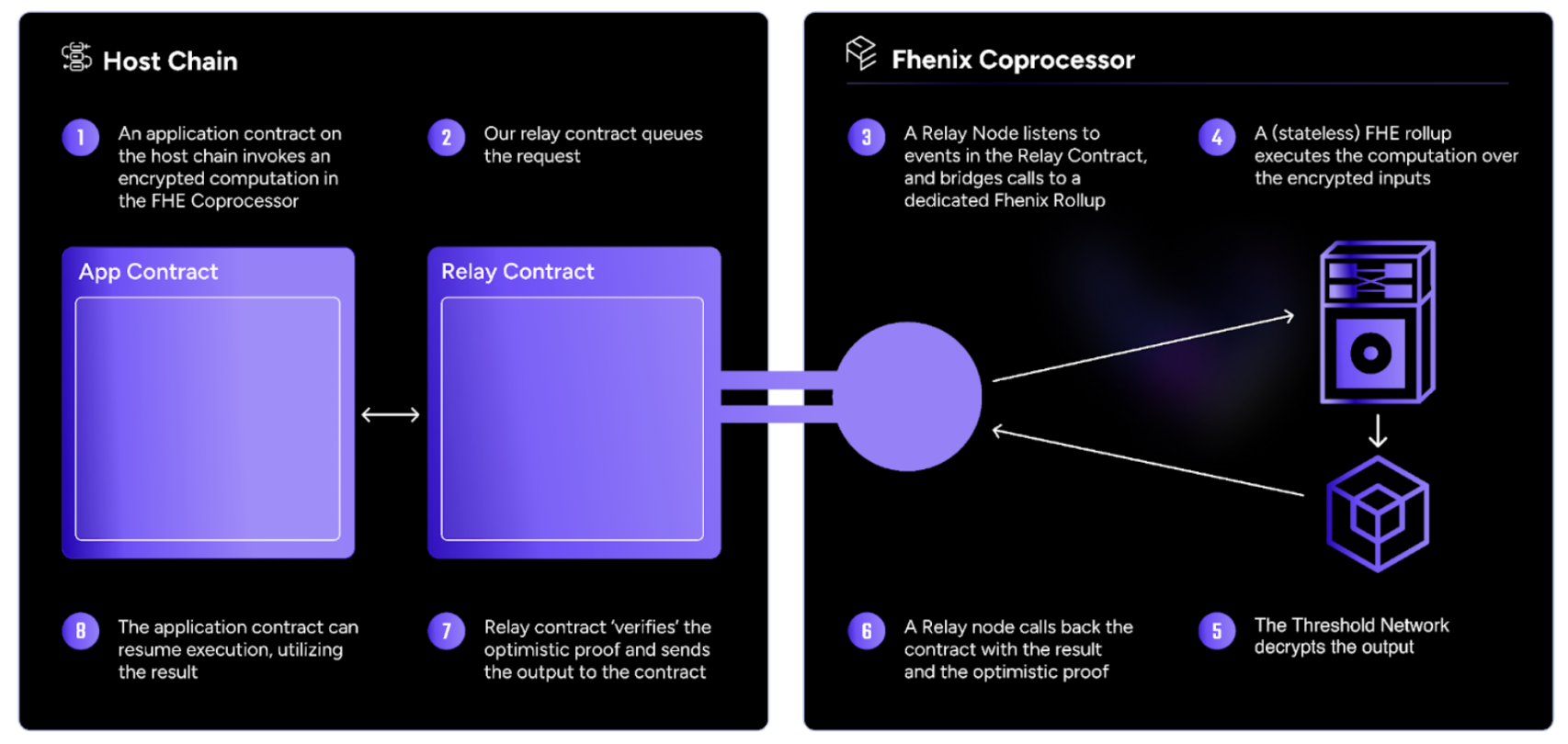
FHE coprocessors are designed in a way to receive inputs from the host chain instead of storing a state themselves, enabling them to be performance-optimized and remain idle until needed. For efficiency purposes, they will rely on fraud proofs instead of zk proofs, which will be settled on the host chain.
FHE coprocessors will be secured by Fhenix’s FHE rollup and EigenLayer’s staking mechanism. EigenLayer enables actively validated services (AVS) to inherit pooled Ethereum security.
By using EigenLayer, the FHE coprocessor can guarantee the economic correctness of the rollup’s execution. If operations are found to be malicious, then the stake of these validators will be slashed. Fhenix believes that this removes the necessity for a fraud-proof period. Doing so will also eliminate the dispute period, making confirmation times faster.
Read more: Why data availability sampling matters for blockchain scaling
Guy Zyskind, the founder of Fhenix, remarks that FHE coprocessors will be not only feasible but also scalable.
“Confidential computing will grow at scale, and the ability to provide immediate confirmations would not be otherwise possible without our joint efforts with EigenLayer,” Zyskind said.

 blockworks.co