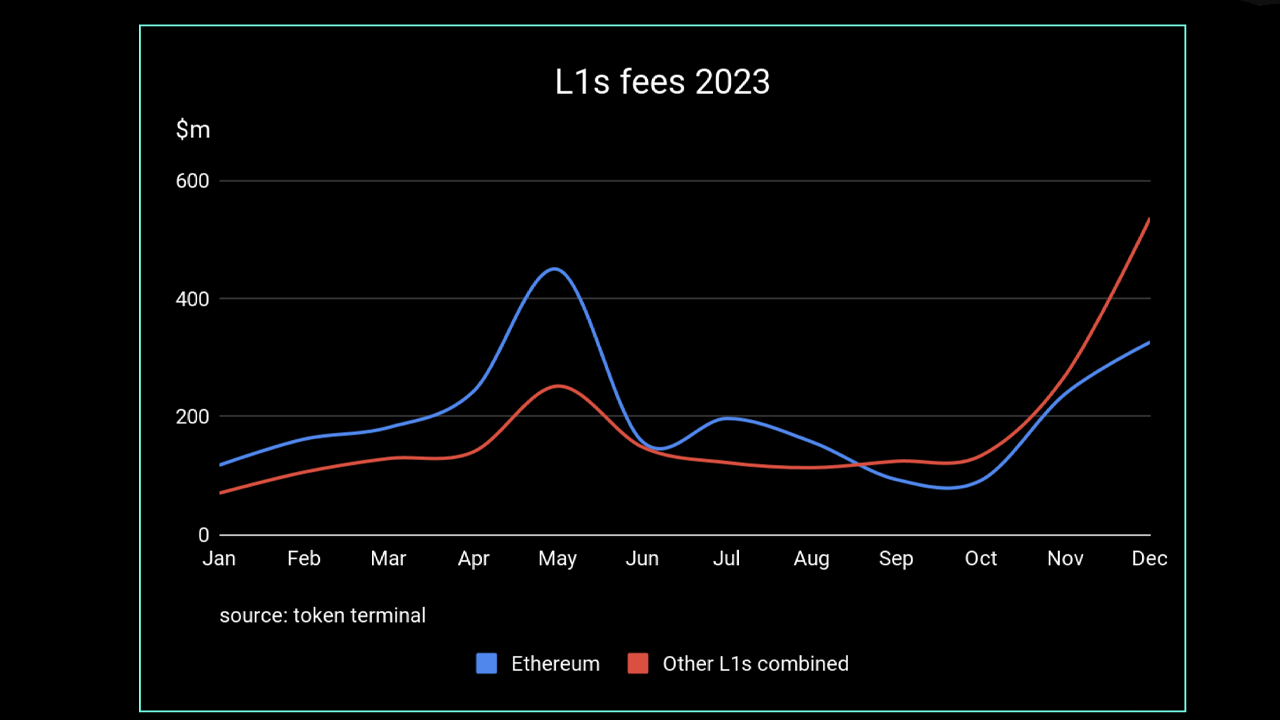
The study shows layer one (L1) blockchains, despite a slight decrease, continued to dominate the fee market, accounting for 59% of all fees, up from 48% in 2022. Ethereum, maintaining its position as a market leader, showed a notable 44% decline in fees, partly due to the migration of activities to L2 networks.
“The rising fees generated by [L2s] signal widespread adoption and a significant impact on user experience,” the study’s researchers detail.
The report also highlights significant changes in individual blockchain platforms. Bitcoin, Tron, and Polkadot saw the most substantial growth in fee generation, with Bitcoin’s fees surging by 461%. The increase in Bitcoin network fees was attributed to the popularity of Ordinal inscriptions, a novel embedding application within the Bitcoin network, marking a notable shift in its usage dynamics. As of Jan. 29, 2024, the count of Ordinal inscriptions on the Bitcoin blockchain has impressively surpassed the 58 million mark.
Decentralized exchanges (dexs) witnessed a 51% decrease in fee generation, with Uniswap emerging as a dominant player, securing 64% of dex-generated fees. The report suggests that despite the decline in fees, the trading volume on dex platforms remained relatively stable, pointing to an evolving relationship between trading activity and fee structures in the decentralized finance (defi) sector.
The report concludes by discussing liquid staking derivatives (LSDs) which showed a significant 93% increase in fee generation, highlighting the growing interest in staking solutions within the crypto-native economy. The report notes that Lido Finance, the LSD leader, collected a significant portion of these fees, reflecting the platform’s strong position in the market.
As the landscape evolves, with user preferences gravitating towards more efficient and innovative platforms, it’s clear that the blockchain ecosystem is continuously undergoing a transformative phase. This evolution paves the way for emerging technologies and strategies, potentially redefining the future of blockchain utility and economic models in the crypto space.
What do you think about PWN’s report surrounding L1s and L2s, dapps and fee generation? Let us know what you think about this subject in the comments section below.

 news.bitcoin.com