Bitcoin Halving Cycle Outdated? Binance’s He Yi Thinks So
crypto-news-flash.com
51 m
Binance co-CEO He Yi said investors should stop applying Bitcoin’s four-year cycle mechanically.
Bitcoin’s 2025 peak arrived on the same schedule as the two previous cycles.
Galaxy Research withdrew its call that the bear market ended in June.
Altcoin returns are likely to depend more on project revenue and token design.
Binance co-founder and co-CEO He Yi used a $BNB Chain livestream from $BNB Bangkok Demo Night on November 27 to urge investors to stop treating the Bitcoin halving cycle, the four-year pattern of booms and busts tied to Bitcoin’s supply cuts, as a trading rule, arguing that crypto’s integration with traditional finance has changed the forces that used to drive it. The timing makes her argument harder to sell, because Bitcoin trades near $60,300, about 52% below its October 2025 high of $126,080, and is following the bear-market path the halving calendar would have predicted.
What He Yi told the Bangkok audience
At the event, organized with YZi Labs, He Yi used the Chinese idiom 刻舟求剑 to describe investors who keep reading a changed market through old reference points. The idiom tells of a man who marks the side of a moving boat to find a sword he dropped in the river. She left room for cycles to continue and aimed her criticism at the four-year template as a complete explanation of the market. She was more direct about altcoins, saying earlier gains came from the whole industry expanding at once, which lifted even projects with weak fundamentals, and that future returns will depend on whether individual projects run real businesses.
Know when your coins move
Alerts, real-time prices, and market news — all in one app
Point your phone camera to install
4.8 based on 40K reviews in the App Store and Google Play
Binance founder Changpeng Zhao questioned the cycle in January at the World Economic Forum in Davos, but he argued that friendlier regulation and institutional buying could stretch the bull market into a supercycle. He Yi’s claim goes further, because it questions whether the historical pattern can guide investors at all.
Each halving now moves fewer dollars
The cycle rests on Bitcoin’s issuance schedule. Every 210,000 blocks, or roughly every four years, the reward paid to miners is cut in half, and the April 2024 halving reduced new supply from about 900 $BTC to about 450 $BTC a day. The 2028 halving will bring it down to roughly 225 $BTC, worth about $13 million a day at current prices.
ETF flows dwarf that figure. US spot Bitcoin ETFs have recorded about $5.5 billion in net outflows in November, putting the month on course to be their worst since they launched in 2024. Spread across the month, that comes to roughly $180 million a day, more than ten times the dollar value of the supply the next halving will remove. Returns have shrunk too: Wells Fargo Investment Institute calculates that Bitcoin’s cycle peak reached 92.1 times its halving-day price after 2012, compared with 1.9 times after 2024.
The calendar kept its date in 2025
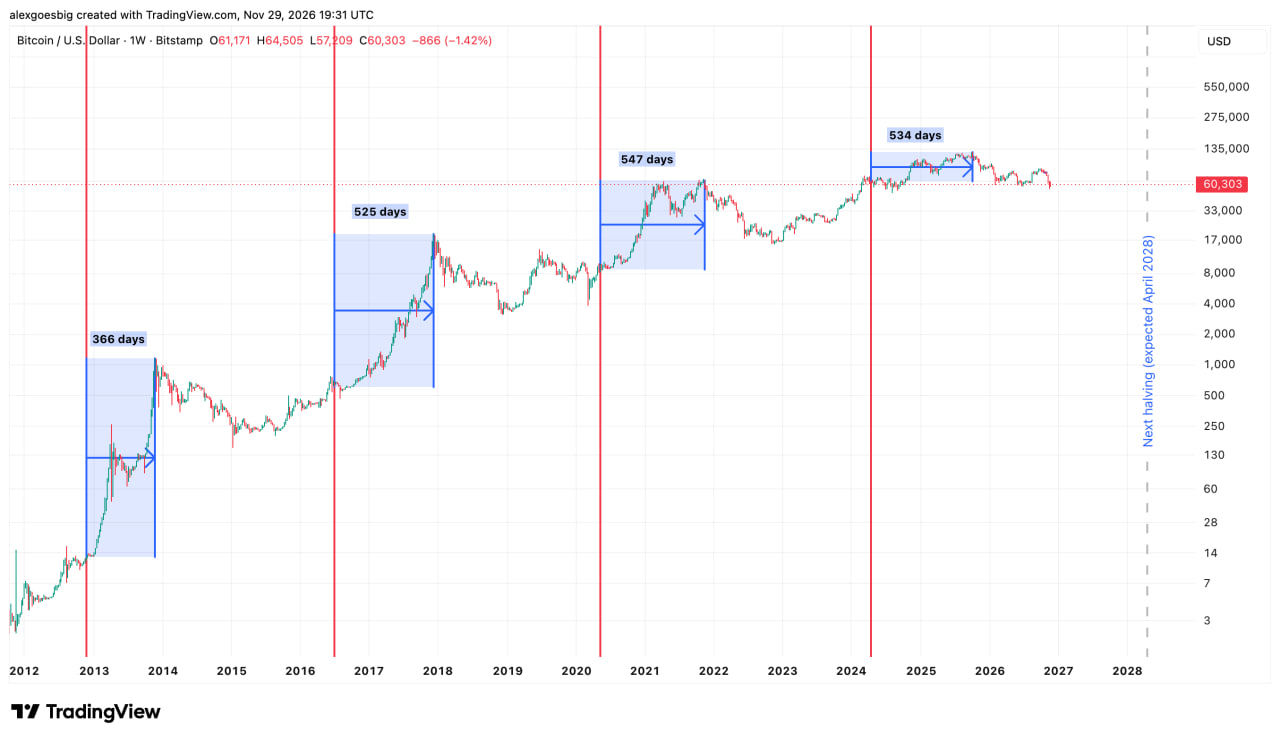
Smaller returns have not changed the timing. In research published in October, Wells Fargo Investment Institute found that the last three cycle peaks came between 525 and 547 days after each halving. Bitcoin hit its October 6, 2025 high 534 days after the April 20, 2024 halving.
Bitcoin halving cycles, weekly chart. Source: Alexander Stefanov / TradingView
Earlier bear markets found their lows about 12 to 13 months after the peak. Bitcoin is now 419 days past its high, which puts it at or beyond the usual bottoming window, while its 52% decline is far shallower than the 77% to 84% drops of earlier cycles. Alex Thorn, Galaxy’s head of firmwide research, argued in a June report that this is what a maturing cycle looks like, with both peaks and troughs becoming less extreme while the rhythm holds.
Cycle
Halving to peak
Bear market decline
2012 halving Peak in 2013
366days
-84%
2016 halving Peak in 2017
525days
-83%
2020 halving Peak in 2021
547days
-77%
2024 halving Peak in 2025
534days
-52% so far
Average of the last three cycles: 535 days from halving to peak
Source: Wells Fargo Investment Institute, Bloomberg.
Galaxy withdraws its June bottom call
Two days before He Yi spoke, Galaxy Research reversed its own position. In late October, Thorn had argued that Bitcoin’s bear market ended at its June 30 closing low of $58,525. In a note released on November 25, the firm dropped that view after Bitcoin fell below both its 50-week and 200-week moving averages. The 200-week average, roughly the average price of the past four years, has marked previous cycle lows, and a price below it means anyone who bought at that average is now holding at a loss. Galaxy counted only two of 13 historical bottom signals as met and noted that the market has not seen the wave of forced, panic selling that came with earlier lows.
The firm now treats a daily close below that same $58,525 level as the trigger for a deeper decline, and its review of earlier bear markets points to roughly $48,500, or $28,200 in a worse case. With Bitcoin at about $60,300, that line is only around 3% below the current price.
Altcoins are where her case is strongest
He Yi’s case is hardest to dispute in the altcoin market. Thousands of tokens now compete for capital that also goes into stablecoins and tokenized assets, and a blockchain can gain users and fee income while its token falls if the token design passes little of that value to holders. Wide gaps between circulating market capitalization and fully diluted valuation, which point to heavy future token unlocks, have made investors wary of projects with high valuations and little real activity. She also said crypto is losing capital and developers to artificial intelligence, which is hurting confidence in the industry, and compared the period to the internet after the dot-com crash.
Binance’s own plans point the same way. In related interviews, He Yi discussed tokenized securities and commodities, and the exchange has been hiring for tokenized equity capital markets while exploring tokenized IPOs, although it has not disclosed a launch date or a regulatory jurisdiction.
The real test comes after 2028
Settling the debate will take at least one more cycle. The next halving is expected in spring 2028, and if the 525-to-547-day window holds again, the following peak would land around autumn 2029. A top well outside that range, or a halving followed by no recognizable rally, would support He Yi’s view far more than shrinking returns do. With only four cycles on record, the statistical evidence is thin in either direction, and Galaxy’s $58,525 threshold is the nearer signal for whether 2026 ends with a textbook cycle low.

 crypto-news-flash.com