Malaysia’s First Shariah Bitcoin ETF Lists Dec. 2 at a 0.84% All-In Cost
blockchainreporter.net
19 m
Malaysia’s first Shariah-compliant Bitcoin fund trades for the first time on 2 December, under the tickers 0840EA in ringgit and 0840EB in US dollars, on the Main Market of Bursa Malaysia. Its registered prospectus, dated 27 November 2026, caps the fund’s combined annual charges at 0.84% of net asset value.
The Halogen Shariah Bitcoin ETF product page calls the fund “the world’s first Shariah-compliant Bitcoin exchange-traded fund (ETF) and the first digital currency ETF on Bursa Malaysia, managed by Halogen Capital.” The document behind that claim carries the terms a buyer needs: fees, custody, the Shariah review process, and a dated timetable that runs from a prospectus issued on 27 November to the first trade on Bursa.
What the Securities Commission Registered on 27 November
The Securities Commission Malaysia approved the listing and quotation of the fund’s units on the Main Market and registered the prospectus, according to the document filed with the regulator. The fund was constituted in Malaysia on 28 October 2026 and offers up to 1,000,000,000 units at an initial issue price of $USD1.00 each, with the US dollar as base currency and a financial year ending 31 December 2026.
Know when your coins move
Alerts, real-time prices, and market news — all in one app
Point your phone camera to install
4.8 based on 40K reviews in the App Store and Google Play
The approval arrives with the caveat printed on the prospectus cover: the commission’s consent “should not be taken to indicate that the Securities Commission Malaysia recommends the Fund or assumes responsibility for the correctness of any statement made”, and “Admission to the Official List of Bursa Malaysia Securities Berhad is not to be taken as an indication of the merits of the offering.”
Six firms hold the named roles. Halogen Capital Sdn Bhd is manager, licensed by the commission under eCMSL/A0388/2023, with RM500 million under management across 10 funds as at 31 October 2026 by its own count. Universal Trustee (Malaysia) Berhad is trustee. Amanie Advisors Sdn Bhd is Shariah adviser. BitGo holds the bitcoin. FTSE International Limited supplies the benchmark, the FTSE Bitcoin Index struck at 1HR 5PM Malaysian time. CGS International Securities Malaysia Sdn Bhd is the sole Participating Dealer named in the prospectus.
The Fee Stack Adds Up to 0.84%, Not 0.60%
Four annual charges are capped in the prospectus, and each is expressed as “up to”. The management fee is the one the issuer’s summary page puts first; the other three sit in the fee table that decides what the fund actually costs.
Annual charge
Cap
Base
Management fee
0.60%
Net asset value
Trustee fee
0.05%
Net asset value
Sub-custodian fee
0.15%
USD value of bitcoin held with the sub-custodian
Index licence fee
0.04%
Net asset value
Combined ceiling
0.84%
Sum of the four caps, before brokerage and spread
Added together the four caps reach 0.84% a year, 40% above the management fee on its own. The custody charge is levied on the value of the bitcoin rather than on NAV, but with at least 95% of NAV required to sit in spot Bitcoin the two bases stay close in ordinary conditions. Audit fees, tax agent fees, printing, bank charges and lodgement costs are permitted expenses outside the four caps.
Run the arithmetic on a RM10,000 position. At 0.84% the first year costs RM84. Hold it for five years with the NAV flat and fees alone leave RM9,587, a gap of RM413; at ten years the gap is RM809. Those figures exclude brokerage, the market spread and any move in the ringgit against the dollar.
For scale, Switzerland’s BBIT, the spot bitcoin ETF that began trading on SIX Swiss Exchange on 26 November, carries a total expense ratio of 0.19%, as detailed in our coverage of that listing. The comparison is not like for like: a Swiss TER and a stack of Malaysian fee caps do not bundle identical items, and the spread on a newly listed line can cost more in its first weeks than a year of fees. The direction holds even so. Malaysia’s first Shariah Bitcoin ETF is priced at several times the European benchmark for unadorned spot exposure, and the buyer is paying for the wrapper.
Trading costs land on top of the annual charge. Bursa Securities charges a clearing fee of 0.03% of transaction value, subject to a maximum of MYR200, and stamp duty of MYR1 for every MYR1,000, which comes to RM13 on a RM10,000 trade before the broker’s commission. A Participating Dealer creating or redeeming units pays a MYR2,500 application fee per 50,000-unit block, capped at MYR10,000, plus a 1.00% creation fee. Those charges belong to authorised participants and their clients, not to a retail buyer lifting 100 units on the exchange.
Four Dates Between the Prospectus and the First Trade
Date (2026)
Event
27 November
Prospectus issued and registered with the Securities Commission
30 November
Initial subscription by the Participating Dealer, by way of private placement
1 December
Allotment of units
2 December
Listing and first day of trading on the Main Market of Bursa Securities
The notice accompanying the electronic prospectus is explicit that subscription before listing is restricted to the Participating Dealer, and that the public may acquire units on Bursa Securities through a licensed intermediary only after listing. Units created in the initial subscription are credited to the dealer’s CDS account before trading begins.
The dates are targets, not commitments. The prospectus states in capitals that “THE INDICATIVE TIMING AS SET OUT ABOVE IS SUBJECT TO CHANGE”, and the directors may extend the listing date with the approval of the relevant authorities, with notice on the fund’s website and through Bursa announcements. Anyone planning around 2 December should treat the date as the current plan rather than a fixed appointment.
After listing, units trade in board lots of 100 or multiples, in either the ringgit or the dollar line, through any Participating Organisation registered with Bursa Malaysia. The fund’s market price can sit above or below NAV per unit because secondary trading reflects demand and supply, and creations and redemptions in 50,000-unit blocks are how authorised participants close that gap.
What the Shariah Screen Changes Inside the Portfolio
Bitcoin’s permissibility here is not the manager’s own opinion. The prospectus relies on a resolution of the Shariah Advisory Council of the Securities Commission on digital assets, and states that Bitcoin appears on the commission’s list of tradeable digital assets with their Shariah status. The regulator publishes the framework that governs digital asset exchanges and custodians on its digital assets page.
The screen then constrains the portfolio in ways a conventional fund does not have to accept. The fund cannot place deposits with institutions outside the Islamic framework and cannot recognise interest income; its residual cash must sit in Islamic money market instruments, Islamic deposits or Islamic collective investment schemes, with each single-issuer exposure capped at 5% of NAV. At least 95% of NAV must be held in physical spot Bitcoin on a digital asset exchange registered with the commission or on another platform acceptable to the Shariah Adviser.
Purification is written into the mechanics rather than left to discretion. A holding later judged non-compliant must be disposed of within a month of the manager learning of it, gains made before disposal go to baitulmal or another charitable body named by the adviser, and any loss on that disposal is borne by the manager rather than the fund. The Shariah adviser reviews the fund every quarter and delivers a written opinion on compliance. Zakat is not collected by the fund, and the prospectus tells Muslim unit holders to pay it themselves.
Certification of this kind has a short record in crypto markets. Tether’s gold-backed XAUT obtained a Shariah compliance certification in July 2026 from Amanah Advisors, a step we covered at the time, and the asset behind those tokens was a metal rather than a bearer digital asset. A fund wrapper adds a second layer to the question, because the units must be structured to avoid interest income and impermissible uncertainty while the underlying asset sits in custody.
The roles are described in the issuer’s own words. “The Fund is overseen by Amanie Advisors, a registered Shariah Adviser under the Securities Commission Malaysia,” the fund page states, and the custody answer is equally direct: “The Fund’s Bitcoin is held in segregated custody by BitGo, an institutional-grade custodian, whereas Universal Trustee (Malaysia) Berhad is the Fund’s trustee.” Units are “Held in your CDS account like any Bursa stock, and eligible for Islamic share margin financing with participating brokers.”
2 December Meets a Bitcoin Price 52% Below Its High
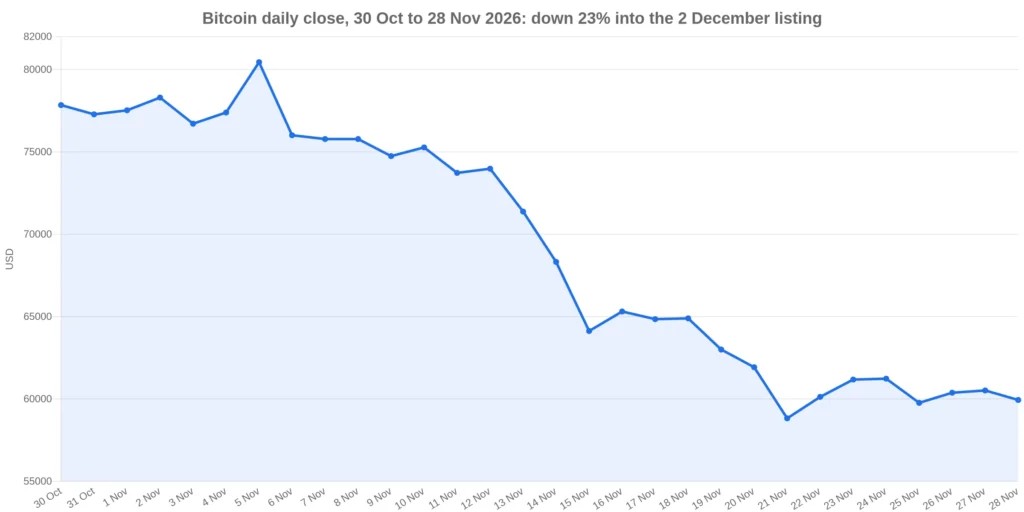
Bitcoin traded at $59,936 at 03:01 UTC on 28 November, down 2.3% over 24 hours, up 2.4% over seven days and 25.0% lower over 30 days, according to CoinGecko. The price sits 52.5% below the $126,080 record, inside a 24-hour range of $58,910 to $62,097, with a market value of $1.205 trillion and $27.5 billion traded in the day.
Bitcoin closed at $77,838.81 on 30 October and $59,933.47 on 28 November, a 23.0% decline. Chart: BlockchainReporter, data from CoinGecko.
The month sets what a subscriber is buying into. The low of $58,817.93 came on 21 November, and the price has recovered 1.9% since then rather than returning to the October range. A fund priced off spot Bitcoin inherits that path on the day it lists, whatever its custody or its Shariah structure says about the asset’s standing.
Translate the terms into a small position. At an initial issue price of $USD1.00 and an implied rate of 4.1208 ringgit to the dollar, RM10,000 buys about USD2,427. In board lots of 100 that is 2,400 units, roughly RM9,890 at issue, and at $59,936 a coin those units represent about 0.04 bitcoin. The 0.84% annual charge on that position works out to about 0.000336 bitcoin, or $20 a year at today’s price.
Two risks in the prospectus bite precisely here. The base currency is the dollar while one line trades in ringgit, so the MYR/USD rate moves the price a Malaysian buyer sees independently of bitcoin. And NAV is struck at 5.30pm Malaysian time from bitcoin prices cut at 5.00pm, so a market that trades around the clock is valued once a day. The prospectus describes the fund as suitable for investors with “extremely high-risk tolerance” and “a long-term investment horizon.”
What the Listing Does Not Establish
The regulatory consent is a registration, not a judgement on the product, and the prospectus says so in its own words on the cover. Nor does the fund’s registration resolve the “world’s first” description: that wording is the issuer’s, and the commission’s documents record Bitcoin’s Shariah status and the fund’s registration without certifying a first. Nothing in the file reviewed for this article contradicts the claim, and nothing in it independently confirms it either.
Distribution is confined to Malaysia. The notice states that distribution of the prospectus and the sale of units are subject to Malaysian law, that the document is not an offer in any jurisdiction where it would be unlawful, and that neither Bursa nor the manager takes responsibility for distribution outside the country. A reader in Singapore, Jakarta or Dubai cannot assume access through a foreign broker.
There is no income to collect. “There will be no distribution of income,” the prospectus states, so the entire return depends on the unit price. The fees quoted are ceilings rather than commitments, and a manager is free to charge less than the caps.
Launch size is unknown. The initial subscription happens on 30 November as a private placement to the Participating Dealer, so no asset figure exists yet, and the first real measure of demand will be creation activity after the first print. A Shariah wrapper also does not make the asset less volatile: the risk section lists currency risk, tracking error risk, liquidity risk, suspension of creations and redemptions, and the possibility that a Shariah classification is revisited after a new ruling.
For a Malaysian investor, the change on 2 December is concrete. A CDS account and an existing brokerage relationship become enough to hold bitcoin exposure inside a fund the commission has registered, with a named trustee and a custodian arrangement separate from the manager. Whether that wrapper is worth 0.84% a year is a question the first weeks of trading will price, in the spread and in how far the market value of the units drifts from NAV.
Frequently Asked Questions
When does the Halogen Shariah Bitcoin ETF start trading?
The fund is scheduled to list on the Main Market of Bursa Malaysia on 2 December 2026. The prospectus timetable sets the initial subscription for 30 November and allotment for 1 December, and adds that the indicative dates are subject to change at the directors’ discretion with regulatory approval.
What are the tickers and currencies?
The fund trades as 0840EA in Malaysian ringgit (BTCETF-MYR, ISIN MYL0840EA008) and as 0840EB in US dollars (BTCETF-USD, ISIN MYL0840EB006). Units are bought and sold in board lots of 100 through any Participating Organisation registered with Bursa Malaysia.
What does the ETF cost each year?
The prospectus caps four annual charges: 0.60% management, 0.05% trustee, 0.15% sub-custodian and 0.04% index licence, for a combined ceiling of 0.84% of net asset value. Trading costs, brokerage and the market spread are paid separately by the investor.
Is Bitcoin halal under Malaysian rules?
The prospectus states that Bitcoin’s status is recognised as halal from a Shariah perspective, relying on a resolution by the Shariah Advisory Council of the Securities Commission Malaysia and on the commission’s list of tradeable digital assets with their Shariah status. Amanie Advisors reviews the fund’s compliance every quarter.
Can investors outside Malaysia buy the fund?
The prospectus and its accompanying notice are limited to Malaysia. Distribution of the document and the sale of units are subject to Malaysian law, and the fund is not registered for public offering in any other jurisdiction.
Does the fund pay dividends?
No. The prospectus states there will be no distribution of income, so returns come entirely from the change in the unit price, less the annual charges and trading costs.
Disclosure: This article does not represent investment advice. The content and materials featured on this page are for educational purposes only.
The post Malaysia’s First Shariah Bitcoin ETF Lists Dec. 2 at a 0.84% All-In Cost appeared first on BlockchainReporter.

 blockchainreporter.net