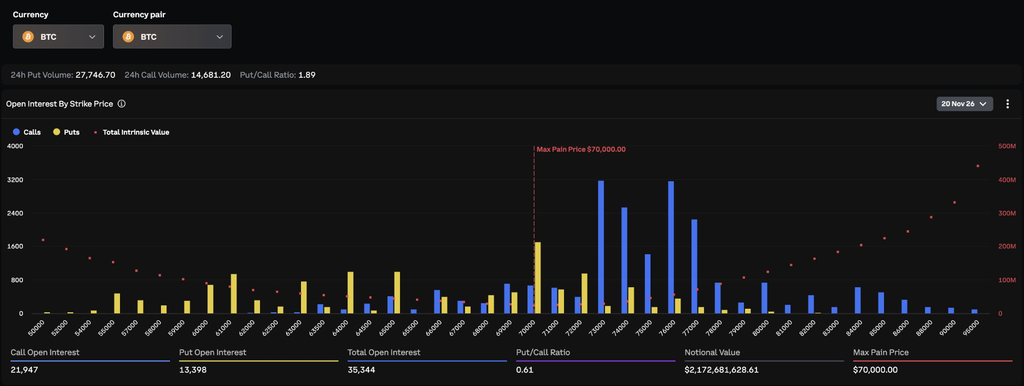
Meanwhile, the open interest (OI) was dominated by calls, with the put/call ratio close to 0.61. The call concentrations were highest at the 73,000, 74,000, and 76,000 strikes, with the puts concentrated at the lower strikes, especially the $70,000. Combined with approximately $303 million in Ethereum (ETH) options, the total notional expiring on Deribit was about $2.47 billion.
Why $70K Max Pain May Not Pull Bitcoin Higher Ahead of Options Expiry
The popular opinion in crypto markets is that max pain is a short-term magnet that can pull the underlying price to the strike at which the total option payouts are maximum. Such an assumption is not very reliable, particularly when the difference is this large.
Most of the heavy call open interest was already way out of the money relative to the current spot price of about $62,000. There is a possibility those contracts can expire without any significant purchasing pressure. This is because the market does not have a mechanical demand that dealers or the market in general must push Bitcoin higher just because there is a high volume of calls above the market.
Furthermore, historical Deribit expiries always paid off by a few percentage points in the max pain when the distance to spot was large and the surrounding positioning was not conducive to a directional payment. In this case, the $70,000 value is a reflection of previous positioning not an actionable force on the expiry date.
What Does Dealer Hedging, Put Exposure and Gamma Distribution Mean for Bitcoin?
The max-pain calculation does not exert as much influence on price action around options expiry as dealer hedging flows and distribution of put open interest and gamma exposure. Dealers who trade options generally keep their positions delta-neutral. Gamma is used to determine how the delta of an option reacts to the movement of the underlying asset.
That said, when dealers are net long gamma, they tend to sell into strength and buy into weakness, which can help to flatten the curve and pin levels around key levels. But when dealers are net short gamma, those hedging flows can do the opposite; rather than mitigate price moves, they can amplify them.
The out-of-the-money calls of $73,000-$76,000 in the November 20 options book provided limited gamma control as $BTC hovered around the $61,800 region. That implied little short-term call hedging pressure that could push spot up to $70,000.
Put exposure was high at lower levels, mainly $70,000, adding to the importance of downside positioning. As the contracts expired and dropped off, their gamma and delta exposure diminished, and so did the mechanical hedging flows associated with these contracts.
Therefore, traders should monitor the gamma profile near spot, put/call balance, and spot demand. These variables give a more accurate clue as to whether options positioning will reduce volatility, support a move,, or leave Bitcoin trading without the support of the $70,000 max-pain threshold.

 coinedition.com