Central Banks Are Loading Up on Gold: Is Bitcoin Losing the Hard-Money Battle?
cryptopotato.com
15 November 2026 16:14, UTC
Central banks are still accumulating gold at one of the fastest rates seen in recent years, even as prices remain historically elevated on a broader scale.
The trend continued beyond the third quarter of 2026, strengthening the case that sovereign institutions still overwhelmingly prefer the traditional safe-haven asset when diversifying their reserves.
Still Buying Gold
According to data shared by the analysts from the Kobeissi Letter, global central banks acquired 321 tonnes of gold during Q3 2026, the largest quarterly amount in almost two years and the fifth-largest on record. Purchases increased 8% from 296 tonnes in Q2 and surged from just 58 tonnes in Q1. For comparison, the five-year quarterly average stands at around 227 tonnes. Year-to-date demand reached 675 tonnes, 6% higher than the same period in 2025.
Know when your coins move
Alerts, real-time prices, and market news — all in one app
Point your phone camera to install
4.8 based on 40K reviews in the App Store and Google Play
The two standout buyers are China and Poland. They have added 63 tonnes and 40 tonnes, respectively, while Kazakhstan and Uzbekistan each bought another 14 tonnes. The Czech Republic continued its multi-year accumulation spree as well.
And the buying did not end in September, as further reports noted. Reuters, for example, said the People’s Bank of China added another 25.8 tonnes in October, which became its largest monthly purchase in three years. Poland bought another 27 tonnes that month, taking its reserves to its previously announced target of 700 tonnes. Governor Adam Glapinski subsequently said he saw no reason for the country to stop accumulating the precious metal.
The World Gold Council argued that reserve diversification and risk management remain key motivations for central banks, while Q3 gold ETF demand also rebounded strongly, adding 211 tonnes.
Gold Beats Bitcoin Again
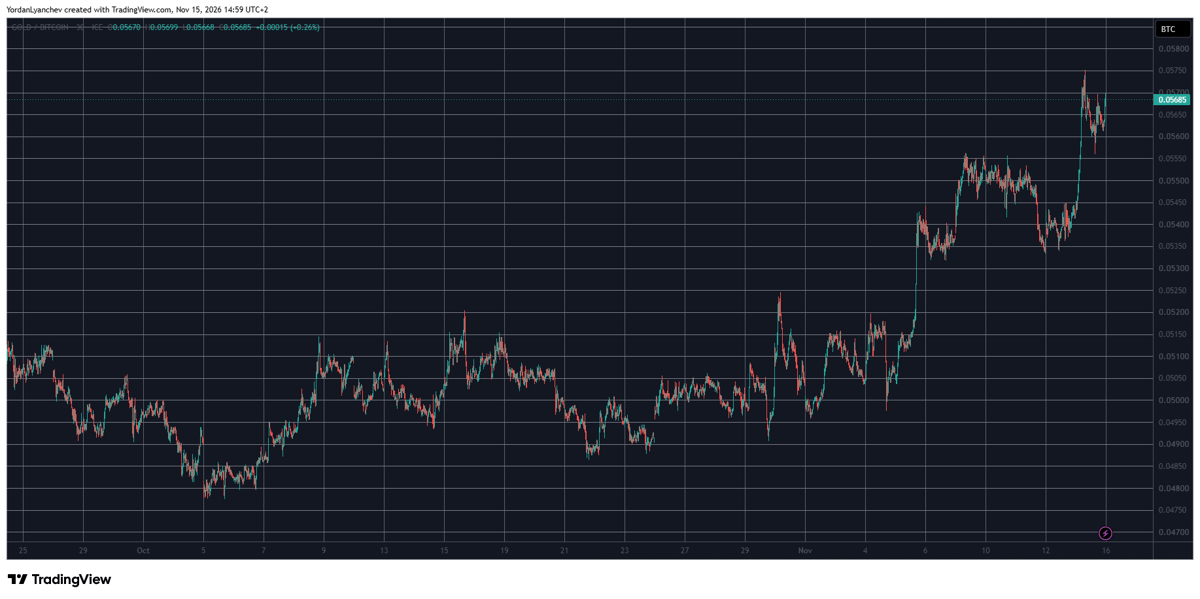
The development becomes particularly interesting when gold is measured not against the dollar, but against bitcoin. The XAU/$BTC ratio has risen from roughly 0.047 in early October to almost 0.057 now, a surge of roughly 20%. Put simply, an ounce of gold now buys considerably more $BTC than it did just over a month ago.
You may also like:
Strategy Is Officially Out of MSCI: What It Could Mean for MSTR and Bitcoin
Nakamoto Extends $60M Kraken Loan, Adds Bitcoin Derivatives to Its Collateral
TSMC Confirms Employee Data Leak as Hackers Try to Sell 46,000 Records for Bitcoin
This reflects the sharp divergence between the two supposed “hard money” assets. $BTC traded well above $80,000 during most of October but has since suffered a brutal correction to $65,000. The precious metal has also lost some ground against the greenback, closing on Friday at around $3,900/oz. However, its losses have been significantly less painful than bitcoin’s.
The comparison does not necessarily undermine $BTC’s longer-term scarcity thesis. Central banks operate under very different constraints from private investors, and gold already has centuries of history to support its narrative.
Bitcoin has struggled amid deleveraging, ETF outflows, and broader risk-off pressure, while central banks have been aggressively accumulating its oldest and perhaps closest rival. The current XAU/$BTC chart from below suggests that the traditional safe-haven asset is winning this round.

 cryptopotato.com