Bitcoin Hits 12-Week Low as Fed Rate Fears Undo Most of Summer Rally
decrypt.co
24 m
In brief
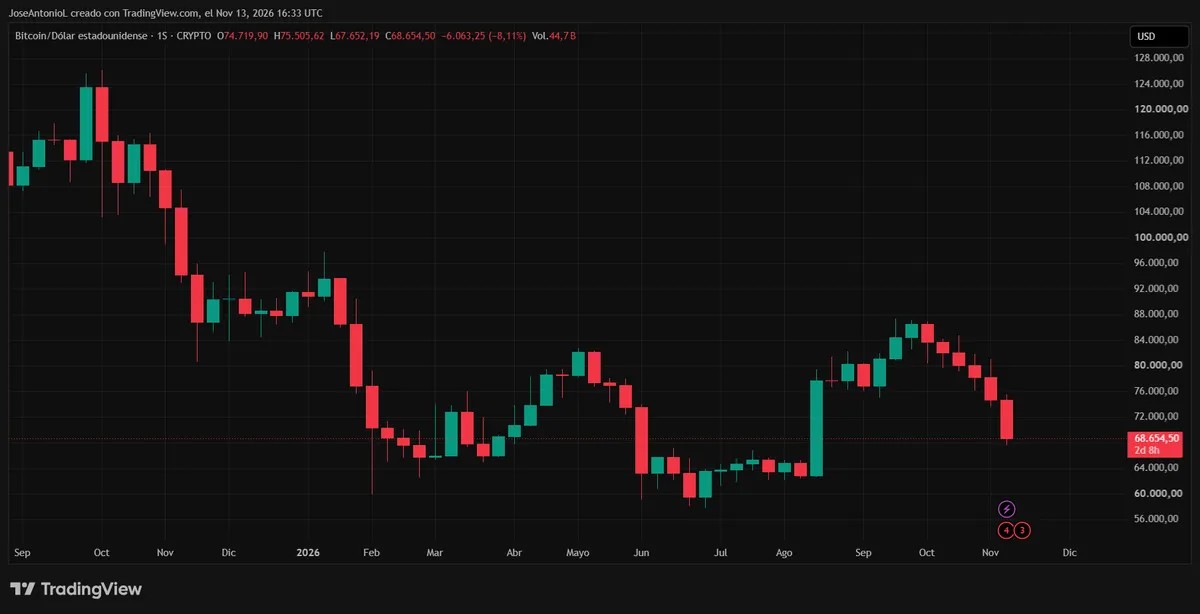
Bitcoin fell to around $68,500 Friday, its lowest level in 12 weeks, erasing much of its late-summer recovery.
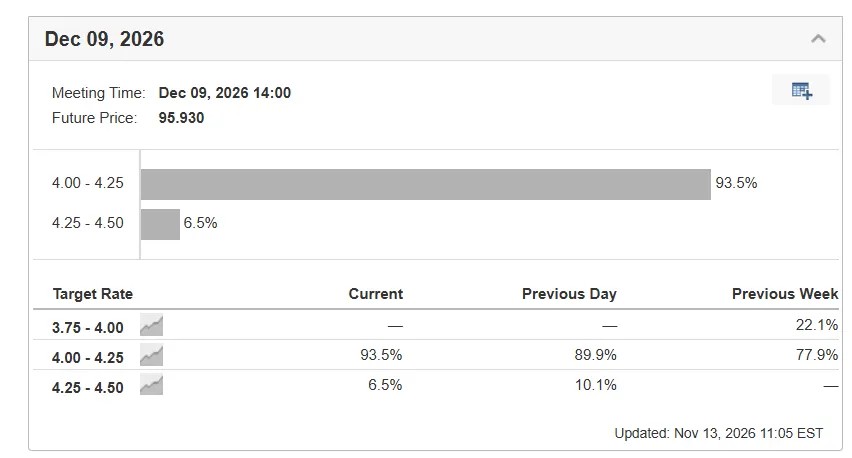
Futures markets overwhelmingly expect a December Fed rate hike, while one official has raised the possibility of a larger-than-usual increase.
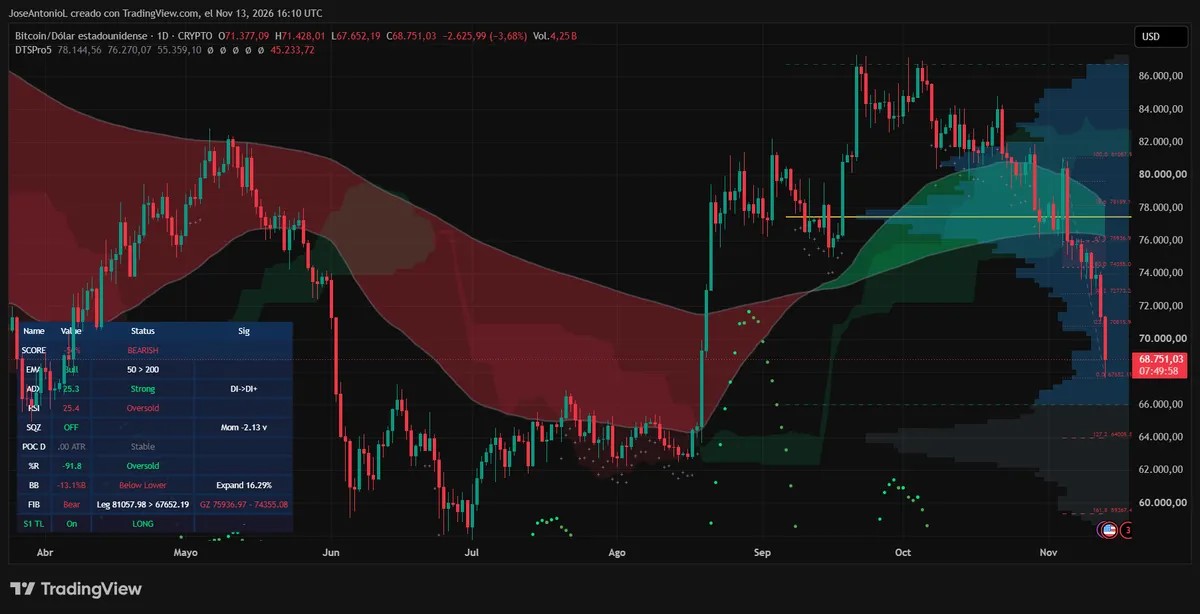
Bitcoin's daily RSI has fallen to 25.4, but bearish momentum remains strong, with immediate support around $67,650.
Bitcoin fell to roughly $68,500 on Friday, hitting its lowest price in 12 weeks as renewed U.S. inflation worries and investor withdrawals pushed the cryptocurrency further into the red.
$BTC was down about 4.5% over 24 hours and 9.5% for the week, according to Friday market data. Ethereum traded near $1,925, while Solana slipped below $80 as selling spread across major cryptocurrencies.
Know when your coins move
Alerts, real-time prices, and market news — all in one app
Point your phone camera to install
4.8 based on 40K reviews in the App Store and Google Play
The latest slide has erased most of Bitcoin's late-summer recovery. But not all of it: $BTC remains approximately 16% above its late-June low near $59,000, even after retreating roughly 21% from its autumn peak around $86,000.
Inflation raises the stakes for December
Chicago Federal Reserve President Austan Goolsbee warned Friday that inflation had spread beyond energy and tariffs, with rising services and medical costs and demand from AI data centers adding to price pressures.
Bitcoin price data. Image: Tradingview
“Are we on a path back to 2%? My feeling right now is we are not and we've got to deal with that,” Goolsbee said according to Reuters.
Goolsbee did not explicitly endorse a December rate hike. But other Fed officials have been more direct.
On Tuesday, Fed Governor Christopher Waller said he supported raising interest rates by at least 25 basis points, or 0.25 percentage points, at the December 8-9 meeting.
He also established a threshold for considering something more aggressive.
“If the October CPI inflation data out later today are similar to the past two monthly readings—with core CPI inflation around 0.3 percent or even higher—then a stronger policy move may be needed,” Waller said in his official remarks.
The report subsequently showed core CPI rising exactly 0.3%, exceeding the 0.2% forecast and meeting Waller's condition for considering a 50-basis-point increase.
Markets have responded accordingly. Futures-based rate probabilities as of November 13 showed a 91.9% probability of a quarter-point increase and an 8.1% probability of a half-point increase.
Those figures reflect trader expectations, not a decision by the Fed. The central bank's current target range is 3.75% to 4.00%.
Friday's producer-price report added to the concerns. Wholesale prices rose 0.3% in October, less than forecast, but increased 6.5% year over year, the largest annual jump since 2022.
For Bitcoin, higher rates make traditional interest-bearing investments relatively more attractive, reducing the appeal of speculative assets.
ETF withdrawals deepen selling pressure
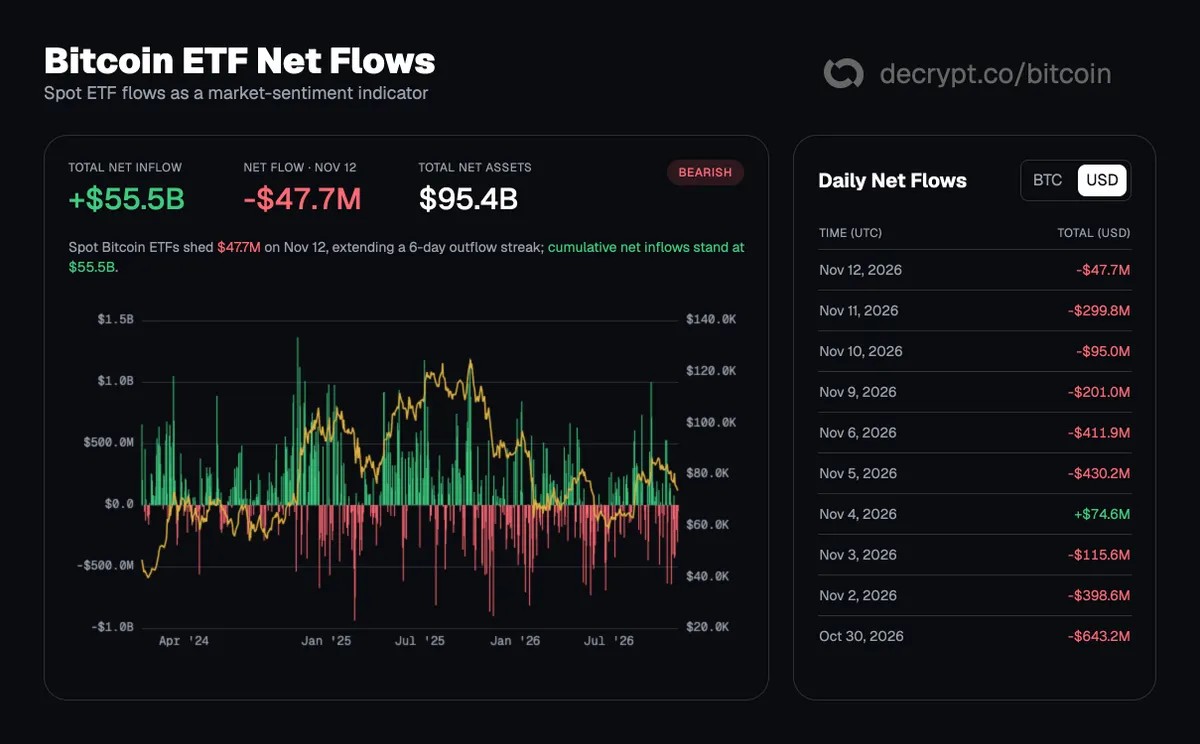
Meanwhile, U.S. spot Bitcoin ETFs have registered six consecutive sessions of net outflows, totaling approximately $1.49 billion between November 5 and November 12.
Thursday's $47.7 million withdrawal extended the five-day outflow streak, bringing another source of pressure to an already struggling market.
Bitcoin ETF flows. Image: Decrypt
That does not mean institutional investors have abandoned Bitcoin. The funds still hold approximately $55.5 billion in cumulative net inflows, but it does show the state of nervousness that investors are feeling.
Weakening ETF demand, combined with forced liquidations of leveraged traders, can accelerate a decline when buyers are scarce.
Bitcoin price: What the technical indicators say
Bitcoin's daily chart now shows a clear sequence of lower highs and lower lows, confirming a bearish short-term trajectory.
Bitcoin price data. Image: Tradingview
Its relative strength index, or RSI, has dropped to 25.4. Readings below 30 are generally considered oversold, suggesting the selling may be stretched.The average directional index, or ADX, stands at 25.3, indicating an established trend. Combined with declining prices, that suggests bearish momentum remains meaningful.
There is still one longer-term positive signal: the 50-day exponential moving average remains above the 200-day EMA, preserving a bullish moving-average configuration. But Bitcoin's price has fallen below the shorter-term average, indicating that recent momentum has turned against buyers.
Immediate support sits around $67,650, Friday's intraday low. Losing that level could expose a deeper support area near $64,000.
On the upside, Bitcoin needs to recover $70,815 and $72,775 before challenging the stronger resistance zone between $74,355 and $75,937.
The combination of extreme oversold readings and strong downward momentum leaves room for a temporary bounce, but not enough evidence to declare a bottom.
For now, traders face two major macroeconomic checkpoints: the Fed's November 18 meeting minutes and the November 25 PCE inflation report, both of which could influence expectations ahead of December's interest-rate decision.

 decrypt.co