Bitcoin price slips below $74,000 as inflation shock sets up a $70,000 showdown
invezz.com
3 h
Bitcoin ($BTC) remains under pressure on Wednesday as stronger-than-expected US inflation figures trigger another wave of caution across the cryptocurrency market.
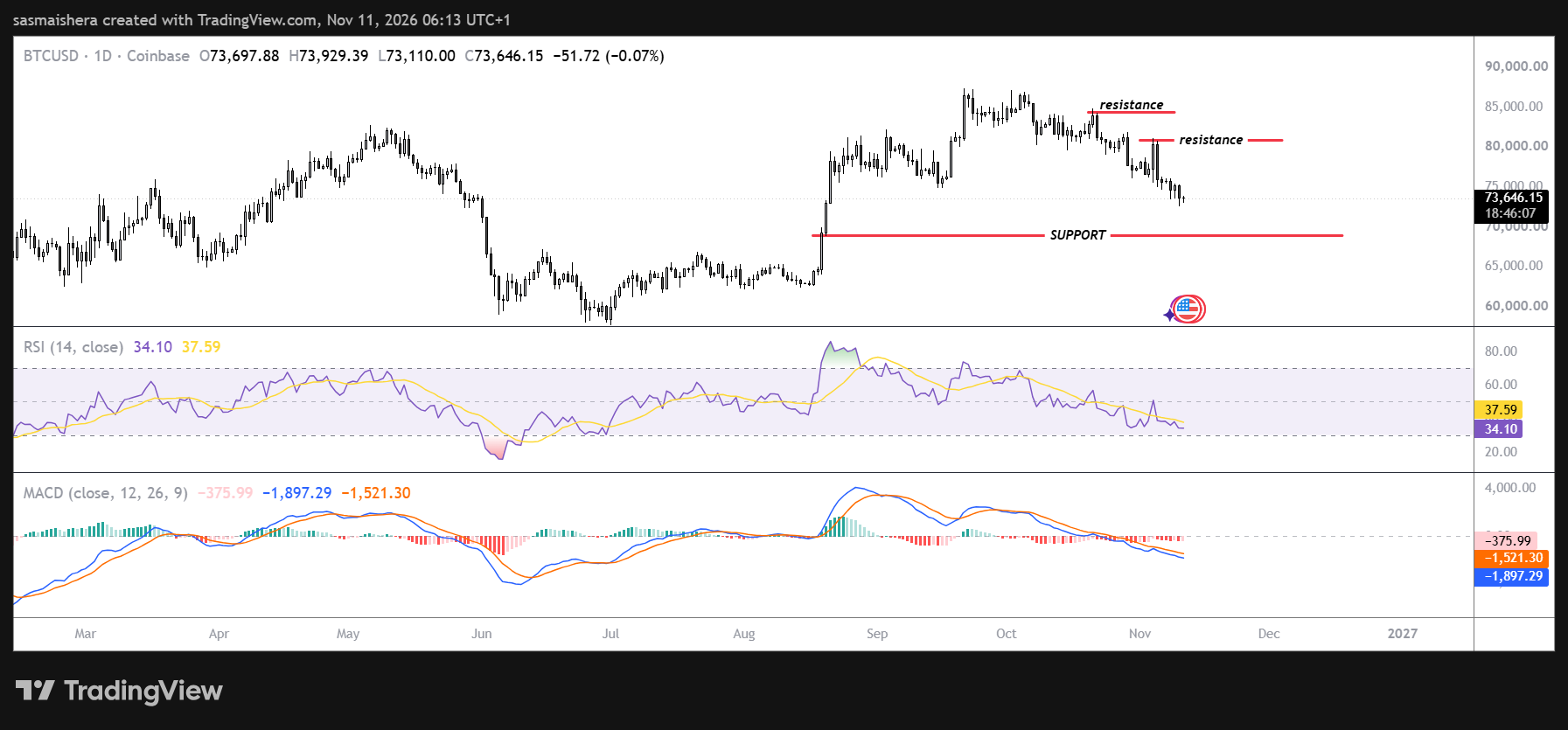
Bitcoin has fallen below $73,800, with sellers increasingly focused on the psychological $70,000 support level.
The latest decline follows the release of hotter-than-expected US Consumer Price Index (CPI) data, raising concerns that the Federal Reserve could maintain a restrictive monetary policy stance for longer.
Know when your coins move
Alerts, real-time prices, and market news — all in one app
Point your phone camera to install
4.8 based on 40K reviews in the App Store and Google Play
Technical indicators suggest that any recovery attempts could encounter resistance unless broader market sentiment improves.
Hot US inflation data weighs on Bitcoin and altcoins
The latest US CPI report has added pressure to an already fragile cryptocurrency market, reinforcing concerns about the Federal Reserve's interest rate outlook.
Higher-than-expected inflation generally reduces the likelihood of monetary easing and can strengthen expectations that the central bank will maintain or increase borrowing costs.
For Bitcoin, such an environment can be challenging because higher interest rates tend to make traditional yield-bearing assets more attractive relative to speculative investments.
Investors are now reassessing the possibility of additional monetary tightening, while traders remain cautious about increasing exposure to risk-sensitive assets.
Unless inflation concerns ease or buying demand strengthens, cryptocurrencies could remain vulnerable to additional losses in the coming sessions.
Bitcoin continues to trade under substantial selling pressure, with its technical structure suggesting that bears remain firmly in control.
At the time of writing on Wednesday, $BTC trades around $73,664, extending its recent decline after failing to reclaim important technical resistance levels.
The cryptocurrency remains below its major daily Exponential Moving Averages, reinforcing the bearish outlook.
The 200-day EMA stands at $76,404, while the 100-day EMA is positioned at $77,473. Meanwhile, the 50-day EMA sits higher at $78,879, creating another significant obstacle for buyers attempting to reverse the downtrend.
The concentration of moving averages above Bitcoin's current price suggests that recovery attempts could encounter considerable selling pressure.
Momentum indicators also reflect persistent weakness. The daily Relative Strength Index (RSI) has declined toward 34, approaching the oversold threshold of 30.
The Moving Average Convergence Divergence (MACD) remains in negative territory, further confirming that bearish momentum continues to dominate.
If Bitcoin extends its decline, the next major downside target stands at the psychological $70,000 support level. This region could attract buying interest from traders looking to capitalize on lower prices.
$BTC/USD Daily Chart
Despite the current bearish conditions, Bitcoin could attempt a temporary recovery if buyers respond to increasingly oversold momentum readings.
The first major resistance level is the 200-day EMA near $76,404. A sustained recovery above this level would provide an early indication that buying momentum is improving.
Beyond this resistance, Bitcoin would need to reclaim the 100-day EMA around $77,473. The next significant supply zone stands at the 50-day EMA near $78,879.
A convincing breakout above these moving averages would improve Bitcoin's near-term outlook and potentially encourage additional buying activity.
If bullish momentum strengthens further, the cryptocurrency could target the horizontal resistance zone around $85,000.
Until Bitcoin reclaims its major moving averages, short-term rallies remain vulnerable to renewed selling pressure.
AI disclosure: AI tools assisted with research and drafting of this piece. An Invezz editor reviewed the facts, sources and wording before publication. Any opinions or analysis are Invezz’s, not those of an automated system.

 invezz.com