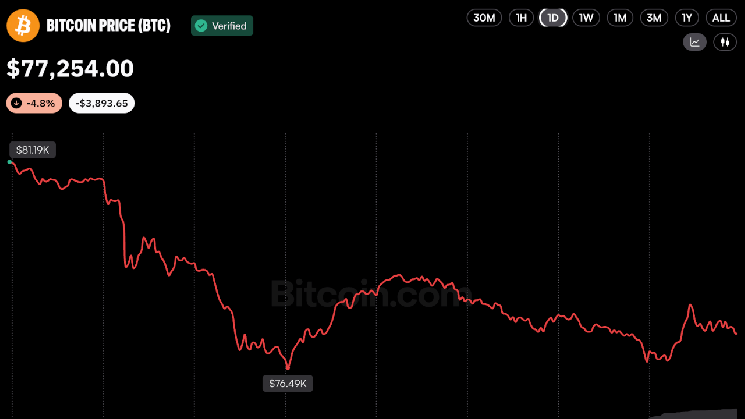
Friday’s losses left bitcoin on the cusp of ending October down more than 7%, while widening the cryptocurrency’s year-to-date losses to more than 11%. The losses also dragged bitcoin’s market capitalization to $1.55 trillion, which in turn helped drag the broader crypto economy’s market cap to approximately $2.7 trillion.
Crypto Liquidations Hit $1.66 Billion
As Binance revealed hackers had stolen $6.3 billion in digital assets, ongoing price volatility drove bitcoin liquidations above $500 million. As of this writing, the tally sits at $556 million over the past 24 hours, per Coinglass.
Long positions bore the brunt of the damage, accounting for 83%, or roughly $464 million, of the wiped-out bets, while short liquidations totaled nearly $92 million. Across the broader crypto market, liquidations hit $1.66 billion, led by $1.45 billion in long position wipeouts.
Meanwhile, analysts warn that the breach of a major cryptocurrency exchange underscores the industry’s wider security vulnerabilities. While AI tools are increasingly helping attackers, recurring breaches across nearly every major exchange suggest security measures remain far from foolproof.
Ryan Kirkley, co-founder and CEO of Global Settlement Network, argued that Binance’s reliance on external assistance to mitigate the attack points to deeper systemic issues.
“We’re talking about the world’s largest crypto exchange relying on emergency freezes and reimbursement promises to contain a multibillion-dollar incident,” Kirkley said. “That’s a serious problem for an industry asking institutions to trust it with substantially more capital. For me, the takeaway is simple. Institutions need more than assurances that their money is safe. They need verifiable ownership, proper controls, and reliable access to their assets, particularly when markets are under pressure.”
Consequently, while crypto leaders pour resources into lobbying Washington for regulatory favors, Kirkley warned that the industry’s most existential threats aren’t coming from lawmakers; they are coming from rapid advances in cybercrime and AI.
“The CLARITY Act and the election outcome will matter for regulatory certainty, but institutions need a financial system they can rely on regardless of who’s in Washington,” he added. “Political influence can help shape legislation. It can’t compensate for weak custody, unreliable access, or poor operational controls.”

 news.bitcoin.com