Bitcoin Rides Out Fed Hawks, 3.6% Inflation and AI Capex Fears
crypto-news-flash.com
29 October 2026 23:07, UTC
The Fed paused its tightening, but two policymakers voted for another hike.
US inflation picked up in September while growth and hiring stayed strong.
Investors punished heavy AI spending at Alphabet but rewarded Microsoft’s restraint.
Fidelity data shows Bitcoin holders have moved back into meaningful profit.
Bitcoin climbed back above $80,000 on Thursday after a Federal Reserve pause that two policymakers openly opposed and a September inflation reading that rose to 3.6%. The European Central Bank also held rates while warning about energy prices, and Alphabet’s earnings revived doubts about how much Big Tech is spending on AI. None of this week’s data made a case for easier money, yet $BTC stayed inside its weekly range, while new on-chain research from Fidelity Digital Assets showed the average holder back in clear profit after a weak first half of the year.
A 10-2 vote with history attached
The Federal Open Market Committee kept the federal funds range at 3.75%-4.00% on Wednesday, its first pause after September’s quarter-point increase. Governor Lisa Cook and Cleveland Fed President Beth Hammack dissented in favor of another 25 basis point hike, making it the first time since October 1992 that a Board governor and a regional bank president dissented on the same side, and Cook’s first dissent since she joined the Board in 2022.
Know when your coins move
Alerts, real-time prices, and market news — all in one app
Point your phone camera to install
4.8 based on 40K reviews in the App Store and Google Play
The policy statement said inflation remains elevated and upgraded the description of economic growth to a strong pace from solid. Fed Chair Kevin Warsh, who took over from Jerome Powell in May, told reporters the economy is not yet at price stability and described the hold as time to see how September’s hike works through financial conditions, while once again refusing to say what the Committee will do in December.
September data keeps December live
On Thursday, the PCE price index, the Fed’s preferred inflation gauge, showed prices rising 3.6% from a year earlier in September after 3.4% in August, helped by a 0.5% monthly jump. Core PCE, which excludes food and energy, edged up to 3.1%, and core services excluding housing, the category Fed officials watch for demand-driven pressure, reached 3.6%, its highest reading since 2024.
Real GDP grew at a 3.4% annualized rate in the third quarter, up from 2.2% in the second and above the 3.2% consensus, with investment, consumer spending and government outlays all contributing. Initial jobless claims fell to 194,000 in the week to October 24, close to their lowest levels in 57 years, which leaves Warsh with a labor market that gives him no reason to go easy on inflation.
Indicator
Latest
Change
US inflation
PCE inflation (YoY)
3.6%
▲ from 3.4%
Core PCE (YoY)
3.1%
▲ from 3.0%
Growth and jobs
Real GDP (annualized)
3.4%
▲ from 2.2%
Initial jobless claims
194,000
▼ from 195,000
Central banks
Fed funds range
3.75%-4.00%
● Hold, 10-2 vote
ECB deposit rate
2.50%
● Hold
Source: BEA, US Labor Department, Federal Reserve, ECB
Frankfurt adds an energy warning
The European Central Bank left its deposit rate at 2.50%, as expected, but said rising energy prices pose upside risks to inflation and downside risks to growth, with European gas prices crossing €100 for the first time since the 2022 crisis. It also noted that financing conditions have tightened since its September meeting as government bond yields climbed, with France’s debt market under the heaviest strain. Marchel Alexandrovich, European economist at Saltmarsh Economics, said the statement signals that a December hike is firmly in play. The decision came only hours after Christine Lagarde announced she will step down as ECB President on February 7, 2027, roughly nine months before her term ends.
Big Tech’s capex bill hits the AI trade
The other pressure point this week came from Silicon Valley. Alphabet’s third-quarter results showed revenue up 25% to $127.6 billion and Google Cloud sales more than doubling to $30.7 billion, yet earnings per share of $2.12 fell well short of the roughly $3.01 analysts expected. The stock dropped about 13% on Thursday, on course for its worst session since its 2004 listing and a loss of roughly $500 billion in market value. Capital spending reached $51.4 billion in the quarter, pushing free cash flow to negative $9.1 billion, and finance chief Anat Ashkenazi said spending will rise significantly again in 2027 on top of this year’s $195 billion to $205 billion budget.
Microsoft got a friendlier reception after Azure grew 48% and quarterly capex of $45.2 billion came in below the company’s own guidance of more than $50 billion, The shares jumped about 4% after hours, but the stock gave back that gain and traded little changed on Thursday as the wider tech selloff weighed. CFO Amy Hood still expects spending to top $50 billion in the December quarter, although she said Microsoft will keep generating positive free cash flow, a promise Alphabet and Meta can no longer make after Meta’s capex of $34.9 billion exceeded its operating cash flow last quarter.
Company
Q3 capex
Stock reaction
Alphabet Free cash flow -$9.1B
$51.4B
▼ ~13% Thursday
Microsoft Free cash flow +$18.6B
$45.2B
● Little changed
Meta Free cash flow -$2.1B
$34.9B
▼ 9.4% after results
Source: company filings, market data as of Thursday’s US session
Investors are now marking down companies whose AI spending outruns the cash they generate, even when revenue keeps growing, which helps explain why the Nasdaq posted two straight weekly losses before this week’s reports. Moody’s expects hyperscaler capex of about $785 billion this year and close to $1 trillion in 2027, so the question of payback is unlikely to fade soon.
For crypto, this opens a possible rotation channel. Investors trimming exposure to cash-burning megacaps need somewhere to put that money, and Bitcoin offers a growth bet that carries no capital spending bill and runs on a supply schedule fixed in code. On Thursday $BTC held near $80,000 while Alphabet’s slide pulled the Nasdaq down more than 1%, although it also fell alongside tech during the Nasdaq’s sharp drop on October 22, so any decoupling remains tentative. There is also a direct link through mining, since Fidelity’s report notes that many miners have redirected power and hardware toward AI compute contracts, a revenue stream that depends on hyperscalers continuing to spend.
Why the hawkish week didn’t break Bitcoin
Very little of the macro news came as a surprise. PCE matched forecasts to the decimal, the Fed hold was the consensus call, and futures traders had been pricing a December hike before Wednesday, so the data confirmed a path markets had already partly discounted. Leverage cleanup did the rest, as roughly $330 million in crypto positions were liquidated over 24 hours, about $205 million of it from long bets, with Ethereum ($66 million) and Bitcoin ($65 million) taking the largest hits, as per Coinglass data. Forced selling on that scale tends to clear out overextended buyers, which helps explain why $BTC is down only about 1.5% on the week and the CMC Fear and Greed Index sits at a neutral 44. Altcoins are mixed, with Hyperliquid up nearly 14% in a day while ETH and SOL are each down around 3% over seven days.
Fidelity’s latest Signals Report tracks NUPL (net unrealized profit/loss), which compares what the market is worth today with what holders paid for their coins, so a reading of 0.36 means roughly a third of Bitcoin’s market value at the end of September was paper profit, up from 0.09 at the end of June. The jump followed a 43% rally in the third quarter, when $BTC traded between $61,438 and $86,505, and moved holders from Fidelity’s Hope-Fear band into what it calls Optimism-Anxiety.
Across 439 historical observations in which NUPL sat within 0.05 of 0.36, Bitcoin’s median one-year return was 93%. That number describes past cycles and hides a wide spread of outcomes, and Fidelity itself cautions that a sustained advance needs unrealized profits to keep expanding. With $BTC now about 7% below the top of its third-quarter range, that expansion has stalled for now.
Bitcoin squeezed into a descending triangle
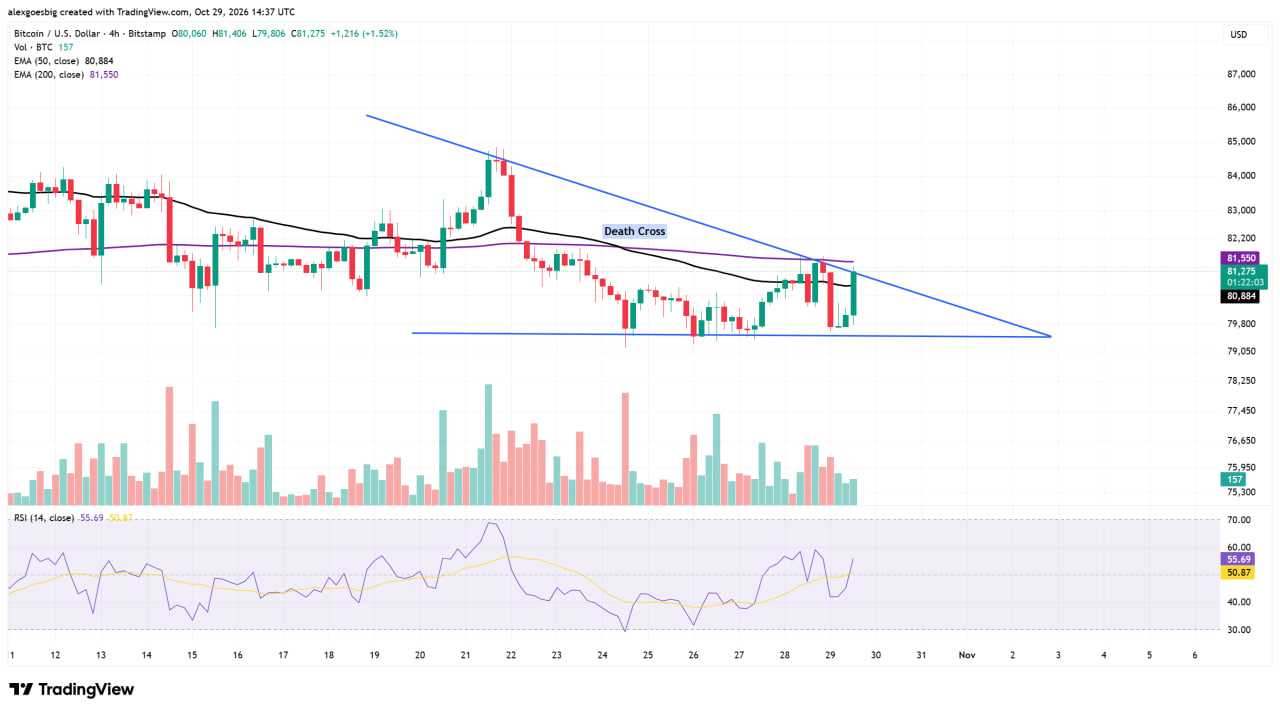
$BTC/USD 4-hour chart. Source: TradingView / Alexander Stefanov
Since the October 21 rejection near $84,800, $BTC has been trading inside a descending triangle, with each rebound topping out lower along a falling trendline while buyers have defended the $79,500 area at least four times since October 24. The 50-period moving average crossed below the 200-period one around October 22, a so-called death cross that signals short-term weakness, and both averages now sit just overhead at roughly $80,900 and $81,500.
Price is pressing that zone from below, so a four-hour close above $81,500 would clear the trendline and the longer average at the same time. RSI near 52 shows balanced momentum with neither side stretched, and fading volume fits a market waiting for a trigger. The triangle runs out of room in early November, and a break below $79,500 would expose the lower half of the October range.
Level
Price
From current price
October high Start of the falling trendline
$84,800
+5.4% above
200-period average Meets the trendline, the breakout test
$81,500
+1.3% above
50-period average First resistance overhead
$80,900
+0.6% above
◆ $BTC NOW
$80,426
Inside the triangle
Triangle floor Support defended since October 24
$79,500
-1.2% below
Levels based on the $BTC/USD 4-hour chart
What December now hinges on
For Bitcoin, the practical question is whether a December hike would be a single step or the start of a longer climb. The October jobs report and October CPI are the last major inputs before the Fed’s next meeting, and with claims near multi-decade lows, inflation holding above 3% would leave Warsh little room to wait. A hike the market already expects usually has a limited effect on risk assets, but guidance pointing to several more would push real yields and the dollar higher, a combination that has historically weighed on $BTC. The ECB meets again on December 17, and simultaneous tightening in Washington and Frankfurt would drain global liquidity further. Amazon’s results after Thursday’s close will show whether the capex worries spread to the last of the big cloud providers.
Warsh also announced that one of the eight FOMC meetings in 2027 will focus only on strategy, with no rate vote and no statement, which cuts the number of scheduled decisions to seven and gives each remaining one more weight for crypto traders who position around them. Across the Atlantic, the ECB will pass to a new president in February, so markets will be reading two central banks in transition just as both weigh further hikes.

 crypto-news-flash.com