
 coindesk.com
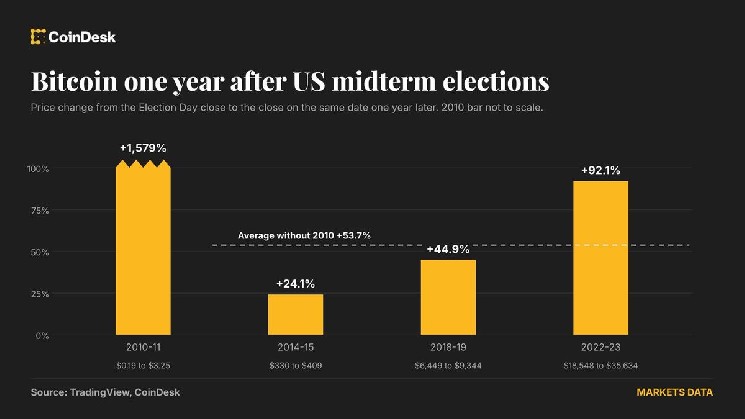
Both crypto and Wall Street could be in for a strong run after the Nov. 3 U.S. midterm elections, if history is a guide.
Since its inception in 2009, bitcoin $BTC$84,459.46, the largest cryptocurrency by market value, has seen four midterms. Leaving out 2010, when the market was tiny and fringe, the other three saw prices for the cryptocurrency rise an average of 53.7% in the 12 months after Election Day, according to data analyzed by CoinDesk. The returns here refer to the percentage rise from the daily close (00:00 UTC) on Election Day to the close on the same date a year later.
Bitcoin surged 1,579% in the 12 months after the 2010 midterm, but the market was fringe and too small then for that figure to be reliable.
If history repeats, bitcoin’s recent subdued price action around $80,000 could pave the way for another leg higher after Nov. 3. $BTC has already bounced more than 35% since bottoming out below $60,000 in June. Some analysts believe now is the time to buy and hold crypto, as a new bull run is upon us.
Politics or halving cycle?
Still, history is too limited to draw firm conclusions, and the post-midterm surges in $BTC seen over the years may have more to do with the four-year cycle than U.S. politics.
Bitcoin tends to move in cycles of roughly four years, built around the mining reward halving, an inbuilt code in the Bitcoin blockchain that reduces the per block $BTC produced and given to miners by 50% every four years.
After each of the four halvings to date, $BTC rallied sharply, peaked 12 to 18 months later and then sliding into a bear market. Those bear markets played out in midterm years – 2014, 2018, 2022 and now 2026. So the rebound that followed the midterms may have been a fresh cycle start rather than politics at work.
S&P 500 has a long bullish history
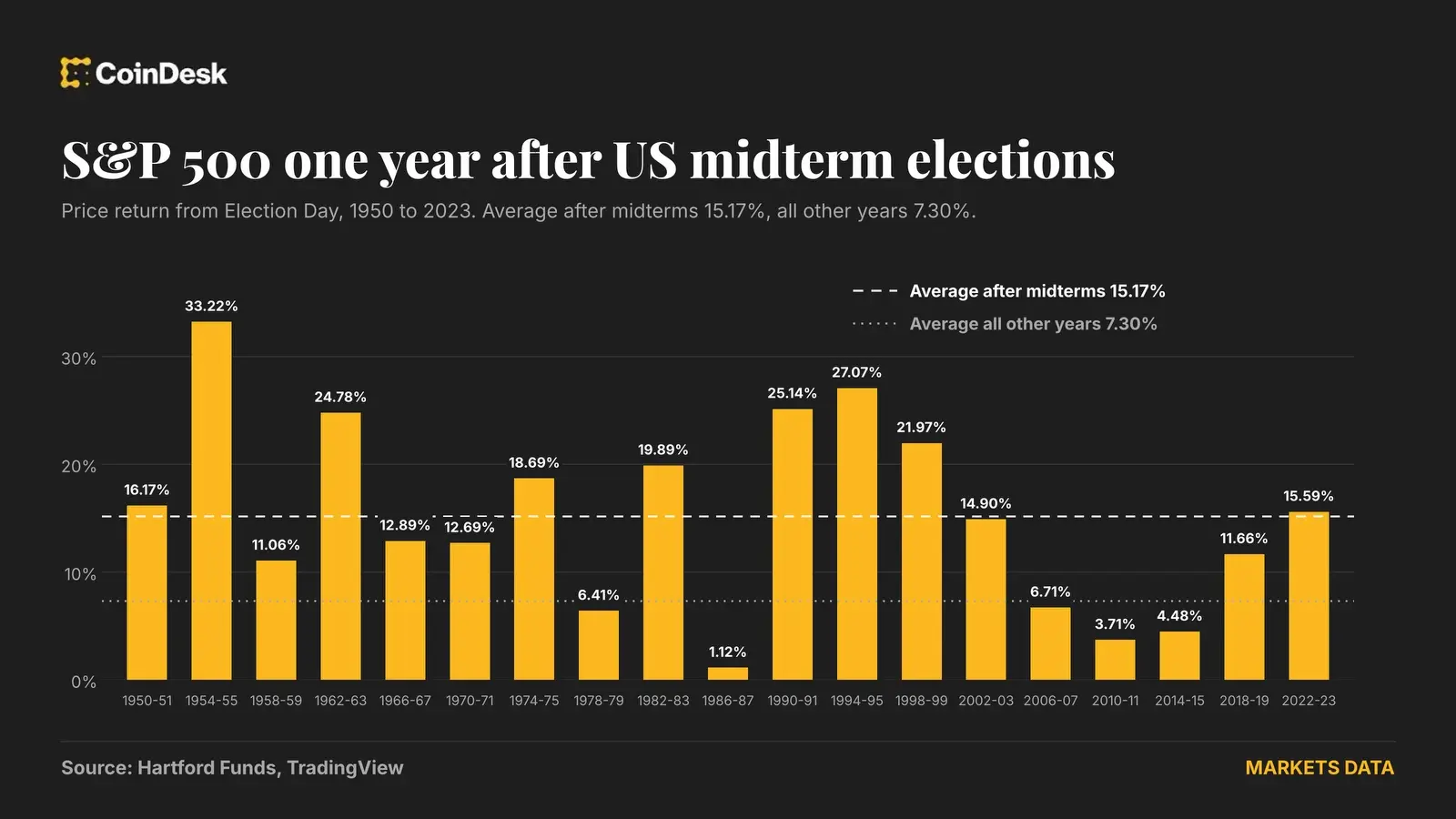
The S&P 500 has a much longer record, and it also points up, a positive sign for bitcoin and other risk assets.
Since 1950, the index has averaged a 15.17% gain in the year after midterms, against 7.30% in all other years, according to Hartford Funds.
What’s at stake this time
The 2026 elections could change how President Donald Trump operates in his final two years in the White House.
If Democrats win one or both chambers of Congress, the politics over the record federal debt may heat up, as the debt limit issue is still unresolved and talks over the same may complicate. Trump’s push for $350 billion in mandatory defense funding may not stand a chance, according to Brookings. Democrats could use legislative hurdles to arrest funding for Middle East escalations.



