“I remain bullish on crypto, AI, and frontier technologies over the long term, but investors have good reason to be selective right now,” Ahuja said, pointing out that inflation, high technology valuations, and restrictive borrowing costs continue to weigh on investor sentiment. “Until markets get reassurance that corporate earnings can support current valuations and that financial conditions are moving in the right direction, I expect investors to remain fairly cautious.”
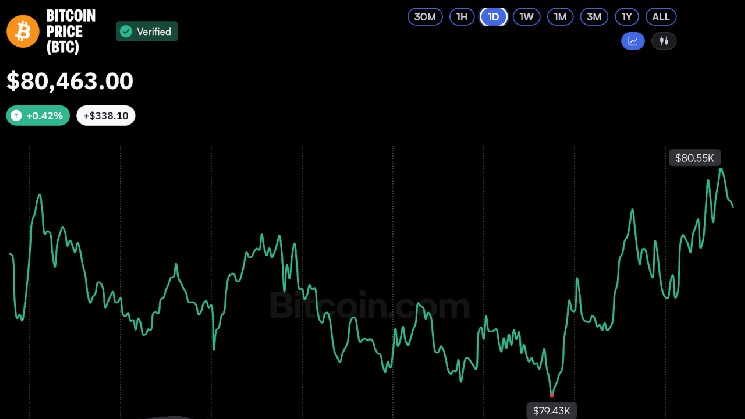
Bitstamp 24-hour data shows bitcoin nearly reached $80,700 late Monday morning as buyers briefly seized control. The rally was short-lived, however, as the price dipped back below $80,000 and bottomed out near $79,600. The cryptocurrency then entered a tight seesaw pattern, bounded by resistance under $80,500 and support near $79,500. Yet, shortly after 6 a.m. EST, bitcoin breached the $79,500 floor for the first time in the session before rebounding above $80,300.
Four-Year Cycles and Monetary Uncertainty
At the time of writing (12:25 p.m. ET), bitcoin’s price hovered just below $80,500, showing an 0.4% gain over 24 hours and its market capitalization unchanged near $1.61 trillion. Ahuja noted that while October is shaping up to be a difficult month for crypto despite historical seasonal strength, bitcoin’s four-year cycle and broader market mechanics remain in play.
“Crypto remains sensitive to liquidity, institutional positioning, and broader risk appetite, and investors have little incentive to take on additional exposure while monetary policy remains uncertain,” Ahuja explained. “The institutionalization of crypto has changed how capital moves through the market, but I don’t think it has eliminated bitcoin’s historical cycles. For now, I’d be watching ETF flows, leverage, and broader liquidity conditions.”
Beyond monetary policy, Ahuja emphasized that the Nov. 3 U.S. midterm elections add another layer of uncertainty, particularly concerning the regulatory landscape for crypto, AI, and energy infrastructure heading into 2027.
In the derivatives market, bitcoin’s flat price action capped its liquidations under $20 million, a significant drop from the $56 million recorded a day earlier. Coinglass data showed long bets liquidated at nearly $12 million, while wiped-out shorts tallied just under $8 million. However, across the broader crypto economy, the situation was slightly different: Of the $133 million liquidated, long positions accounted for $62 million versus nearly $70 million in short positions.

 news.bitcoin.com