Bitcoin Bull Score Index Drops From 80 to 60 as Momentum Weakens
news.bitcoin.com
16 h
Bitcoin Bull Score Signals Slower Momentum
Bitcoin’s market momentum has weakened since late September, with incoming capital and investor profitability presenting obstacles to further progress. Cryptoquant contributor Darkfost highlighted those conditions in an Oct. 21 assessment of bitcoin’s Bull Score Index on X. $BTC was trading at $81,345 at the time of writing.
The analyst stated:
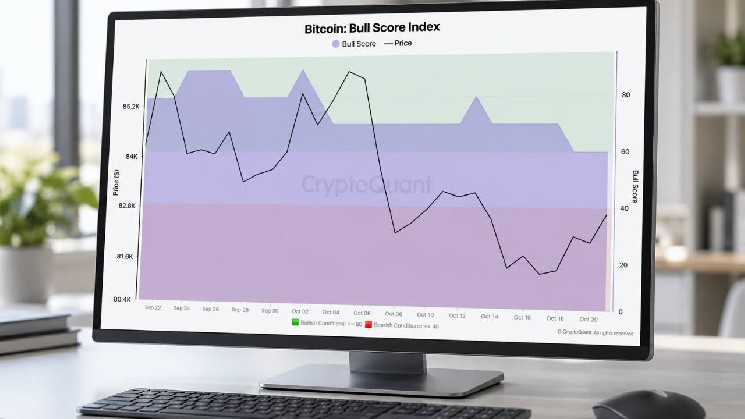
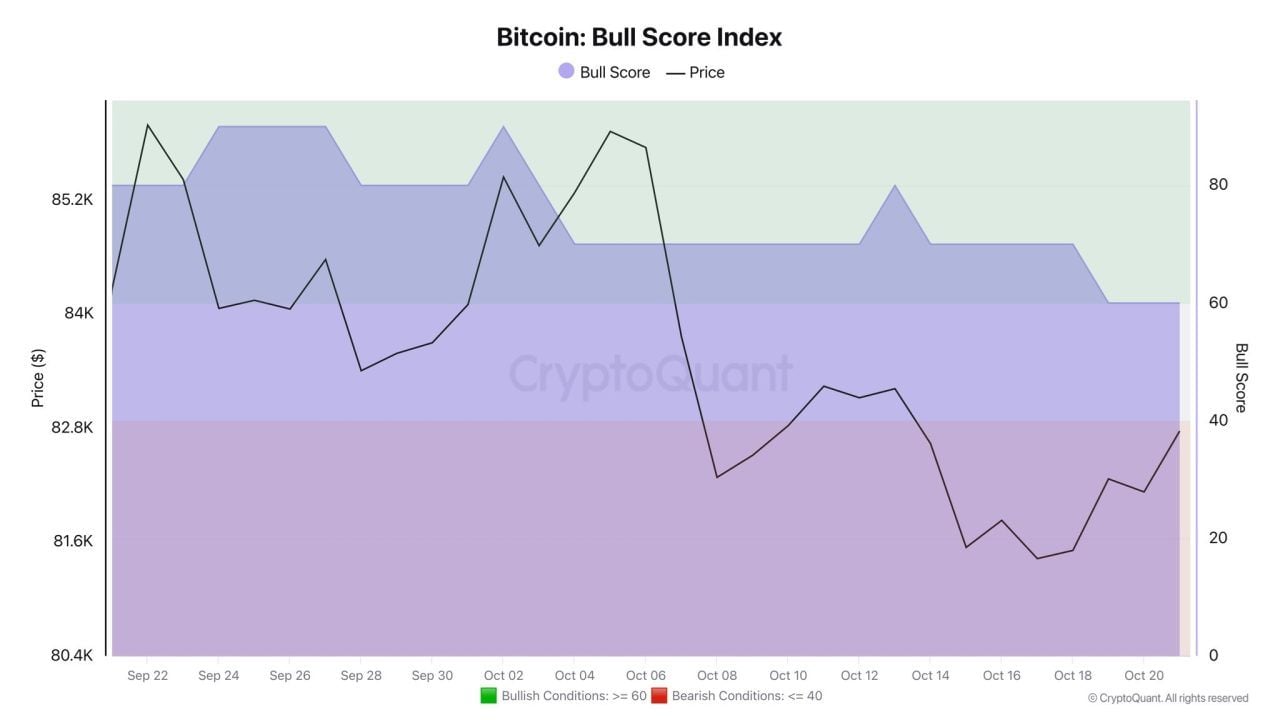
“Since late September, the Bull Score Index has fallen from 80 to 60, signaling a slight slowdown in the trend.”
Know when your coins move
Alerts, real-time prices, and market news — all in one app
Point your phone camera to install
4.8 based on 40K reviews in the App Store and Google Play
The index combines 10 indicators covering demand, investor profitability, network activity, and liquidity to assess the market environment. Its earlier increase from 30 to 80 in August reflected eight components turning bullish. That improvement accompanied a price recovery, with spot and futures demand rising together for the first time since early October 2025.
The assessment included a condition for continued positive momentum. The analyst noted:
“Even so, as long as it stays above 60, the overall momentum remains positive.”
Bitcoin’s Bull Score Index declined to 60 during the period shown. Source: Cryptoquant, shared by Darkfost.
Liquidity and Demand Remain Obstacles
Short-term holders, abbreviated as STHs, are among the groups whose profitability the analyst identified as a weakness. This category commonly refers to coins held for fewer than 155 days, a threshold used in Glassnode’s holder classification methodology.
The analyst identified three constraints:
“The main weak points are the lack of incoming liquidity, the growth in bitcoin demand, and the lack of sustained profitability among STHs in particular.”
Buying activity earlier in the recovery varied substantially across wallet sizes, with larger holders accumulating while smaller wallets reduced their balances. Wallets holding at least 100 $BTC added approximately 60,000 bitcoin during August. Over the same period, wallets with between 1 and 100 $BTC sold roughly 33,000 $BTC, while those below 1 $BTC shed about 14,000 $BTC.
An Oct. 13 analysis of large-holder activity by Cryptoquant placed the Bull Score Index at 80 after a September peak of 90. Researchers described an early bull market in which large investors typically establish positions before retail demand arrives later in the uptrend.
Holder Profitability Shapes the Recovery
Investor profitability also features in broader assessments of how $BTC’s market structure is changing as institutional ownership expands. In September, Cryptoquant founder and CEO Ki Young Ju linked moderating market extremes to a larger capital base. His analysis cited rising realized capitalization, which he interpreted as fresh capital entering the market, among the signals supporting his cycle outlook.
Sustained price trends, liquidity, and investor participation help characterize bull and bear market dynamics. Ju’s outlook addresses how institutional ownership could moderate gains and losses across a cycle. Darkfost’s latest comments focus on the immediate improvements needed to support another advance.
The analyst concluded:
“These three conditions still need to improve further before bitcoin can make more progress.”

 news.bitcoin.com