Luke Dashjr Proposes Zero Bitcoin Subsidies for 30 Days to Challenge Profit-Driven Miners
crypto-economy.com
10 September 2026 21:48, UTC
Luke Dashjr proposes temporarily eliminating the Bitcoin block subsidy for about 30 days, leaving miners dependent on transaction fees.
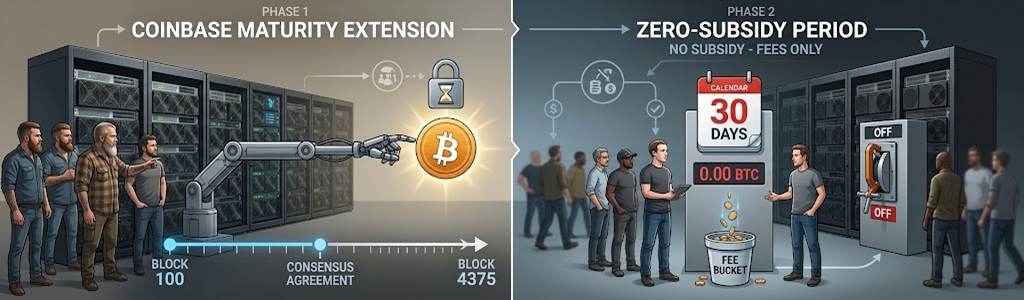
An alternative would extend coinbase maturity from 100 to 4,375 blocks, delaying miners’ access to newly mined $BTC.
The proposals remain preliminary and would require broad consensus, technical implementation, and a clear activation process before affecting Bitcoin’s network rules.
Luke Dashjr has proposed temporarily setting Bitcoin’s block subsidy to zero for 30 days, arguing that a fee-only period could pressure miners that prioritize short-term profit over network decentralization. He also suggested extending coinbase maturity to roughly one month as an alternative.
The Bitcoin Subsidy proposal, shared on September 10, 2026, is not a finalized consensus change. Dashjr said both ideas are temporary, while activation rules and implementation details remain unspecified.
Know when your coins move
Alerts, real-time prices, and market news — all in one app
Point your phone camera to install
4.8 based on 40K reviews in the App Store and Google Play
Mined bitcoins are unspendable for their first 100 blocks. There has been proposals to either delay spending them for 4375 blocks (~a month), or to zero the block subsidy for a month (so miners only get paid fees and nothing more).
The motive here is to deter a large batch of…
— Luke Dashjr (@LukeDashjr) September 10, 2026
Luke Dashjr’s Bitcoin Subsidy Proposal
Dashjr described two possible changes. The first would extend the existing 100-block coinbase maturity period to 4,375 blocks, keeping the subsidy intact while delaying when miners can spend it. At Bitcoin’s ten-minute target, that equals about 30 days.
The second option would set the block subsidy to zero for approximately one month, leaving miners dependent on transaction fees. Bitcoin currently pays a 3.125 $BTC subsidy per block following the April 2024 halving, with the next halving scheduled around block 1,050,000.
A 30-day zero-subsidy period would affect roughly 4,320 blocks and temporarily defer about 13,500 $BTC of scheduled issuance. It would not automatically reduce Bitcoin’s 21 million supply limit because the proposal concerns issuance timing rather than permanently deleting future rewards.
Why Mining Economics Are Central
Dashjr’s argument focuses on mining decentralization. Bitcoin miners receive newly issued $BTC and transaction fees, while halvings progressively reduce the subsidy. Over time, fees are expected to become increasingly important to network security.
A month without subsidy could pressure operators with high electricity costs or heavy debt, while miners with efficient infrastructure and lower expenses could gain a relative economic advantage. That makes the proposal both a decentralization debate and a test of Bitcoin’s incentive structure.
The alternative maturity extension would be less disruptive to issuance but would increase miners’ working-capital requirements. Bitcoin already prevents coinbase rewards from being spent for 100 blocks, helping protect against reorganizations that can invalidate recently mined rewards.
Dashjr has not specified a BIP number, activation threshold, software release, or exact method for measuring the proposed month. Any consensus-level change would require broad agreement across miners, node operators, developers, and businesses.

 crypto-economy.com