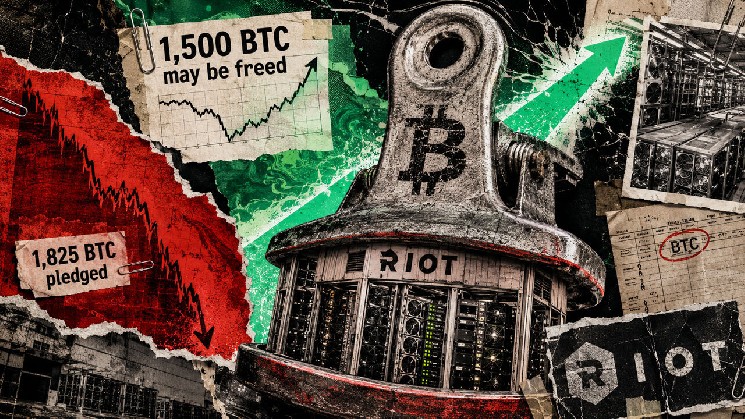
That level is below the release line in two of the three schedules written into Riot's loan. CryptoSlate calculates that the rally could place between 1,159 $BTC and 1,547 $BTC above the amount needed to reset the facility, depending on which schedule applies. The strictest schedule allows no release near $78,000.
Riot hasn't disclosed a current release request, and its filings don't establish which schedule Coinbase is using. The calculation shows that Bitcoin's price can alter how much of a miner's treasury is available long before its reported $BTC total moves.
Riot's loan can send Bitcoin in both directions
Loan-to-value, or LTV, is simply the amount Riot owes divided by the market value of the Bitcoin securing it. Using a $78,000 reference price, the math is $200 million divided by $454 million, or about 44.1%.
A lower ratio gives Coinbase a wider cushion. Riot still owes the same $200 million, but each pledged coin now supports more of that debt. The loan doesn't have to be repaid for some added collateral to become eligible for return.
Riot's April credit agreement contains three schedules. The applicable version depends on the collateral's market value relative to the benchmark set by the contract.
The release column is the important part for the rally. If Riot's actual LTV stays at or below the applicable level for at least two consecutive days, the company can send Coinbase a written request. No blocking event can be active. Coinbase then runs its own real-time calculation and, if the ratio still qualifies, directs the custodian to return enough added collateral to bring the loan back to the reset LTV.
Simply put, Riot doesn't have to repay the $200 million to get some Bitcoin back. The same debt can sit on fewer coins once every coin is worth more.
The agreement refers specifically to Bitcoin deposited as additional collateral. Riot's public filing doesn't divide the 5,821 $BTC balance between the original collateral and later additions, so the amount carrying that contractual label still needs confirmation.
The movement has already worked in both directions. The February decline forced 1,825 $BTC into the collateral account. An April refinancing released 1,544 $BTC, leaving 4,258 pledged. By June 30, the balance was back at 5,821 $BTC. The quarterly filing doesn't explain that increase, so it can't be assigned to another collateral demand.
Riot reported 11,380 $BTC in total at quarter-end. Slightly more than half was securing the Coinbase facility, leaving 5,559 $BTC outside that collateral account.
Near $78,000, the range runs from zero to 1,547 $BTC
Under the standard schedule, Riot's estimated 44.1% LTV is comfortably below the 50% release line. A release would return the facility to its 60% reset level, which requires $333.3 million of collateral. At $78,000 per $BTC, that equals about 4,274 $BTC. The gap between 5,821 $BTC and 4,274 $BTC is roughly 1,547 $BTC worth $120.7 million.
The first deleveraging schedule is tighter. Its release line is 45%, and its reset level is 55%. Supporting $200 million at that ratio requires about 4,662 $BTC at the same reference price, leaving roughly 1,159 $BTC worth $90.4 million above the reset amount.
The second deleveraging schedule requires LTV to reach 40%. Riot's estimated 44.1% doesn't qualify. Holding the disclosed $BTC and loan balances constant, Bitcoin would need to trade near $85,896 for the ratio to touch that line.
Every figure in the table is a CryptoSlate calculation based on a static snapshot. It assumes the 5,821 $BTC collateral balance and $200 million principal haven't moved, and it uses $78,000 as a proxy for the contract price. Coinbase chooses its own price from transactions on a New York-regulated platform.
The price line alone doesn't complete a release. The agreement also requires two consecutive days below the relevant LTV, a formal request, and no active blocking event. Bitcoin only moved above the first-deleveraging price line during the current rally, so one session near $78,000 can't satisfy the timing condition by itself.
The standard estimate would move Riot's unrestricted pool from 5,559 $BTC to about 7,106 $BTC under the quarter-end snapshot. The first-deleveraging estimate would take it to about 6,718 $BTC. Riot's total holdings would stay the same in either case, while the amount available outside the lender account would expand by roughly 21% to 28%.
The $90 million to $121 million is the reference value of Bitcoin that could move from restricted collateral into a pool Riot can deploy elsewhere.
MARA makes the same loan structure much larger
MARA shows how large Bitcoin-backed miner financing has become. On Aug. 4, the company pledged 18,750 $BTC across Coinbase and Two Prime facilities. The two agreements supplied $600 million of new borrowing and folded an existing $150 million Coinbase balance into the package, taking the related facilities to $750 million.
MARA valued the opening collateral near $1.2 billion. At $78,000, the same 18,750 $BTC would be worth about $1.46 billion, adding roughly $262.5 million of market value around the debt. The simple principal-to-collateral ratio would move from 62.5% to about 51.3%, assuming all $750 million is outstanding and the pledged balance hasn't moved.
MARA hasn't published enough of the release details to calculate how many coins it could retrieve. Riot supplies the detailed contract, while MARA supplies the scale. CryptoSlate's earlier review of MARA's financing also found that the company had pledged a large part of its treasury without publishing a comparable release ladder.
Riot's pledged $BTC gained about $113.4 million in market value between its June 30 reference price of $58,527 and the $78,000 reference used here. Add MARA's $262.5 million, measured from its own disclosed starting value, and the rally has added about $376 million to the two miners' pledged Bitcoin. That sum is additional market value inside lender-controlled collateral, separate from cash or borrowing capacity.
The extra room has real value because Riot now has more demands on its balance sheet. Its second-quarter results included $113.7 million of mining revenue and $23.2 million from data centers. In August, Riot signed a 20-year lease to build 191 MW for an AI tenant, then disclosed a separate facility of up to $573 million for equipment and project costs.
A returned coin would give Riot another asset it can deploy while that construction advances. Management could keep the $BTC available or use it in another financing arrangement. A sale is also possible, though the filings provide no evidence that one is planned.
This makes Bitcoin-backed miner debt procyclical. A falling Bitcoin price made Riot's loan consume more of its treasury when the asset and mining economics were weaker. The rally lets the same debt rest on fewer coins, giving the company more financial room when its collateral is stronger.
For Bitcoin's supply, the result comes before any sale appears. A miner can report the same total treasury while more than 1,000 $BTC move between an available account and a lender-controlled account. That movement can reduce the need to raise cash elsewhere or make more Bitcoin available for another purpose.
Riot reported the same 11,380 $BTC on June 30, not disclosing whether the 5,821 coins were pledged or available. Its loan agreement determines how much of that treasury the company can actually deploy, and Bitcoin's rally has pushed the calculation toward the release side of the contract.

 cryptoslate.com