How the permissionless consensus construction removes the beacon
A 2024 construction by Ball and collaborators combined proofs of work with fine-grained complexity assumptions. Its model also gave every participant access to a beacon that delivered a fresh public random value at regular intervals.
The new paper says it removes that recurring service with d-wise independent distributed samplers. In plain terms, the samplers are designed to keep multiple executions secure at the same time, without requiring the beacon to keep producing new public randomness.
For this permissionless consensus construction, the replacement still needs shared setup. Participants use a common random string, although the abstract says it does not need to be structured or sampled precisely when the protocol begins. The sampler constructions also rely on the decisional Diffie-Hellman and learning with errors assumptions.
The authors combine those samplers with proofs of work grounded in fine-grained complexity to build multi-verifier signatures of work, which the consensus protocol uses as a modular component. Removing the beacon therefore changes one dependency in the earlier design rather than eliminating cryptographic assumptions.
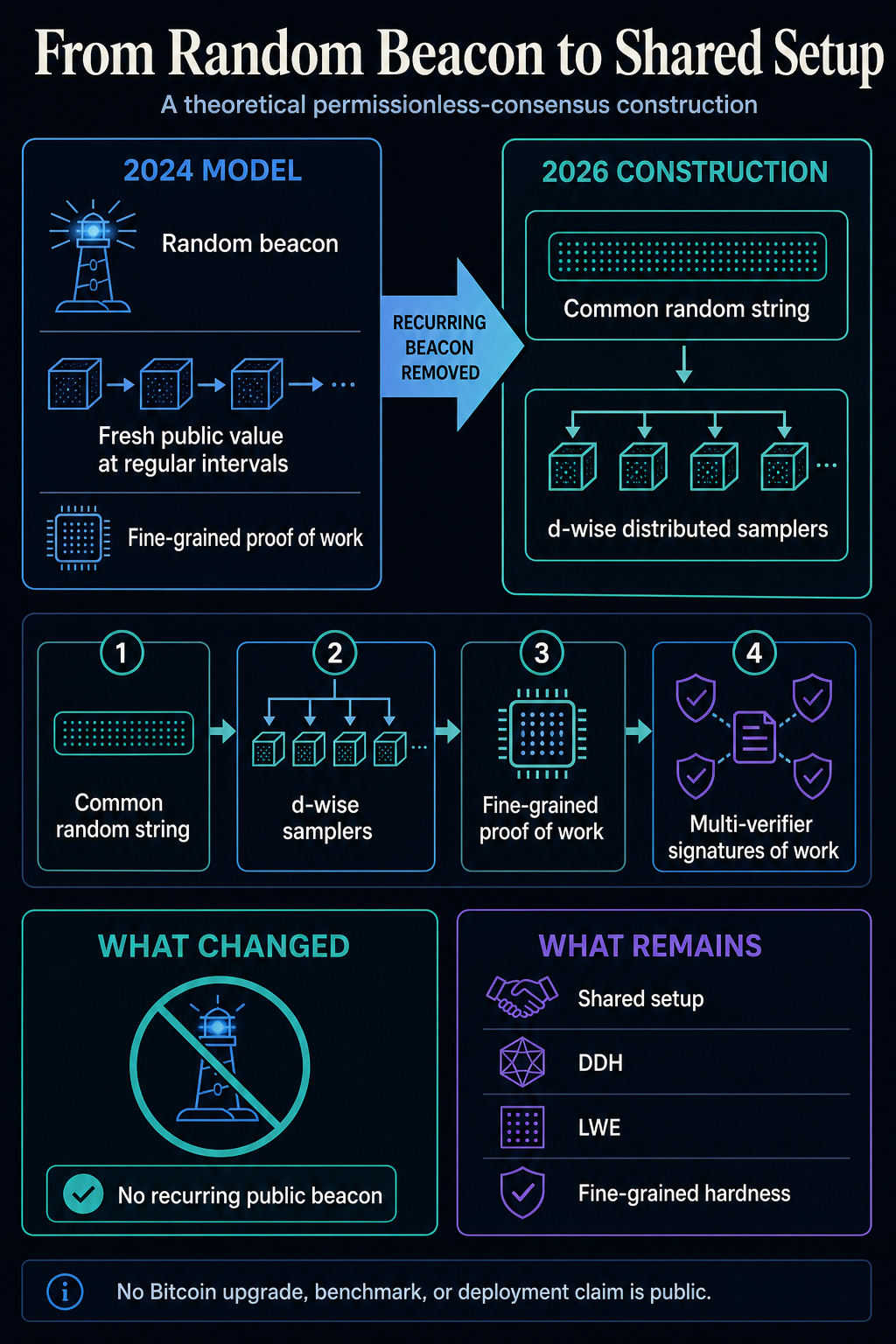
The result remains theoretical for permissionless consensus. The public material does not state the 2026 protocol’s numerical corruption threshold, exact synchrony and communication conditions, concrete costs, or benchmark performance. Details from the 2024 construction cannot be assumed to carry forward, so the available evidence does not support comparisons with Bitcoin’s security model or claims that the protocol is ready for deployment.
The accepted manuscript remains embargoed until Aug. 20 at 00:00 BST, according to the Edinburgh record. What is public supports a specific advance: a recurring randomness beacon is replaced by distributed samplers and a common random string, while DDH, LWE, and fine-grained proof-of-work assumptions remain part of the construction.

 cryptoslate.com