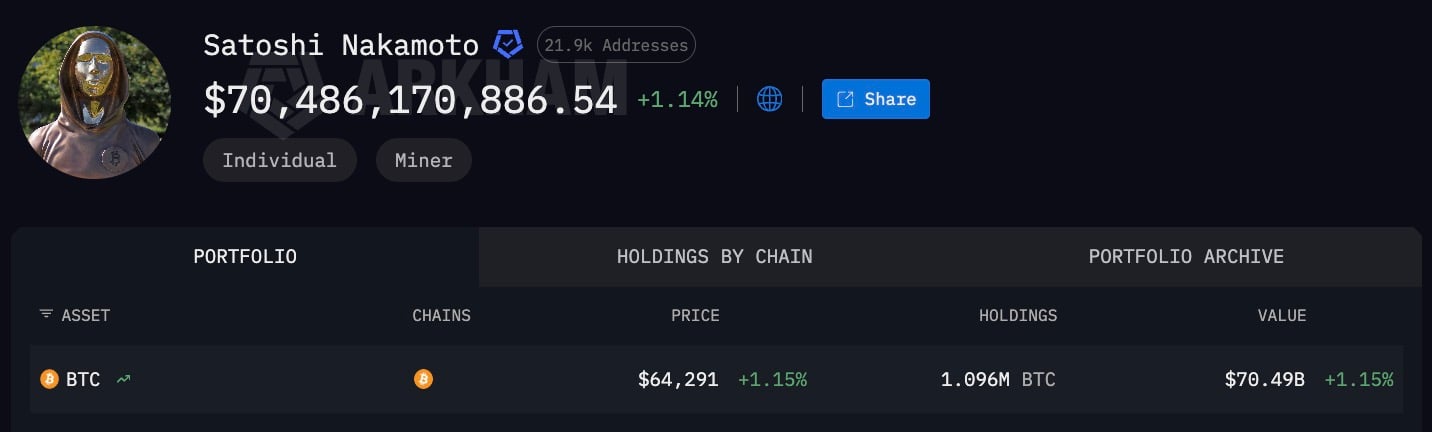
The balance of Bitcoin creator Satoshi Nakamoto has once again become the focus of the global crypto community after a viral claim that this fortune could be seized by randomly guessing a private key triggered a new wave of discussion on X.
According to Arkham Intelligence, the developer's wallets hold 1.096 million BTC, worth approximately $70.43 billion at the current price of $64,245. The debate emerged from an observation that the hypothetical possibility of obtaining $70 billion simply by guessing 24 words in a row "seems like an insane" opportunity.
Technical experts were quick to dismiss this claim, as according to researchers, even with computing power capable of generating one trillion combinations per second, finding a specific 24-word seed phrase with a 50% probability of success would take approximately 1.8 octodecillion years.
Know when your coins move
Alerts, real-time prices, and market news — all in one app
4.8 based on 40K reviews in the App Store and Google Play
This figure vastly exceeds the age of the universe, which is estimated at 13.8 billion years, making the network's mathematical protection effectively absolute.
Combined value of Satoshi's Bitcoin wallets estimated based on Patoshi pattern, Source: Arkham Intelligence
However, there is also a fundamental technical misconception among the general public — Satoshi Nakamoto's fortune cannot be accessed using a single seed phrase in the first place.
The modern BIP-39 mnemonic phrase standard was developed long after Bitcoin's creator had stepped away from the project. In 2009–2010, keys were generated differently, and Nakamoto's coins were distributed across more than 22,000 independent old-style P2PK, or Pay-to-Public-Key, addresses.
A potential attacker would therefore have to compromise thousands of wallets individually. Given that these assets have remained untouched for more than 15 years, even the smallest movement could trigger a tectonic shift in the market.
Why industry veterans favor a Bitcoin-only approach
Amid the debate over the network's cryptographic security, software developers and industry veterans also raised the issue of secure self-custody. Adam Back, the inventor of the Hashcash system, joined the discussion.
According to Back, hardware wallet manufacturers integrate support for thousands of altcoins in pursuit of marketing trends, even though most of these assets lack Bitcoin's advanced security mechanisms, such as multisignature schemes and Schnorr signatures. This forces developers to build architectures around the "lowest common denominator."
Back emphasized that the minimalist and isolated design of Bitcoin-only devices eliminates such vulnerabilities, providing dedicated protection for the Bitcoin protocol without exposing users to third-party technological risks.

 u.today