Strategy’s $4.6 billion cash buffer gives it almost 3 years before Bitcoin sales create real stress
cryptoslate.com
12 August 2026 05:14, UTC
Strategy said it held 840,447 $BTC as of Aug. 9 and has begun treating its Bitcoin reserve as a source of balance-sheet flexibility.
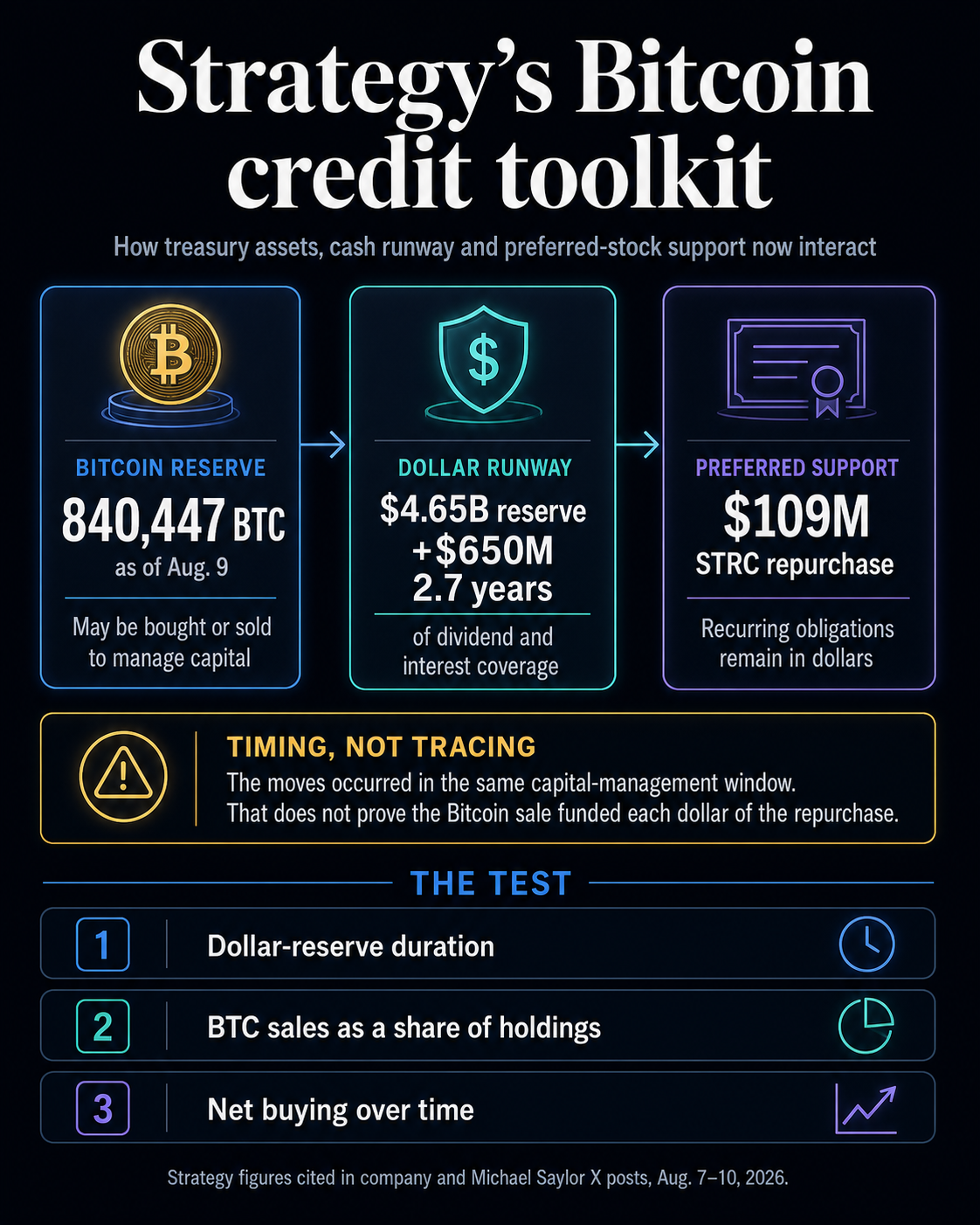
Michael Saylor said Strategy sold $108 million in Bitcoin and $653 million in MSTR shares to increase its dollar reserve by $650 million, and repurchased $109 million of STRC, its variable-rate preferred stock.
The timing aligns the three moves without proving that each dollar from the Bitcoin sale directly funded the repurchase. Strategy is also willing to convert a small portion of its $BTC into liquidity while supporting a capital structure whose dividends and interest are measured in dollars.
Know when your coins move
Alerts, real-time prices, and market news — all in one app
Point your phone camera to install
4.8 based on 40K reviews in the App Store and Google Play
The success of Strategy's Bitcoin experiment now depends on preserving enough flexibility to meet dollar obligations while retaining control over when and how much Bitcoin it sells.
Related Reading
Bitcoin treasury companies said they'd never sell – the bear market changed that fast
As debt, dividends, and buybacks enter the picture, some companies are starting to treat Bitcoin less like a sacred reserve and more like liquidity.
May 7, 2026·Gino Matos
Bitcoin becomes a managed reserve
Saylor said in an Aug. 3 post that his personal “never sell” position did not bind Strategy, a public company that has disclosed since 2020 that it may buy or sell Bitcoin to manage capital.
A Bitcoin holder can measure success solely by the number of coins retained, while Strategy also tracks how long its cash can cover dividends and interest across its capital structure.
On Aug. 10, Saylor said the company’s dollar reserve had increased by $650 million to $4.65 billion. Strategy also repurchased $109 million of STRC and extended what Saylor called its dollar duration by 143 days to 2.7 years. The same post put its Bitcoin reserve at 840,447 $BTC as of Aug. 9.
The update followed an Aug. 7 company post that placed coverage at 2.3 years, already above Strategy’s one-year minimum. Taken together, the posts show management lengthening its dollar runway while continuing to hold a large $BTC reserve.
Strategy pairs an 840,447 $BTC reserve with $4.65 billion in dollar reserves and a $109 million STRC repurchase.
Related Reading
Strategy’s $10 billion STRC Bitcoin yield product sinks to yearly low as market demands higher payout
STRC was built to trade near $100, but its drop toward $92 is testing one of Michael Saylor’s key funding channels.
Jun 17, 2026·Oluwapelumi Adejumo
Bull Theory described the latest Bitcoin sale and similarly sized STRC repurchase as a matched transaction. The company’s primary post confirms the repurchase, the reserve increase, and the longer duration, while leaving the exact funding path unspecified. Bitcoin sales, dollar reserves and preferred-stock support now sit inside the same treasury toolkit.
QR Capital co-founder João Paulo Mayall estimated in an Aug. 11 thread that Strategy sold $213 million of Bitcoin over two weeks, about 0.4% of its position. He interpreted the sales as small, voluntary steps to protect liabilities rather than a panic response.
Pete Rizzo also attributed comments to Saylor that framed the transactions as a demonstration that Strategy could sell $BTC without breaking the market while strengthening the case for STRC’s credit profile.
Related Reading
MSTR jumps after Strategy says it may sell more Bitcoin to fund dividends and buybacks
MSTR rose after the company unveiled a plan to defend its capital structure with cash reserves, higher dividends and possible Bitcoin sales.
Jun 29, 2026·Oluwapelumi Adejumo
Strategy’s position remains that it intends to be a net buyer of Bitcoin. Selective sales can coexist with long-term net accumulation when dollars improve reserve coverage or when preferred-stock support improves.
The core question is whether sales remain a choice made from strength.
Voluntary selling is the real test
A $4.65 billion dollar-denominated reserve and a stated duration of 2.7 years give Strategy time. They create distance between a Bitcoin drawdown and pressure on the company’s dividend and interest coverage.
A deeper or prolonged Bitcoin decline could make additional liquidity more valuable, while expanding sales would reduce the asset reserve supporting the broader strategy. The significance would change if small, voluntary transactions grew into sales driven by shrinking dollar coverage.
Mayall’s estimate of $213 million over two weeks represented only 0.4% of the position he cited. The scale supports his voluntary-management interpretation, while future transactions could be larger.
Strategy common shareholders are exposed to how well management balances $BTC ownership with the demands of its capital structure.
STRC holders are exposed to the durability of the dollar reserve and the company’s ability to keep supporting the preferred security. Companies studying the Bitcoin-treasury model should also notice that the design problem spans both asset acquisition and obligations management.
Three measures will show whether the model is holding: the size and duration of the dollar reserve, the scale of Bitcoin sales relative to total holdings, and whether Strategy remains a net buyer over time.
At its current scale, the latest sale looks like a controlled test of whether Bitcoin can support corporate credit while the company continues accumulating over time. The experiment succeeds only while Strategy controls the timing of its sales.

 cryptoslate.com