
 coindesk.com
Whether bitcoin $BTC$65,029.32 works better as a store of value or a payments mechanism can be debated. But one of its core appeals, its radically free-market, permissionless design, is not. The BIP-110 saga put that design on full display.
The Bitcoin Improvement Proposal (BIP)-110 started as a proposal to limit non-financial data such as Ordinals inscriptions, seen by some as spam, to free up blockchain space. The proposal was debated in an open forum by the developer community, failed to secure broad support and was effectively denied by distributed consensus. The key here is distributed consensus: No regulator or central committee banned it.
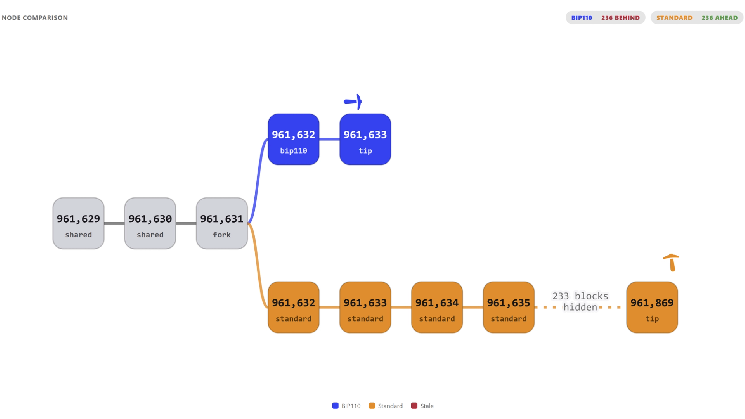
The free-market story continues, though. Supporters also got to exercise their right to form their own blockchain, forked or split from the original Bitcoin. They did so at block 961,632 in an attempt to implement their preferred rules in the newer version in a voluntary move not forced by any regulator or middlemen.
Miners quickly chose the more profitable version, the original Bitcoin. The new chain, which inherited Bitcoin’s massive mining difficulty, attracted only a tiny fraction of hashpower and produced just two blocks before grinding to a halt. Meanwhile, the original Bitcoin network continued uninterrupted, retaining virtually all activity, liquidity and security.
“Bitcoin worked exactly as designed,” Michael Saylor, the founder of $BTC-holding company Strategy (MSTR), said on X.
Contrast that with the so-called free-market economies of the world. Falling corporate profitability should trigger cost-cutting and layoffs, but electoral politics often leads governments to block that adjustment, resulting in prolonged industrial sickness. Or, when high inflation hits, governments issue subsidies that artificially prop up demand, fueling even higher inflation. The usual free-market response of reduced consumption and price discipline never gets a chance to play out.
Bitcoin’s takeaway for the real economy is clear. The free market economy works when you let it run its course.
As for the coin’s spot price, it continues to trade near $65,000 alongside a continued demand for downside protection. This week’s U.S. inflation data is expected to influence the price trajectory.
Stay alert!
Read more: For analysis of today's activity in altcoins and derivatives, see Crypto Markets Today . For a comprehensive list of events this week, see CoinDesk's "Crypto Week Ahead."



