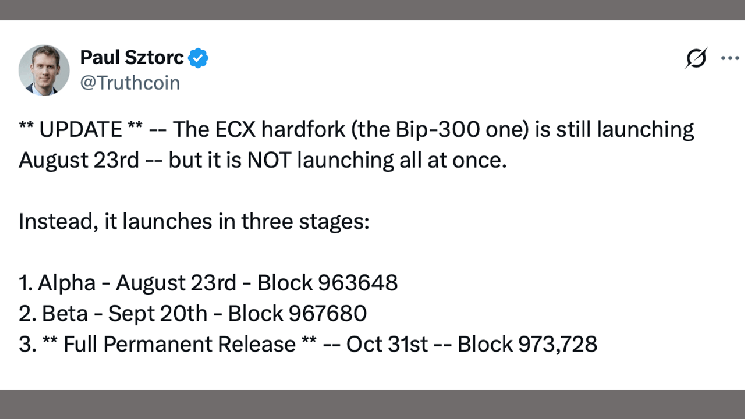
Why Wait? Sztorc Points to Software Risk and Price Discovery
Sztorc listed several reasons for spacing out the launch. Among them: giving the project time to work through what he called “LLM bug chaos,” letting the market settle on an early price for ECX before the network’s mining difficulty locks in, and giving traders something to test and speculate on ahead of the final release.
He also framed the staged approach as a safety net. “Gives us cover if there is some kind of big problem or disaster,” he wrote, adding that the format functions as a live demonstration for people asking whether the new chain will work as intended. The move comes at a time where crypto developers have been scrambling to protect projects from bugs discovered faster by artificial intelligence (AI) models.
Replay Protection Stays Optional, and Sztorc Warns Users
One detail carries over from the original plan: replay protection, the mechanism that keeps a transaction from executing on both the Bitcoin and ECX chains at once, remains opt-in rather than automatic. Official ECX wallet software will apply the protection and alert users before a transaction goes through.
Sztorc was pretty direct about what happens to anyone who ignores that warning. “If you ignore us, we will replay your txns,” he wrote, meaning ECX will follow a user’s outgoing Bitcoin to its new owner unless the split is done intentionally.
Full Launch Lands on a Symbolic Date
The Oct. 31 mainnet date is not arbitrary. It falls on Halloween, exactly on the 18th anniversary of the publication of Satoshi Nakamoto’s Bitcoin white paper, the document that first described Bitcoin’s design in 2008.
What Comes Next
Sztorc gave holders and exchanges a specific runway. “You have 12 weeks to practice,” he wrote, referring to the stretch between the Aug. 23 alpha and the Oct. 31 full release.
Between now and then, bitcoin holders and exchanges face a set of practical decisions: whether to run the official wallet software to separate their BTC and ECX holdings, how exchanges plan to credit customers with the new asset, and how the network’s mining difficulty behaves once the alpha and beta phases begin generating real activity. Each of the three block heights, 963648 in August, 967680 in September and 973728 in October, will mark the next checkpoints to watch.
Sztorc’s announcement comes as Bitcoin faces another fork of a different color, BIP-110, that is estimated to occur at some point today.

 news.bitcoin.com