
 coindesk.com
The fallout from the Coldcard security breach is now surfacing on-chain.
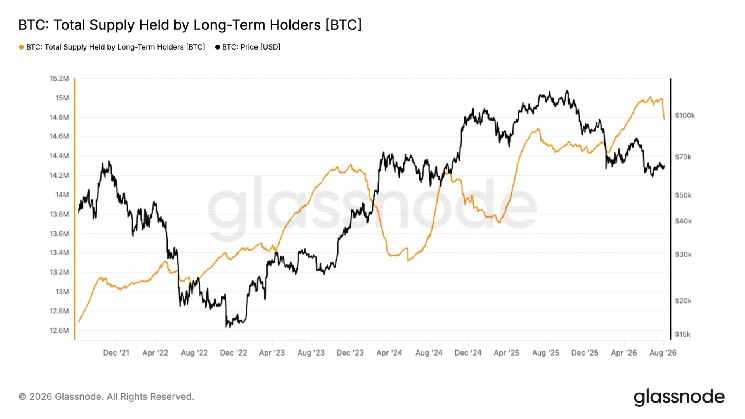
According to Glassnode data, roughly 210,000 $BTC have moved out of long-term holder (LTH) wallets over the past week, the largest decline since December 2024, when bitcoin approached $100,000 for the first time.
Glassnode classifies long-term holders, or LTHs, as entities whose coins have remained dormant for approximately 155 days, or just over five months. This cohort is often considered the market’s “smart money” because its members tend to hold through short-term volatility.
Long-term holder supply now stands at approximately 14.7 million $BTC. Before the Coldcard incident, it was just under 15 million $BTC, close to an all-time high.
Historically, heavy spending by long-term holders has coincided with periods of market strength or tops. Similar waves of distribution occurred around the market peaks of March 2021, March 2024 and December 2024, as experienced holders took profits into rising demand.
This time, however, the movement is occurring near the lows. Bitcoin is trading around $64,000, roughly 50% below its October all-time high.
This type of spending from this cohort is not profit-taking, but a migration in how bitcoin is being stored following the Coldcard incident. In addition, bitcoin did not make new lows following the hack.
The breach stemmed from weak randomness in affected Coldcard firmware, which allowed attackers to reconstruct some users’ wallet recovery phrases and drain their bitcoin. Thousands of addresses were affected, with estimated losses reaching as much as $114 million. Coldcard subsequently urged affected users to generate new wallets and move their funds because updating the firmware alone cannot secure keys that may already be compromised, according to CoinDesk.
Some of the decline in long-term holder supply could therefore reflect users transferring bitcoin into newly generated wallets with stronger custody arrangements. Other holders may be moving their assets to regulated custodians or spot bitcoin ETFs as they reconsider the risks of self-custody.
ETF flows offer some support, U.S. spot bitcoin ETFs attracted approximately $754 million over the past week, with BlackRock’s iShares Bitcoin Trust (IBIT), accounting for most of those inflows.
The crucial distinction is that on-chain movement does not necessarily mean selling. In this case, the decline in long-term holder supply may be capturing a broader migration in bitcoin custody rather than a straightforward loss of conviction.