
 coindesk.com
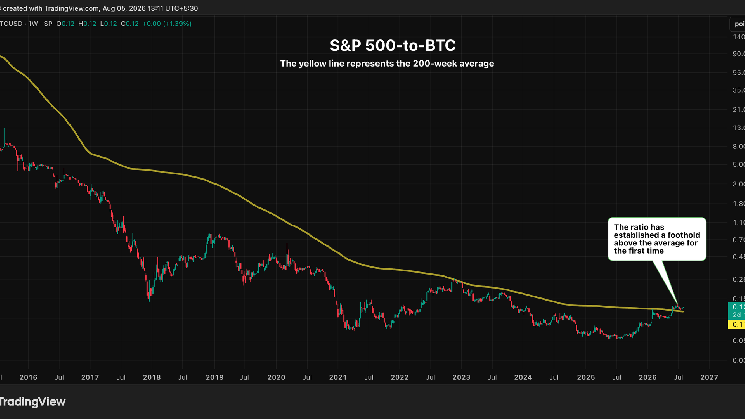
For years, bitcoin $BTC$64,196.50 trounced stocks and most other assets, and supporters pointed to that outperformance as proof it was the best store of value around. Now, one chart suggests that edge may be fading.
That chart is the S&P 500-to-bitcoin ratio. It measures how much bitcoin it takes to buy the index. Today it takes roughly 0.12 $BTC, versus more than 300 $BTC in 2012. The ratio moved largely lower in a steep downtrend since $BTC’s inception in 2010, with the 200-week simple moving average, a barometer of long-term trend, acting like a ceiling holding a ball underwater. There were brief instances of stocks outperforming $BTC, lifting the ratio, but never beyond that average.
Until now.
In recent weeks, the ratio hasn't just topped the 200-week average, it's established a firm foothold above it, clearly visible on the far right of the chart above. It's not isolated to the S&P, either. The Nasdaq/$BTC ratio is showing the same first-ever crossover above the 200-week average.
That’s exactly why this chart may be painful for bulls. The fact that the break above the key average has held and hasn’t reversed quickly suggests bitcoin’s era of outsized rallies versus equities has likely ended. If that proves true, the “superior store of value” narrative could start to lose its edge.
For macro traders, the stocks-to-bitcoin ratio that no longer moves decisively in favor of $BTC undercuts the cryptocurrency’s appeal as an asset capable of single-handedly lifting a portfolio higher. It also cuts against the more aggressive bullish forecasts for the next bull cycle, predicting prices at $300,000 or higher. These largely extrapolate from prior cycles, when bitcoin's small size let it multiply many times over in months.
That brings us to a more constructive read of the situation and it’s about bitcoin growing up. Moonshot rallies are a young-asset phenomenon when liquidity is thin and a handful of buyers can move the small market 10x in a year. That's harder to repeat once an asset is worth over a trillion dollars and trades alongside spot ETFs, options, futures and structured products.
In other words, the same plumbing that has made bitcoin easier to buy has also made it harder to move violently.