Bitcoin holds $65k as US debt hits $39.5 trillion creating Bitcoin’s next liquidity test for August 3
cryptoslate.com
21 July 2026 13:57, UTC
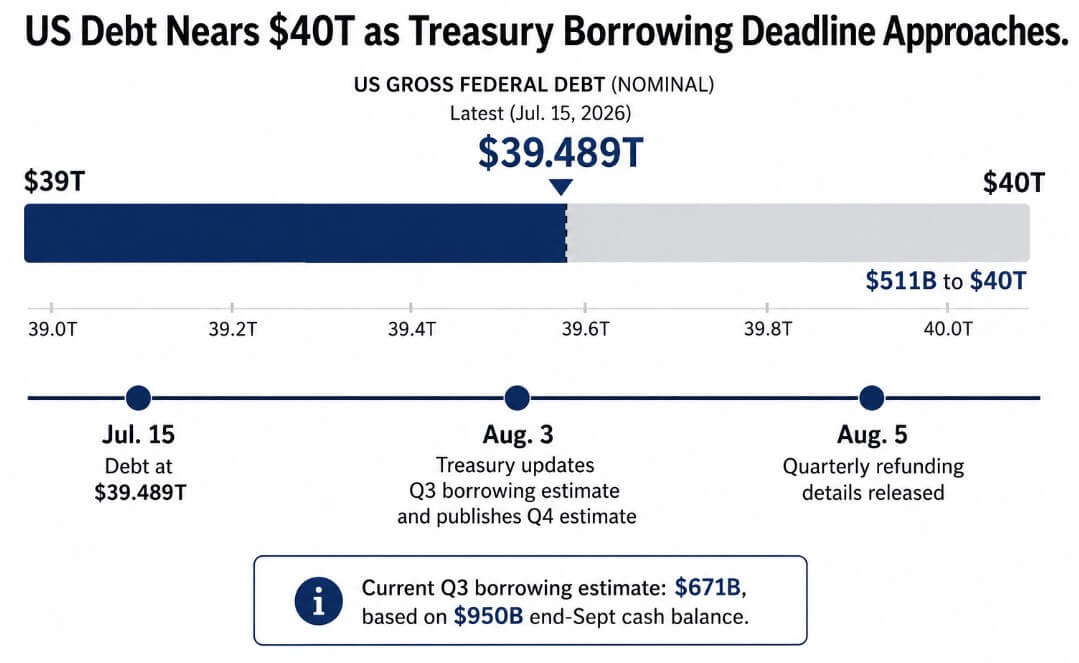
US gross federal debt reached $39.489 trillion on July 15, leaving roughly $511 billion before the $40 trillion threshold, and this debt total strengthens Bitcoin's fixed-supply argument.
Treasury currently expects to borrow $671 billion in privately held net marketable debt during the July-to-September quarter, with the estimate built on a $950 billion end-of-September cash balance.
On Aug. 3, the department will revise the third-quarter figure and publish its first estimate for October through December, setting the expected borrowing total.
Know when your coins move
Alerts, real-time prices, and market news — all in one app
4.8 based on 40K reviews in the App Store and Google Play
The full quarterly refunding package arrives Aug. 5 with auction and financing details, showing how Treasury plans to distribute financing across bills, notes, bonds, floating-rate notes and inflation-protected securities.
A larger total can increase the volume private investors must absorb, and a heavier coupon mix can place more duration risk into the market.
The $39.489 trillion total records obligations already outstanding, and the borrowing estimate maps the government's next funding requirement. Gross debt also reflects maturities, intragovernmental flows, cash movements and Federal Reserve portfolio effects, which prevents a one-for-one mapping from the $671 billion estimate to the debt total.
US debt stood at $39.489 trillion on July 15, $511 billion below $40 trillion, before Treasury's Aug. 3 borrowing update.
Treasury supply reaches Bitcoin through yields
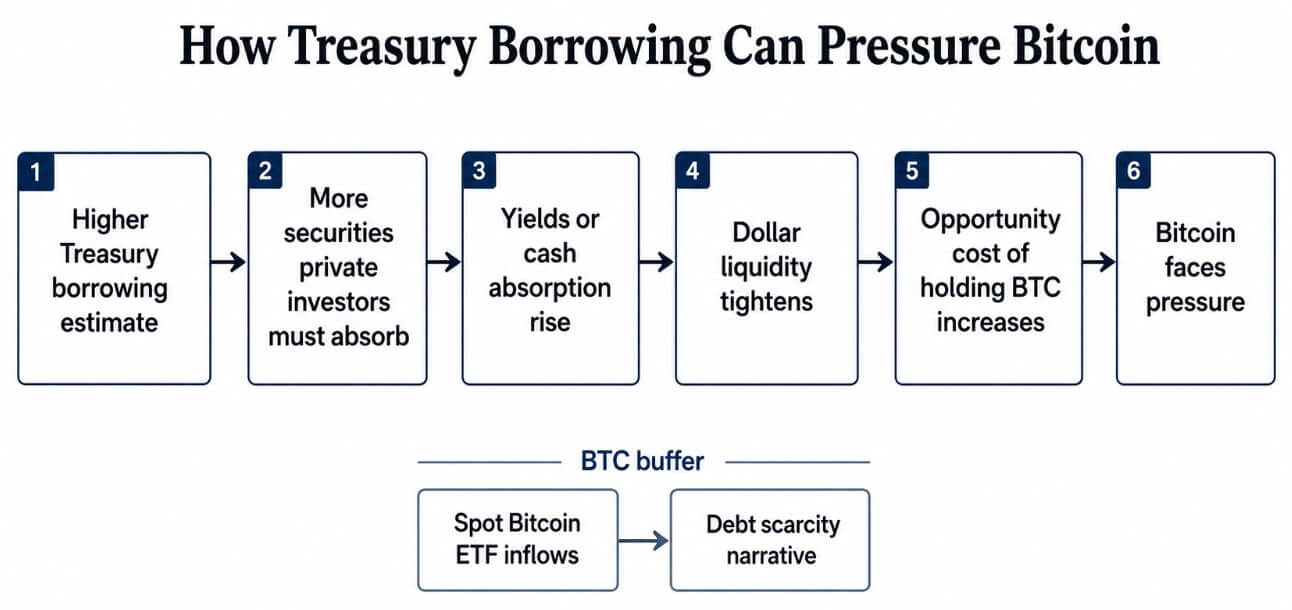
An upward borrowing revision can require investors to absorb more government securities. Buyers may demand higher yields, or they may fund purchases with cash drawn from deposits and other assets.
Federal Reserve research published in May found that a one-percentage-point increase in expected US debt relative to GDP adds about 2 to 3 basis points to the 10-year Treasury term premium.
Higher Treasury returns increase the opportunity cost of holding Bitcoin because $BTC pays a zero coupon, and a firmer dollar can add another constraint by making dollar liquidity more expensive across global markets.
Bitcoin entered the week near $65,000 with the 10-year Treasury yield around 4.60%, with reports noting that oil-linked inflation fears lifted the benchmark yield to 4.6% on July 20.
The latest official Federal Reserve close put the two-year yield at 4.16%, the 10-year at 4.57% and the 30-year at 5.09% on July 16. Those levels already offer investors a large contractual return across the curve, leaving Bitcoin more sensitive to any early-August yield increase.
Higher Treasury borrowing can tighten dollar liquidity and raise Bitcoin's opportunity cost, while ETF inflows and scarcity demand provide a buffer.
The Treasury General Account held nearly $795.98 billion on July 15, about $154 billion below the current $950 billion quarter-end assumption. Reaching that target through borrowing would accumulate additional cash in the Treasury's Federal Reserve account before government spending returns it to the banking system.
The funding source will shape the market effect because bills can draw on money-market cash, and longer-duration securities can draw on bank deposits or asset sales.
The Federal Reserve reported near-zero overnight reverse-repurchase usage on most days and about $3.1 trillion in reserves during the first half of 2026, reducing the stock of idle facility cash available to absorb bill issuance.
Bitcoin also has a direct demand buffer, with US-traded spot Bitcoin ETFs taking in a combined $500.2 million across four positive sessions from July 14 through July 17, reversing a $424.7 million outflow on July 13.
Continued fund demand could absorb part of the macro drag created by a higher borrowing estimate.
The early-August thresholds
In the bull case, Treasury keeps the third-quarter estimate at or below $671 billion, leaves the $950 billion cash target intact, and publishes a fourth-quarter requirement below market expectations.
A financing package that preserves demand across the curve could pull the 10-year yield lower and weaken the dollar.
Positive Bitcoin ETF flows would give $BTC a direct source of demand, allowing the $65,000 area to hold and the debt milestone to reinforce the scarcity thesis.
In the bear case, Treasury raises the third-quarter estimate, publishes a large fourth-quarter requirement, or increases the cash target. Larger coupon auction sizes on Aug. 5 could push term premiums and long yields higher, especially if investors demand more compensation for duration.
A stronger dollar and ETF redemptions would remove two supports from Bitcoin, exposing the rebound to a break below its recent range.
The Congressional Budget Office projects a $1.9 trillion federal deficit for fiscal 2026 and publicly held federal debt at 120% of GDP by 2036. Those figures sustain Bitcoin's long-horizon scarcity argument and set up repeated Treasury financing tests across future quarters.
Aug. 3 turns that long-run thesis into a near-term market event by connecting the debt record to the cost of financing it through yields, cash absorption and the dollar.
Bitcoin's defense of $65,000 will carry more weight if it survives a larger borrowing estimate and a higher Treasury curve.

 cryptoslate.com