
 ambcrypto.com

For the current macro-driven rally to turn into a bull rally, investor conviction will be the key factor.
From the macro perspective, Bitcoin’s reclaim of the $65k level came alongside a softer-than-expected CPI report, signaling that inflation is cooling.
Historically, this type of macro relief has acted as a bullish catalyst, as investors, particularly long-term holders, begin to position for easier monetary conditions. With CPI coming in weaker, Bitcoin’s rally clearly highlighted this shift in market sentiment.
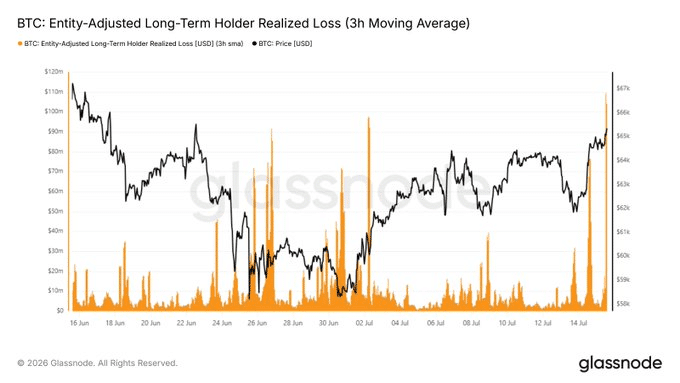
However, on-chain data suggests that long-term holders are still struggling to maintain their conviction. As $BTC pushes toward $66k, LTH realized loss volume is rising sharply.
This indicates that cycle-top buyers are using the relief rally as an exit opportunity, selling into strength instead of waiting for a full recovery.
Adding to the pressure, Glassnode recently highlighted another key signal.
According to the report, short-term holders who bought near the recent lows are now taking profit at volumes last seen around the May peak.
Together, these two forces are creating resistance for Bitcoin’s rally: Cycle-top buyers are reducing losses, while local-bottom buyers are locking in gains. With both groups selling into the same recovery, Bitcoin clearly needs stronger demand to absorb the supply.
What’s more, rising speculative liquidity around these key zones is fueling more friction for the rally. In short, it looks like Bitcoin [$BTC] is entering a high-stakes setup at a time when conviction is starting to fade.
Naturally, the question becomes: Is $BTC’s $65k breakout the start of a bull trend, or just another relief rally?
Bitcoin’s post-CPI rally faces a conviction test
After three straight quarters of downtrend, the CPI report clearly helped trigger a risk-on move.
From a technical standpoint, Bitcoin is up over 9% so far in Q3, marking its first green quarter after averaging nearly 20% losses across the previous three quarters. Against this backdrop, rising profit-taking is expected, as short-term holders look to secure gains after the strong recovery.
However, long-term hodlers realizing losses shows that this cohort is still not viewing $BTC’s recovery as the start of a new trend. Instead of “buying the dip,” some are using the bounce to reduce exposure.
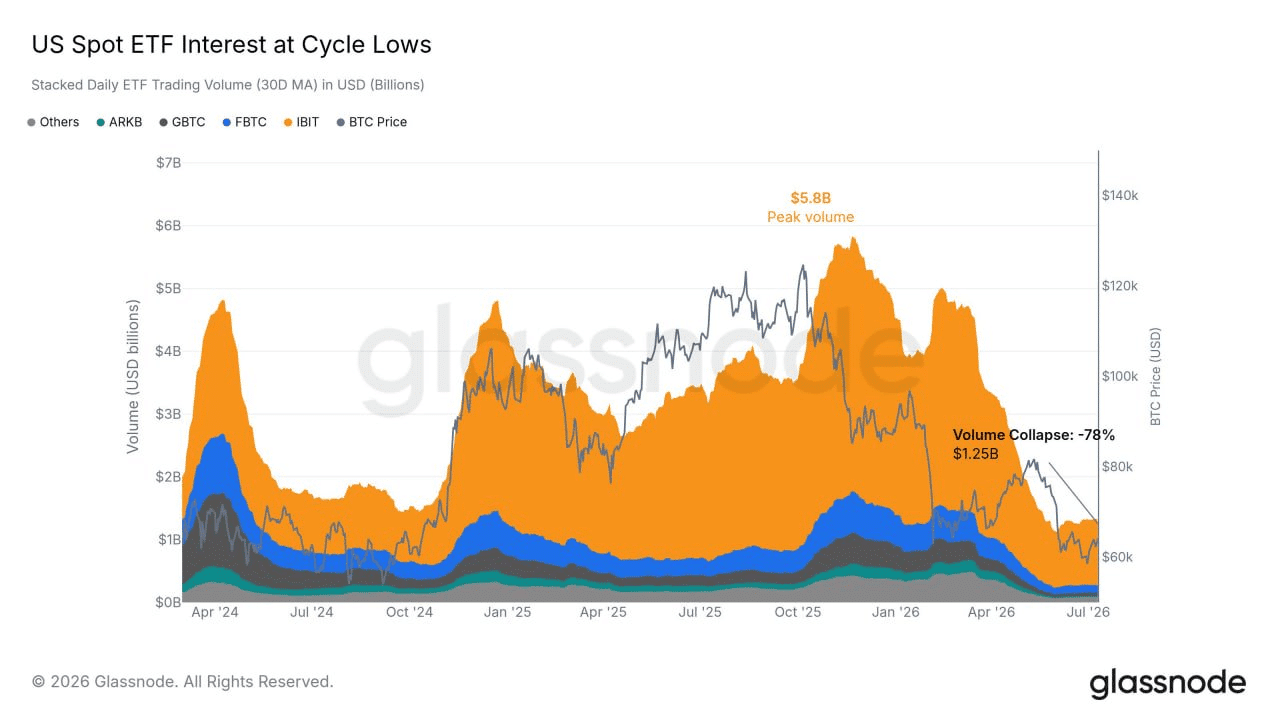
Notably, this setup is now playing out on-chain as well. Bitcoin spot ETF volume has collapsed 78% from its peak, with daily volume dropping to $1.2 billion versus $4.4 billion at the top.
This decline suggests that ETF-driven demand has cooled, leaving the market with weaker liquidity as $BTC attempts to sustain its recovery.
In essence, Bitcoin’s current setup highlights a growing demand-supply imbalance.
While selling pressure continues to rise, buyers have not stepped in strongly enough to absorb the supply, especially as LTHs typically act as a key source of demand during market dips.
Without stronger accumulation from this cohort, $BTC’s consolidation around $65k risks turning into a bull trap rather than the start of a sustained breakout.
Final Summary
- Bitcoin’s $65k rally faces a key test as long-term holders sell into the recovery instead of buying the dip.
- ETF demand has slowed, while selling pressure rises, creating a risk that $BTC’s breakout could turn into a bull trap.