
 coindesk.com
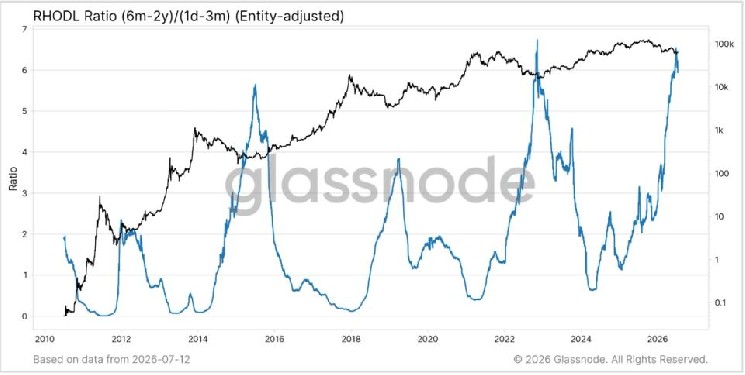
Bitcoin is currently down roughly 50% from its October 2025 all-time high of approximately $124,000. Trading near $62,000, it has spent the past five months grinding sideways between $60,000 and $80,000, leaving the market in a state of apathy.
But a closely watched onchain metric suggests this quiet period may be setting the stage for a significant move.
Glassnode’s RHODL Ratio, which compares the wealth held by long-term holders with that of newer market participants, reached 6.5 in early July, its second-highest reading in Bitcoin’s history. It has since begun to decline and is now below 6. Crucially, this compression is occurring while the price stagnates, rather than collapses.
In 2022, the ratio rolled over alongside a violent selloff. The collapse of FTX sent Bitcoin tumbling to around $15,000. The situation in 2026 looks different. Bitcoin continues to trade near $60,000, while coins change hands without signs of panic.
This suggests a gradual transfer of supply from long-term holders, many of whom accumulated throughout 2023 and 2024, to a new cohort of buyers who view current prices as a discount.
This trend can also be attributed to distribution, per Wyckoff's model, which sees astute sellers offload their holdings to overly eager buyers. The distribution phase typically occurs at typically occurs at the start of the middle of a bear market before transitioning into an accumulation phase.
Extended consolidations near the 2015, 2019, and 2023 lows each preceded meaningful recoveries. In every case, the RHODL Ratio compressed before the price eventually broke higher.
The market has now endured five months of tight consolidation without the capitulation event that many investors are still waiting for.
A Federal Reserve rate hike could be the catalyst that sends Bitcoin to new lows, with markets currently pricing in 50 basis points of tightening over the next six months.