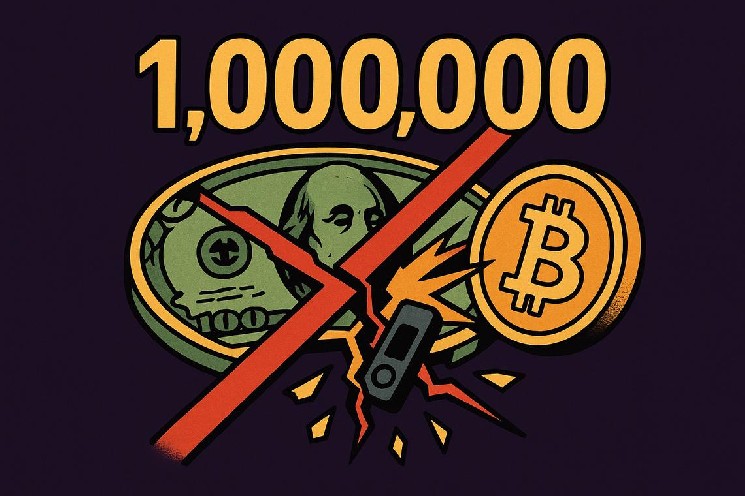
That reframes the entire mainstream conversation around Bitcoin price targets. Where most forecasters treat seven figures as validation, Larchevêque treats it as a symptom. He accepts the price destination, but explicitly rejects what others want it to mean.
Bitcoin as Insurance Against Economic Disorder
Larchevêque describes Bitcoin as a final settlement tool — the kind of asset that preserves wealth when conventional financial infrastructure collapses. He does not hold it to get rich. He holds almost all of his liquid net worth in Bitcoin as a form of protection, not speculation. The distinction is not semantic. It changes how you think about entry points, exit strategies, and what a rising price actually tells you about the state of the world.
He also makes a point about geography. For someone living in Iran under sanctions and currency controls, Bitcoin can function as a genuine financial lifeline. For a comfortable saver in France, it can feel abstract — a hedge against risks that do not yet feel real. The value of the asset is context-dependent, and the context Larchevêque worries about is one most Western investors prefer not to think about.
He was also careful to note that none of this constitutes investment advice — a disclaimer worth taking seriously given how loaded his thesis is.
Macro Factors Behind Bitcoin’s Role
The structural argument behind his view rests on sovereign debt. US national debt has now exceeded $39 trillion, a fresh record, and Larchevêque sees that trajectory ending in currency debasement or outright failure. Governments across the developed world continue to borrow at a pace that strains the credibility of fiat systems, and Bitcoin — with its fixed supply and no central issuer — sits outside that dynamic entirely.
That macro backdrop has also been reinforced by recent economic data. Weaker-than-expected US employment figures for June, with nonfarm payrolls rising just 57,000 against forecasts of 113,000, have increased pressure on the Federal Reserve and softened expectations for rate hikes. Historically, softer monetary conditions and fiscal stress have pushed investors toward scarce assets, including both gold and Bitcoin.
Mainstream Bullish Predictions Contrast Larchevêque’s View
The disagreement between Larchevêque and the broader forecasting community is not really about price. It is about interpretation. Most major Bitcoin bulls expect $1 million and treat it as proof of Bitcoin’s triumph. Larchevêque expects the same number and treats it as evidence of systemic failure.
Adoption and Scarcity Drive $1 Million Forecasts
VanEck research head Matthew Sigel has called $1 million a base-case scenario within roughly five years, grounded in growing institutional adoption and the hard cap of 21 million coins ever to exist. That forecast was floated when Bitcoin was trading near $80,000 — the token has since pulled back to around $63,000, widening the gap to seven figures considerably. Michael Saylor and ARK Invest have echoed similar long-term conviction, pointing to institutional demand and 2030 price targets built on scarcity mechanics.
Interestingly, Larchevêque does not dispute these voices. He has cited Saylor directly and says he shares the view that Bitcoin is the best asset available globally, historically. The split is entirely on what crossing that threshold would mean for the world around it.
Supply Shock and Institutional Demand
Jan3 chief Samson Mow takes a more dramatic short-term view. He anticipates what he calls an “omega candle” — a single-day supply shock powerful enough to push Bitcoin above $100,000 almost overnight. The mechanism would be a sudden mismatch between available supply and surging institutional demand, compressing what might otherwise be a months-long rally into hours.
That kind of scenario is speculative by nature, but it illustrates how differently market participants frame Bitcoin’s path forward. Mow is thinking about near-term mechanics. Sigel and Saylor are thinking about multi-year structural demand. Larchevêque is thinking about the geopolitical and monetary conditions that would need to deteriorate to justify prices an order of magnitude above today’s levels.
Bitcoin Price Today and What the Gap Reveals
Bitcoin is currently trading just below $63,000. That puts the $1 million target approximately 16 times away from current levels — a distance that makes the debate feel abstract but does not make it unimportant. The core question being asked here is not really about price math. It is about what Bitcoin is for.
On-chain data adds a short-term note of caution. CryptoQuant contributor gaah_im has reported that Bitcoin’s realized profit-to-loss ratio has fallen to its lowest level since 2022, with the share of supply currently in profit turning negative — a condition that has historically aligned with cycle lows. Technically, Bitcoin has recovered above its 20-period and 50-period EMAs on the four-hour chart, around $60,470 and $60,571 respectively, but remains below the 200 EMA near $64,141, which suggests the medium-term trend has not yet turned decisively bullish.
Larchevêque’s framing cuts through the short-term noise entirely. Whether Bitcoin is at $63,000, $100,000, or $1 million, his position remains the same: the higher it climbs, the worse the underlying world is likely to look. That is either the most sobering bitcoin price outlook in the industry or the most honest one — depending on which direction history moves.
FAQ
What does a $1 million Bitcoin price signify according to Ledger co-founder Eric Larchevêque?
Larchevêque warns it would signal global crises including war, debt crises, and a collapsing fiat currency system rather than mainstream adoption or success for Bitcoin.
How does Eric Larchevêque view Bitcoin’s role?
He views Bitcoin primarily as insurance against economic disorder and a tool for wealth protection — not as a speculative jackpot. He holds nearly all of his liquid net worth in Bitcoin on that basis.
What are the contrasting views on Bitcoin reaching $1 million?
While Larchevêque links a $1 million price to global systemic failure, experts like VanEck’s Matthew Sigel and Michael Saylor predict it based on adoption, Bitcoin’s fixed 21-million supply, and long-term institutional demand. Samson Mow also expects a near-term supply shock pushing Bitcoin above $100,000.
Is Eric Larchevêque giving investment advice in his statements?
No. He explicitly states that his views are not investment advice, a point he emphasizes alongside his personal decision to hold nearly all liquid assets in Bitcoin.
Article produced with the assistance of artificial intelligence and reviewed by the editorial team.

 en.cryptonomist.ch