
 coindesk.com
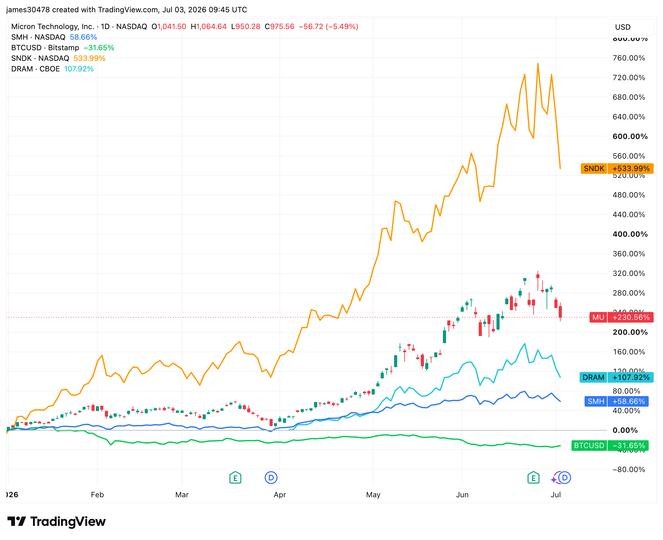
The standout equity winners this year have been memory and semiconductor stocks, which are crucial to the AI industry and have sidelined much of the crypto industry as investors sought to get a look-in on the hottest new trend.
The question now is whether that trend is beginning to reverse as the AI standard-bearers begin to lose momentum and bitcoin BTC$61,779.89 rebounds from its lowest level in almost two years.
Consider the performance of exchange-traded funds. The Roundhill Memory ETF (DRAM) more than doubled in the first half and the VanEck Semiconductor ETF (SMH) climbed 60%. Both are tied closely to the demand for computing resources to support the AI industry. Then compare that with BlackRock's iShares Bitcoin Trust (IBIT), the largest bitcoin ETF, which has dropped 30%, in line with the largest cryptocurrency.
Behind the AI-linked performance are companies like Sandisk (SNDK), which designs and manufactures the NAND flash memory used in products from AI servers to smartphones and data centers. Its shares have surged more than 530% this year.
Micron Technology (MU), one of the world's largest producers of DRAM and high-bandwidth memory (HBM) chips, used to power AI infrastructure, has climbed more than 230%.
In recent days, there have been signs of a reevaluation.
The Roundhill Memory ETF has fallen roughly 25% from its June 22 record high, while VanEck Semiconductor ETF has dropped 12%. Bitcoin, which dipped below $58,000 on July 1, is back trading above $61,000.
The AI-related selling pressure accelerated on Wednesday after Bloomberg reported that Meta Platforms (META) is creating a business unit called Meta Compute, which will sell excess GPU (graphic processing unit) computing capacity to third parties.
The news rattled companies that have benefited from the AI compute boom, particularly "neocloud" providers that lease GPU infrastructure to AI developers. That includes former bitcoin miners that have pivoted their computing resources to support the emerging industry with high-performance computing (HPC) and GPU hosting services. IREN (IREN), Cipher Digital (CIFR) and TerraWulf (WULF) have each fallen at least 20% from their all-time highs.
It is too early to call the move a sustained rotation, but after months of capital flowing into AI infrastructure at the expense of crypto, the recent pullback in semiconductor leaders alongside bitcoin's rebound could be the first indication that investors are beginning to rebalance risk back towards digital assets.