
 news.bitcoin.com
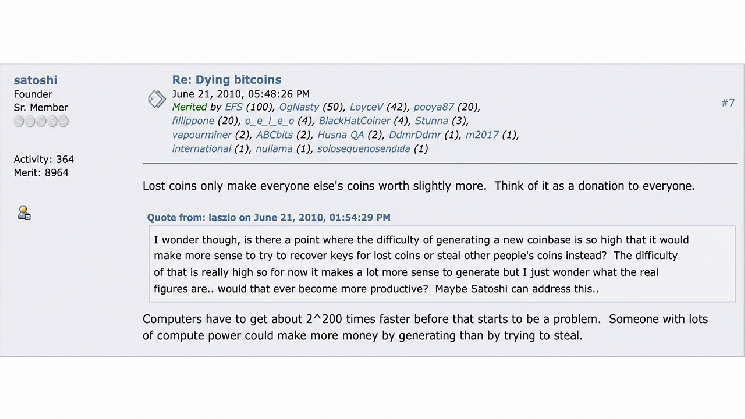
The discussion happened 16 years ago today, on June 21, 2010, in a Bitcointalk thread called “Dying bitcoins.” A user had asked whether forgotten wallets meant the network would shrink over time. After replies from Laszlo Hanyecz and Gavin Andresen, Satoshi answered at 17:48:26 UTC with a line that still circulates today:
“Lost coins only make everyone else’s coins worth slightly more. Think of it as a donation to everyone.”
Satoshi’s lost-coins quote is less a prediction that bitcoin’s price would rise and more an observation that scarcity intensifies as coins disappear from circulation. Still, the premise ultimately relies on the same assumption: that bitcoin would retain enough value for people to want to hold it in the first place.
Satoshi also told Laszlo that computers would need to become roughly 2^200 times faster before recovering or stealing lost coins could outpace mining. That statement was a scarcity argument, not a measurement. It left open a question researchers are still trying to answer in 2026: how many bitcoins are actually gone.
Several reports put the number at about 3.1 million $BTC, with a central range of 2.7 million to 3.9 million $BTC and a wider envelope of 2.3 million to 5.25 million $BTC. Against current circulating supply of 20,045,680.42 $BTC, tracked by Glassnode as of June 20, 2026, that midpoint equals roughly 15.5% of all mined bitcoin. It should be noted that the estimate of 3.1 million so-called “lost” bitcoin cannot be proven with certainty.
What Can Actually Be Proven
Very little is provable onchain. The blockchain can confirm certain coins are unspendable. It cannot confirm that an unmoved coin is lost rather than held.
The hardest data point comes from a 2025 study by Mohamed El Khatib and Arnaud Legout, which used entropy filtering and machine learning to identify burn addresses. Their count: 3,197.61 $BTC permanently destroyed through block 840,682, dated April 24, 2024. Add Bitcoin’s unspendable 50 $BTC genesis reward, and the provable floor barely moves.
Everything past that floor is based on probability and speculation, not proof. Since the 2025 study was published, additional bitcoin have been sent to known burn addresses, where the coins are effectively removed from circulation and are not expected to be spent again.
Dormancy Paints a Bigger Picture
Glassnode’s supply-by-age data for June 20, 2026, shows 3.557 million $BTC untouched for more than 10 years, 1.690 million $BTC sitting in the 7-to-10-year range, and 1.479 million $BTC in the 5-to-7-year band. That puts roughly 5.25 million $BTC dormant for over seven years and about 6.73 million $BTC dormant for over five.
Glassnode treats coins inactive beyond seven years as “Inert Supply,” calling it likely lost. But old coins still move. Treating every dormant coin as gone overstates the case.
The Patoshi Factor
Much of the debate centers on Bitcoin’s earliest miner. Sergio Demian Lerner’s original research identified a single dominant miner active in 2009 and 2010, producing what became known as the “Patoshi” pattern, totaling about 1.1 million $BTC.
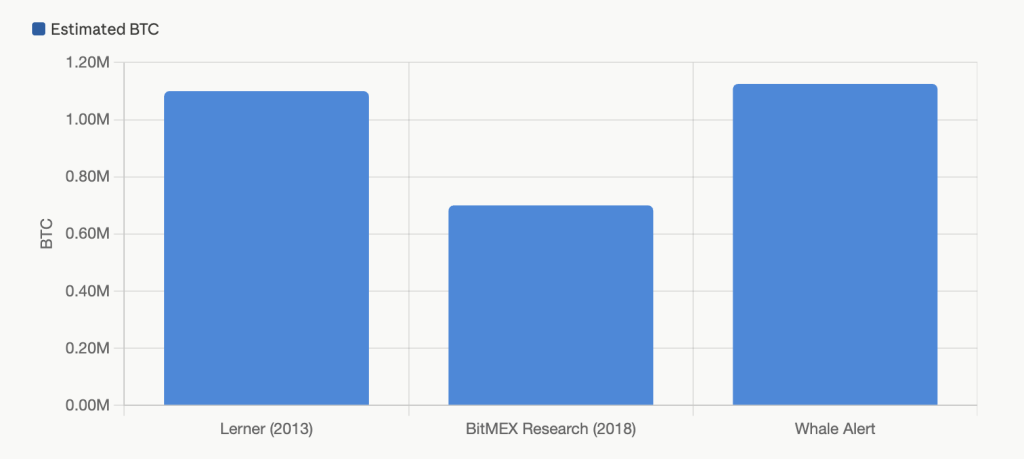
BitMEX Research later argued that the figure runs too high, putting the number closer to 700,000 to 750,000 $BTC. Whale Alert, as reported by Bitcoin.com News, pushed the estimate the other direction, to 1,125,150 $BTC across the first 54,316 blocks.
Whether analysts count that stash as lost, dormant, or simply unattributed swings the total lost-coin estimate by hundreds of thousands of $BTC.
Self-Custody and Exchange Failures
River’s 2025 custody report estimates 1.57 million $BTC permanently lost through self-custody, with 98% of those losses occurring before 2020. River also notes more than 3 million $BTC lost or lost through exchanges overall, though it cautions that public lawsuits and bankruptcies only support low-end estimates.
You might ask yourself how coins can be lost through self-custody. In reality, there are several ways this can occur. For example, a person may install a new bitcoin wallet and neglect to back up the seed phrase tied to the funds. If that individual’s phone is later wiped, access to the $BTC held in the wallet could be lost permanently.
Self-custodial wallet providers do not possess these seed phrases, meaning the responsibility for safeguarding the mnemonic phrase rests entirely with the user.
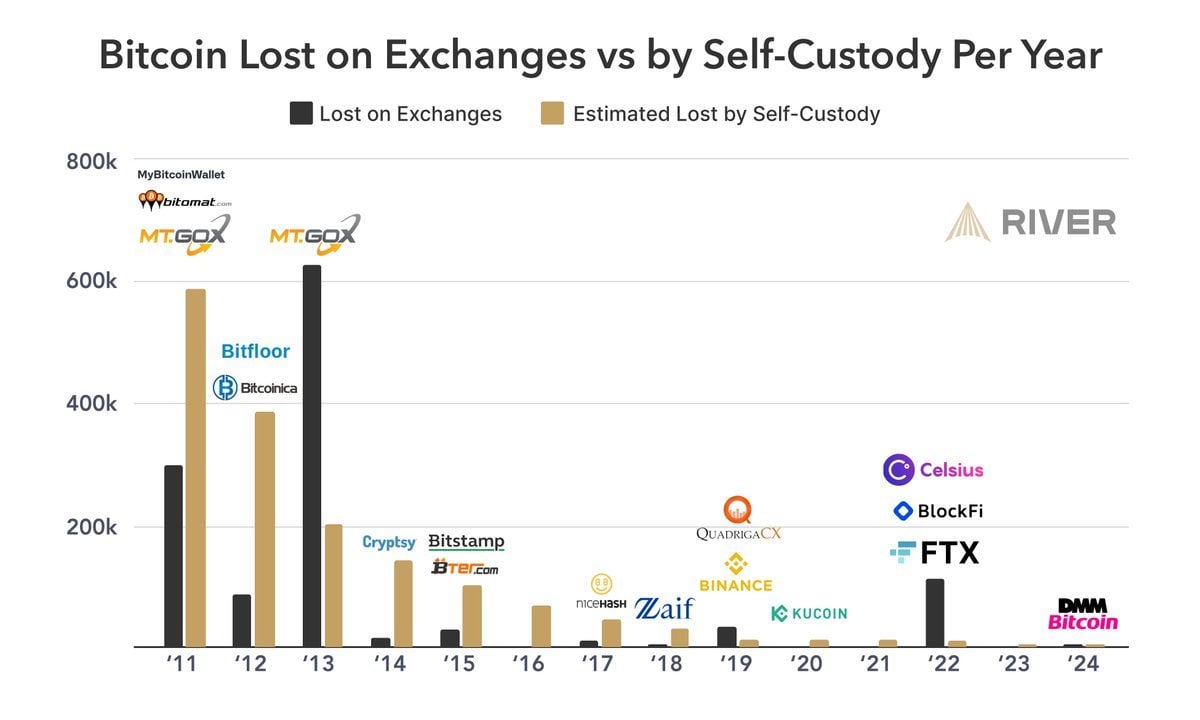
Mt Gox‘s roughly 740,000 $BTC loss illustrates the problem. Some of those coins were later recovered and are now moving through a rehabilitation distribution plan, meaning the original loss figure no longer represents permanent destruction.
One of the most well-known examples of loss involves Welsh IT engineer James Howells, who accidentally discarded a laptop hard drive containing the private keys to 7,000 to 8,000 bitcoin. The drive ended up in the Docksway landfill in Newport, Wales, where it has remained buried beneath hundreds of thousands of tons of waste.
Over the years, Howells assembled a team of specialists and obtained financial backing for an excavation effort, but Newport City Council repeatedly denied permission, citing risks associated with methane gas, asbestos, and toxic leachate. In January 2025, the High Court dismissed his legal challenge, ruling that the case had no realistic prospect of success.
At current prices, Howells’ lost cache is valued at nearly half a billion U.S. dollars.
What This Means for Traders
For anyone holding bitcoin, the dormancy data reinforces a scarcity case that goes beyond the 21 million hard cap. If even the conservative 2.7 million $BTC figure holds, effective circulating supply runs meaningfully below headline numbers, a detail long-term holders may find more relevant than short-term price swings.
The debate is unlikely to be resolved soon. Burn-address proof remains tiny. Dormancy metrics remain probabilistic. And the Patoshi-era coins, whoever controls them, remain untouched. Many believe Nakamoto’s coins will never move, but that remains a matter of opinion rather than an established fact.