Bitcoin price slips toward $65K as Fed jitters test key support
crypto.news
17 June 2026 11:36, UTC
Bitcoin has retreated toward $65,000 ahead of the Federal Reserve’s policy decision as traders cut risk and reassess the outlook for interest rates under newly appointed Fed Chair Kevin Warsh.
According to data from crypto.news, Bitcoin ($BTC) price fell from a June 16 high of near $67,200 to an intraday low around $65,236 on June 17 before stabilizing near $65,300 at press time. The pullback came as investors awaited the outcome of the Federal Reserve’s two-day policy meeting, with policymakers expected to keep rates unchanged at 3.50%–3.75% when the decision is released later today.
Attention has instead shifted to the Fed’s updated dot plot and Warsh’s first post-meeting press conference. Traders have increasingly focused on whether policymakers abandon any remaining easing bias and reinforce expectations that borrowing costs could remain elevated for longer amid inflation running above 4%.
Know when your coins move
Alerts, real-time prices, and market news — all in one app
4.8 based on 40K reviews in the App Store and Google Play
Outside crypto, the cautious mood extended across several asset classes. Gold and silver both traded modestly lower during the session, while crude oil slid toward $75 per barrel for a fifth consecutive day as markets priced in the possibility of renewed Iranian oil exports under a proposed U.S.-Iran agreement.
At the same time, Asian technology shares continued attracting capital, with Japan’s Nikkei 225 reaching fresh record highs above 70,000 amid ongoing enthusiasm surrounding artificial intelligence investments.
Technical structure leaves Bitcoin trapped between $60K support and $68K resistance
Bitcoin’s recent rebound from below $60,000 has stalled near a major technical resistance zone.
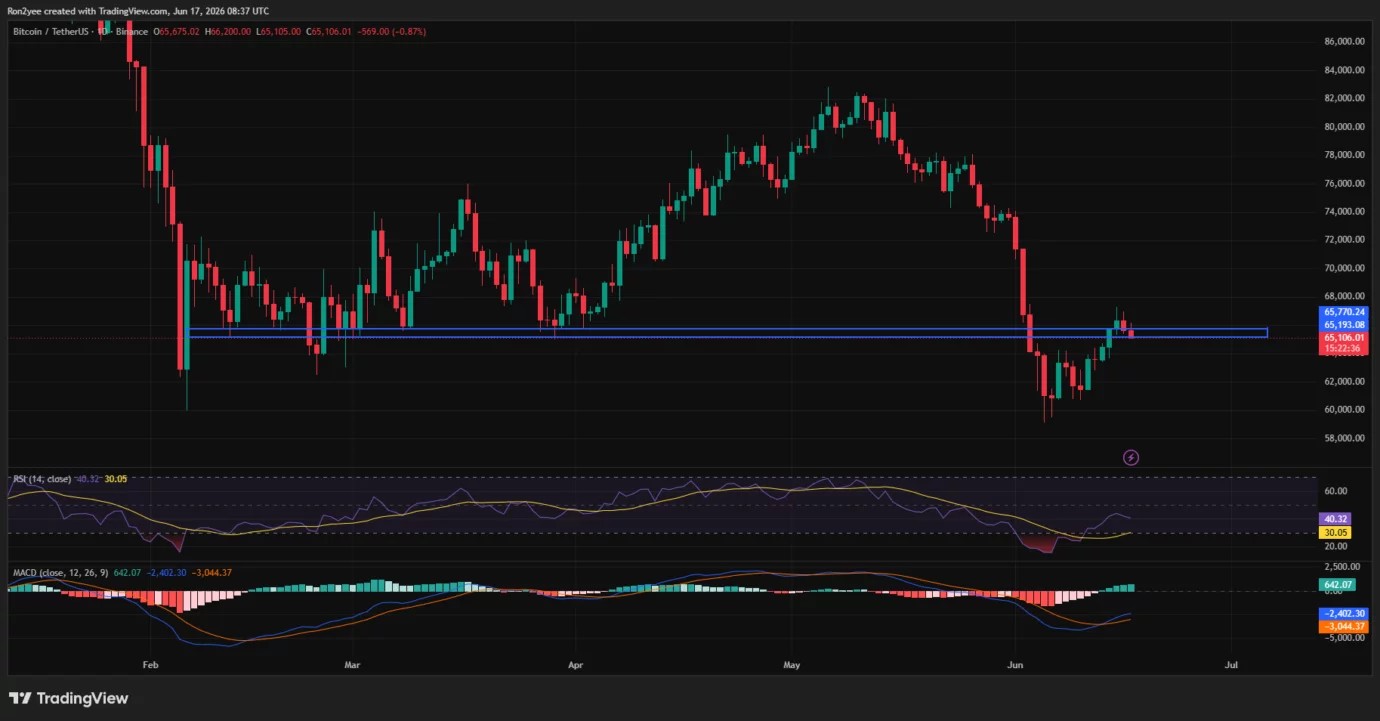
On the daily chart, $BTC has returned to a support-turned-resistance region between roughly $65,200 and $65,800. The area previously acted as a key floor during February and March before breaking during the sharp selloff earlier this month. $BTC price briefly reclaimed the zone before slipping back underneath it.
Bitcoin daily price chart — June 17 | Source: crypto.news
Momentum indicators remain mixed. The daily RSI has recovered from oversold territory but remains below the neutral 50 mark, while the MACD continues to trade beneath its signal line despite narrowing bearish momentum.
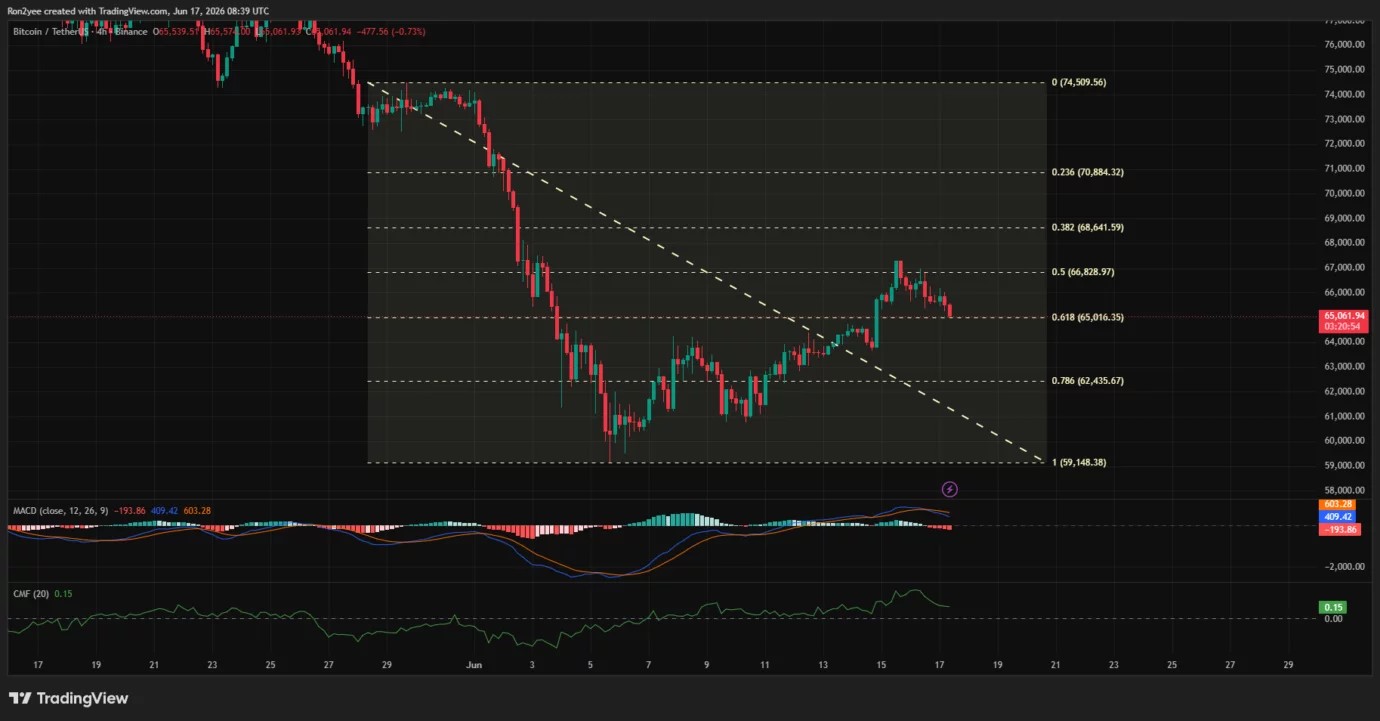
On the four-hour chart, Bitcoin has also fallen back below the 61.8% Fibonacci retracement level near $65,016 after failing to sustain a breakout above the 50% retracement around $66,829.
Bitcoin 4-hour price chart — June 17 | Source: crypto.news
According to analyst Kamile Uray, the market is now closely watching whether support around $63,700 can hold.
“In deep declines, we will be tracking the 60000 level. This level must be held. Otherwise, the decline deepens further.”
On the positive side, Uray added that $67,500 remains the first major resistance zone, while a sustained move above $74,500 would be required to restore a stronger bullish structure.
Meanwhile, CoinGlass liquidation heatmaps show a dense concentration of leveraged positions sitting above current prices. Commenting on the setup, crypto analyst Daan Crypto Trades noted that “$68K is the biggest one to watch in the short term,” adding that the largest liquidity clusters now sit above the market after Bitcoin swept liquidity beneath $60,000 earlier this month.
$BTC It is clear where the liquidity sits in this area.
A lot was taken out on the way down below $60K, but with that February low swept, the biggest levels are now above.
$68K is the biggest one to watch in the short term. Below, there's a decent area at $60K but nothing… pic.twitter.com/bAT0t2aNbM
— Daan Crypto Trades (@DaanCrypto) June 17, 2026
Fed guidance and Middle East tensions could determine the next move
Macro developments remain the primary risk factor heading into the Fed announcement.
While falling oil prices have eased some inflation concerns, geopolitical uncertainty has persisted after Iran accused Israel of violating a Lebanon truce dozens of times and warned of a “harsh response” if attacks continue.
Tehran has also linked any final agreement with Washington to sanctions relief, the release of frozen assets, and an Israeli withdrawal from Lebanon.
The combination of Fed uncertainty, geopolitical risks, and persistent institutional caution has kept Bitcoin below major resistance despite recovering from its June lows.
A break above $68,000 could expose the next liquidity zones near $74,000 and $78,000, where large concentrations of leveraged positions remain.
On the downside, losing support around $63,700 would place renewed focus on $60,000. A decisive move below that level could open the door toward the $55,000–$50,000 region highlighted by several market analysts.

 crypto.news