Circle and Blackrock Lead the Treasury Race
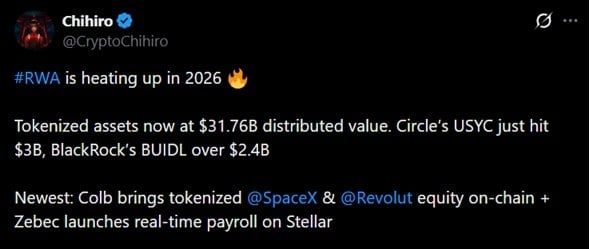
Tokenized Treasuries remain the engine of the sector with Circle’s USYC product pushing past $3 billion in value, edging Blackrock’s tokenized fund BUIDL, which sits around $2.4 billion. The latter had previously sought the SEC’s approval for the BUIDL fund on Ethereum, a milestone that helped legitimize tokenized money-market exposure for institutional allocators.
Beyond treasuries, the asset mix seems to be widening as private credit too has grown into one of the largest tokenized segments, and Bitcoin.com News reported that real-world assets on Solana crossed $2 billion as networks compete to host the new instruments. Tokenization infrastructure has also expanded across chains, with Securitize integrating with Tron to broaden distribution earlier this year.
Equities and Payroll Move Onchain
The newest launches point to where the sector is heading, given that tokenization platform Colb recently brought tokenized SpaceX and Revolut equity onchain, giving investors blockchain-based exposure to two of the most sought-after private companies in the world (assets normally walled off from all but the wealthiest backers).
Payments have followed as well, with Zebec recently launching a real-time payroll platform on Stellar, letting workers receive wages continuously rather than waiting for biweekly cycles, an early example of tokenization touching everyday financial plumbing rather than just investment products.
That said, risks remain since much of today’s tokenized supply remains concentrated with a handful of issuers, and regulatory treatment of tokenized securities still varies by jurisdiction. Furthermore, liquidity for newer instruments such as tokenized private equity is thin compared with the deep markets for tokenized treasuries.
Even then, the direction is quite clear as the market currently holds a total capitalization of $31.76 billion, rapidly expanding into domains like equities and payroll. Consequently, the next test will be whether tokenized assets can keep attracting institutional capital as the offerings move further from the safety of government debt.

 news.bitcoin.com