
 thecryptobasic.com

Bitcoin demand crashes to its lowest level in more than four years, but this may mark the start of a more difficult phase rather than an imminent reversal.
Bitcoin has faced fresh selling pressure, with its price falling to around $61,000 during the latest market downturn. The premier crypto asset has dropped 3.41% this week after a massive 13.94% decline last week, bringing the monthly loss to 16.77%.
As the decline continues, verified CryptoQuant analyst Moreno has called attention to a sharp drop in demand, warning that the market has entered one of its weakest demand phases in years.
Bitcoin Demand Slumps to Level Last Seen 3 Times Since 2019
Moreno noted in his recent analysis that Bitcoin demand has now fallen into a contraction zone that has appeared only three times since 2019. He based this on the 30-day growth of combined spot and perpetual futures demand, which has dropped toward -650,000 $BTC.
According to him, readings at this level are extremely uncommon and show that demand has weakened way beyond what is normally seen during a routine market slowdown.
The analyst stressed that the current situation is important because both spot demand and perpetual futures demand are declining at the same time.
In other words, the weakness is not limited to leveraged traders. Specifically, regular buying activity and derivatives exposure are both falling together, leaving Bitcoin with fewer buyers available to absorb additional selling pressure.
Bitcoin’s Historical Data
While the -650,000 $BTC level remains important, Moreno argued that history suggests it does not usually indicate an immediate market bottom. Notably, previous moves into this zone often marked the beginning of a difficult phase before Bitcoin eventually reached its lowest point.
The first example came ahead of the COVID-19 market crash. Specifically, Bitcoin fell to around $6,400 in December 2019 as demand conditions continued to deteriorate. During this period, the demand indicator reached extreme contraction levels before the broader liquidity shock arrived.
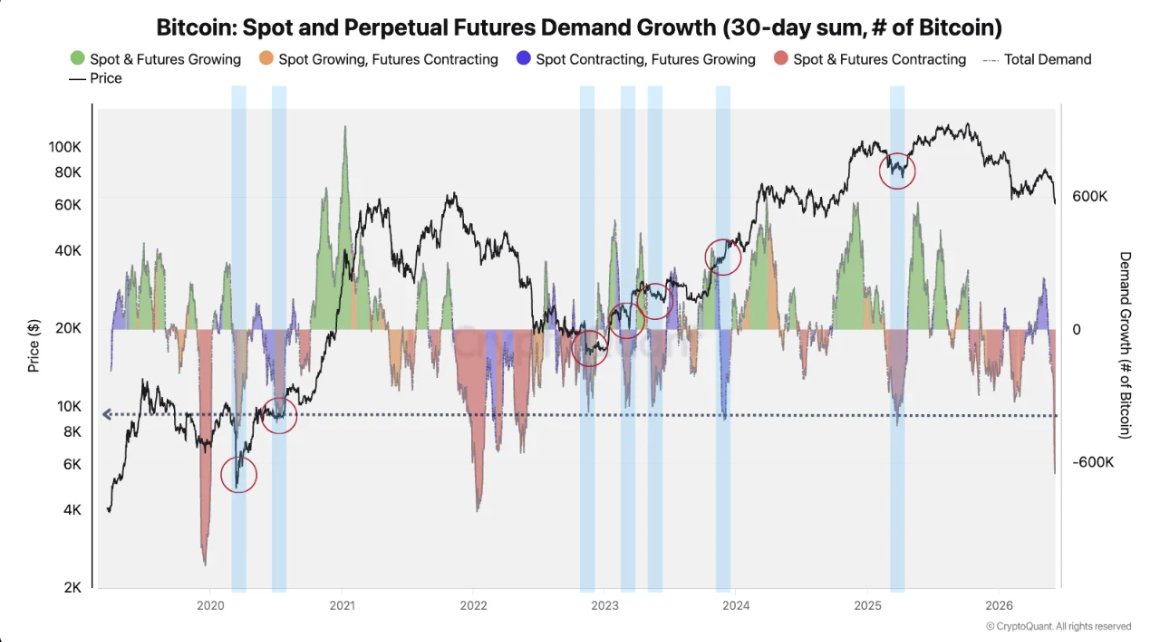
Later, as the March 2020 market collapse occurred, the metric recovered toward a higher support area while Bitcoin dropped to its cycle low of about $3,800. This ultimately aligned with the formation of the COVID-era bottom.
A similar pattern appeared during the 2022 bear market. Moreno said the extreme decline in demand reflected deep structural weakness across the market.
Notably, the indicator reached the -650,000 $BTC mark around January 2022, when Bitcoin dropped from its then-record high of $69,000 to roughly $32,951. As the demand metric improved, Bitcoin recovered into March 2022.
However, the rebound did not mark the end of the downturn. Bitcoin resumed its decline from April 2022 and continued falling for several months. The asset eventually reached a bear-market low of around $15,500 in November 2022, months after the demand indicator had touched the -650,000 $BTC level.
Why More Turbulence Lies Ahead
Based on these historical instances, Moreno believes the current market situation looks less like a confirmed recovery and more like the start of a final cleansing phase.
He expects the market could first experience a rise in volatility before moving into a longer period of weak momentum and reduced activity.
According to Moreno, Bitcoin may enter an extended stretch of sideways trading marked by low participation and limited price movement. He believes this phase could prove more challenging for many investors than the selloff itself, as long periods of stagnation often test market participants’ patience and confidence.
Bitcoin Needs to Recover $65K
Meanwhile, market veteran Michaël van de Poppe focuses on a specific price level amid the decline. He noted that Bitcoin continues to trade below $65,000 and said a move above that level could open the door for a strong rally toward the $72,000 to $74,000 range.
Van de Poppe explained that the $65,000 area previously acted as support after the market crash in early February but has now become a major resistance level. He believes that if Bitcoin breaks above this barrier, the price could move toward the upper end of its current range.
The market analyst also argued that such a move may not be far away, as he considers the recent selloff largely irrational despite the broader market weakness.