
 cryptoslate.com

Bitcoin's brief weekend rally lost its footing as a sudden resumption of military hostilities between Israel and Iran triggered a broad rotation away from risk-on investments.
The geopolitical escalation, which defied explicit diplomatic pressure from Washington, sent global energy benchmarks surging and equity markets lower, leaving $BTC to defend a highly fragile $60,000 baseline.
Data from CryptoSlate showed that Bitcoin retreated to approximately $63,316 as of press time, after reaching an intra-day high of $64,128 during a weekend short squeeze.
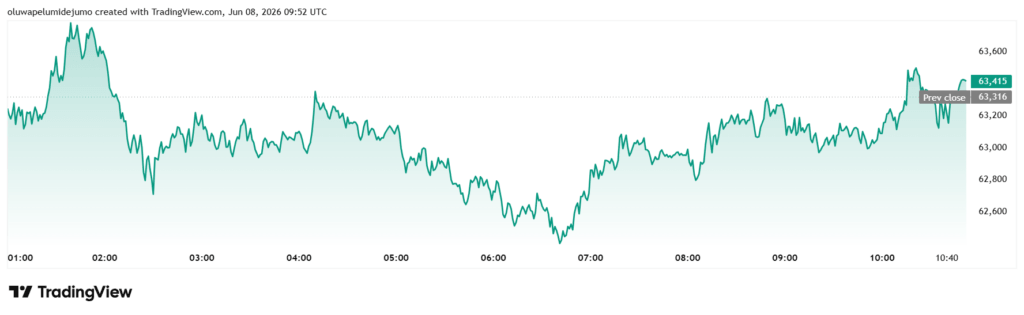
This reversal underlines the crypto market vulnerability to a mix of institutional deleveraging, fatigue in the artificial intelligence trade, and widening macro anxieties.
Israel-Iran friction defies Washington
The macroeconomic shock originated from a sudden collapse of the two-month truce that had paused direct military confrontation between Israel and Iran since April.
Over the weekend, Israeli forces reportedly executed a series of targeted airstrikes across central and western Iran, hitting key infrastructure, including a petrochemical facility in Isfahan, alongside locations in Tehran and Tabriz.
According to reports, those strikes followed a barrage of roughly 10 Iranian ballistic missiles fired toward northern Israel on Sunday night, which the Israeli military reported were largely intercepted or landed in uninhabited areas.
Tehran framed that missile launch as direct retaliation for a prior Israeli operation in southern Beirut that killed two people and injured 20 at a militant command center.
The renewed violence complicates ongoing diplomatic efforts led by US President Donald Trump, who recently suggested that a comprehensive peace agreement was nearing finalization.
Trump publicly expressed frustration with the unfolding events, explicitly distancing his administration from the Israeli prime minister’s tactical decisions and stating:
“I call all the shots. He doesn’t call the shots.”
In Tehran, the rhetoric has similarly hardened. Iranian Parliament Speaker Mohammad Bagher Ghalibaf dismissed the prospect of an immediate ceasefire.
He argued that the existing naval blockades and tacit US support for Israeli operations have effectively turned American assets in the region into legitimate military targets.
Cross-asset contagion and the energy shock
The immediate financial fallout was concentrated in the energy markets, which erased a late-week selloff that had been predicated on hopes of regional de-escalation.
According to oilprice.com, Brent crude futures spiked 4.47% to reach $97.15 a barrel, while U.S. West Texas Intermediate advanced 4.50% to $94.61.
Although crude remains below the $120 peak recorded in March, prices have surged nearly 60% since the wider conflict began in late February.
This shows that traders are aggressively pricing in the risk of disruptions in the Strait of Hormuz, a critical maritime chokepoint that handles roughly 20% of the world's daily transit of liquefied natural gas and oil.
Meanwhile, this commodity shock triggered immediate defensive posturing in traditional equities.
Asian markets absorbed the initial wave of selling, punctuated by South Korea’s KOSPI index, which plummeted more than 8% as capital fled toward perceived safe havens. The Kobeissi Letter reported that South Korea’s stock market was halted due to this drastic fall.
A ‘hollow' squeeze in the crypto derivatives market
For Bitcoin, this geopolitical turbulence arrived precisely as the asset was attempting to establish a technical floor after last week's punishing 16% drawdown, which briefly pushed the top crypto below the $60,000 threshold.
CryptoSlate previously reported that the world's largest cryptocurrency has faced intense structural headwinds recently.
The pressure has been driven by more than $4 billion in outflows from US spot exchange-traded funds and weaker market sentiment after Strategy (formerly MicroStrategy) executed its first Bitcoin sale since 2022.
So, as $BTC's spot prices fell below the $60,000 threshold last week, bearish speculators aggressively positioned themselves for a deeper breakdown.
However, when the market unexpectedly pivoted upward over the weekend, those late shorts were forcefully unwound. Notably, CryptoSlate previously reported that $BTC was creating a short-heavy setup that could fuel its uptrend.
However, leading market analysts caution against interpreting the weekend price action as a sustainable recovery, with crypto research firm 10x Research stating:
“After last week's sharp selloff, Bitcoin sits in technically oversold territory, and a brief bounce early this week looks likely. But don't mistake a relief rally for a recovery.”
Axel Adler, an analyst at on-chain data provider CryptoQuant, noted that the internal mechanics of the derivatives market point to a severe lack of fundamental demand.
Adler highlighted that while the spot price recovered roughly 4% from its lows, aggregate futures open interest actually contracted by 6%, dropping from $1.65 billion to $1.55 billion.
In view of this, Adler concluded that the upward price movement was entirely mechanical because funding rates remained uniformly positive during this window. He explained:
“The combination of price up, open interest down, and funding positive means leverage is being reduced.”
Adler further classified the weekend action as a deleveraging bounce driven by short-covering rather than by fresh capital being deployed into leveraged long positions.
Without new spot demand, Adler warned, the market risks a rapid reversion to the $60,000 support zone.
That technical fragility is mirrored by deteriorating retail psychology. Joao Wedson, CEO of the analytics firm Alphractal, pointed out that current social metrics categorize the market environment in “Extreme Fear” with a heavily bearish bias.
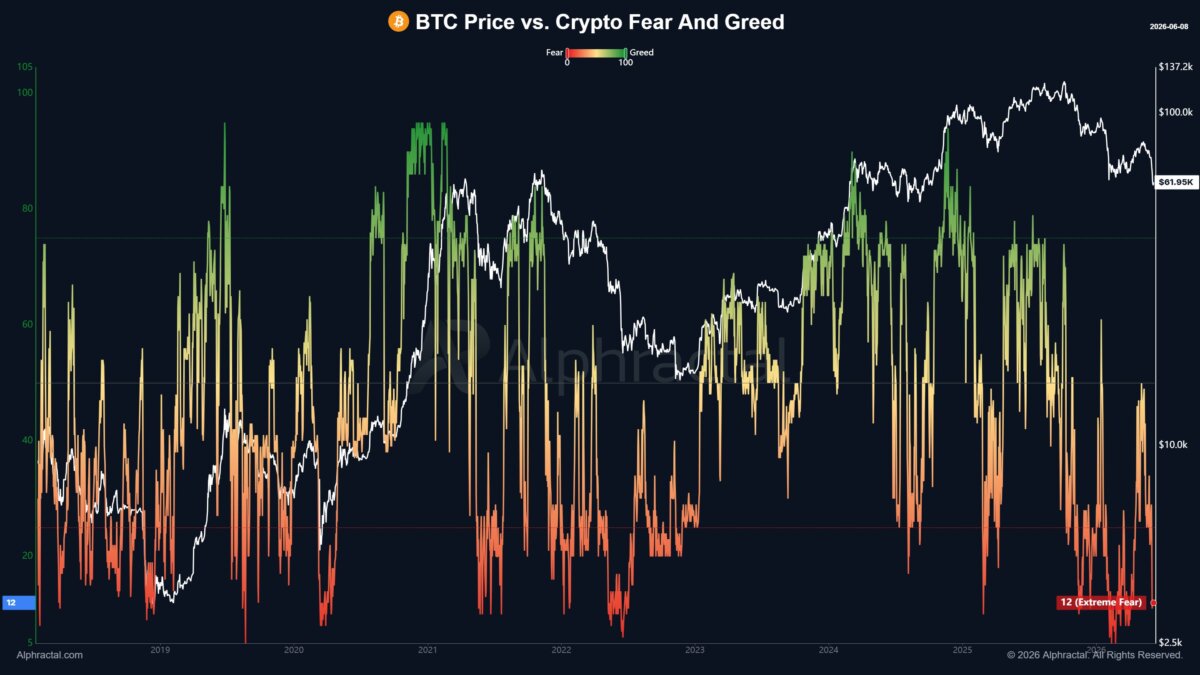
Wedson noted that panic-driven Google searches for crypto are spiking again, warning investors to brace for a highly volatile trading week as geopolitical realities clash with an already-exhausted digital asset market.
The result is a market caught between two pressures. Short covering has lifted Bitcoin away from last week’s lows, but renewed Middle East conflict has pushed oil higher and weakened the broader risk backdrop.
Bitcoin’s next move will depend on whether buyers return with enough force to turn the rebound into a sustained recovery. Without that, the weekend bounce risks becoming another pause before traders retest $60,000.