
 news.bitcoin.com
Binance Research says bitcoin’s recent weakness may be driven by capital rotating into a small group of hot U.S. equity themes. The firm argues that without a crypto-native crisis, such pressure has often proved temporary.
Key Takeaways:
- Binance Research says Bitcoin’s 11% Q2 2026 drop tracks capital rotating into AI and energy.
- Cboe Dispersion Index hit 42, suggesting U.S. stock gains are concentrated in a few sectors.
- Binance Research says bitcoin often bottoms within 0-20 weeks absent a crypto crisis.
Cboe Dispersion Index Hits 42 as Bitcoin Competes With AI Stock Rally
Bitcoin’s latest pullback may have less to do with crypto-specific stress and more to do with Wall Street’s crowded trade in U.S. equities, according to Binance Research.
The institutional research arm of Binance said capital is being pulled into a narrow set of powerful themes in the S&P 500, leaving bitcoin on the sidelines. The firm pointed to the Cboe Dispersion Index, which has climbed to 42, its third-highest level on record.
A high dispersion reading suggests that market gains are heavily concentrated in a limited number of stocks or sectors. In the current cycle, Binance Research said investors are crowding into artificial intelligence, semiconductors, defense, energy, and commodities.
That creates a simple but important liquidity problem for bitcoin. When a few equity themes generate outsized returns, capital follows those trades. As money concentrates in stocks, less liquidity is available for crypto assets. Bitcoin then becomes a funding casualty rather than the source of the weakness.
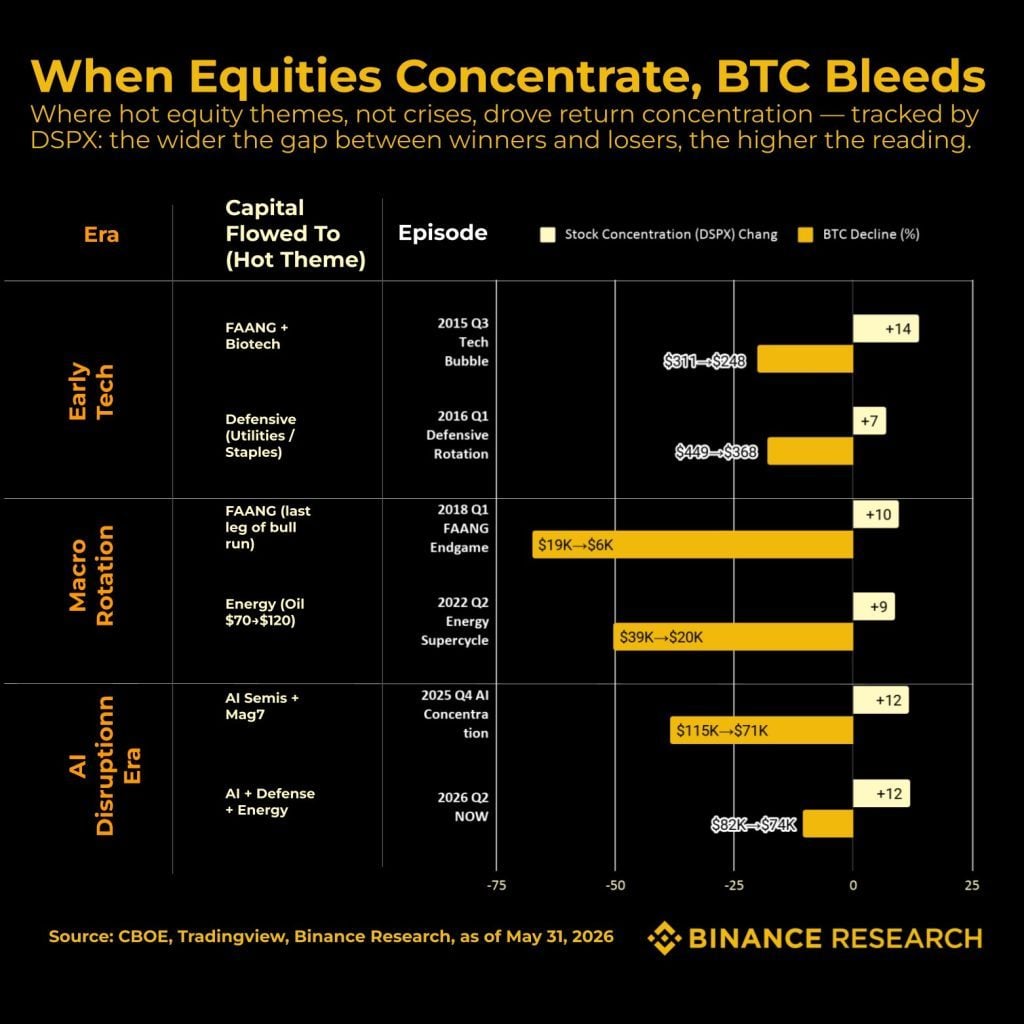
The pattern is not new. Binance Research cited several past examples when intense equity-market rotations coincided with bitcoin declines.
In 2015, capital moved into FAANG stocks and biotech, while bitcoin fell 20%. In 2016, a defensive equity rotation matched an 18% bitcoin drop. Late-cycle FAANG strength and the ICO collapse in 2018 came alongside a 68% fall in bitcoin.
The same pattern appeared again in 2022, when energy stocks surged, and bitcoin lost 50%. Binance Research also pointed to the fourth quarter of 2025, when AI and semiconductor stocks gained more than 200%, while Bitcoin declined 39%.
The latest pressure is smaller but still meaningful. In the second quarter of 2026, Binance Research said a combined rotation into AI, defense, and energy has coincided with an 11% bitcoin decline.
The firm described the current backdrop as one of bitcoin’s strongest multi-theme capital diversions. Growth capital is moving into AI infrastructure and applications. Geopolitical hedge capital is flowing into defense and energy. Inflation-hedge demand is shifting toward commodities.
Bitcoin, in that setup, is competing for attention on several fronts at once.
Still, Binance Research said history points to a possible rebound. In past periods when the Cboe Dispersion Index reached extreme levels, Bitcoin often found a bottom within zero to 20 weeks. The median was about two weeks in cases without a crypto-native crisis.
That distinction matters. Binance Research said the current downturn does not appear to be caused by a major internal crypto shock. If the weakness is mainly due to temporary capital diversion into equities, the firm said Bitcoin may recover faster once those crowded trades cool.