
 ambcrypto.com

Each cohort holding an asset differs primarily in motive.
Short-term holders aim to capture quick gains over relatively brief time horizons. In contrast, smart money participants focus on longer-term positioning, often independent of near-term volatility.
In this framework, sustained accumulation tends to carry greater weight than transient positioning by weaker hands.
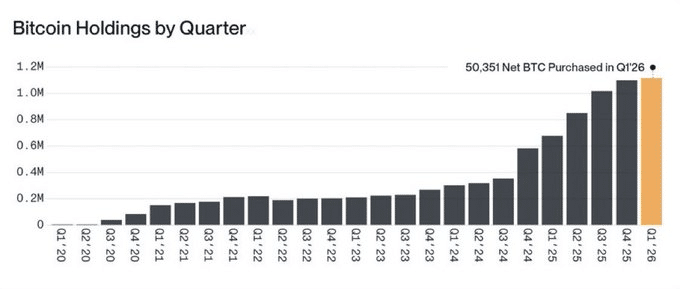
Given this context, the chart below carries significance.
As shown, companies accumulated 50,351 Bitcoin [$BTC] in Q1 this year, the highest quarterly total on record. Notably, this accumulation coincided with a 22% correction in $BTC, highlighting the divergence between price weakness and sustained corporate demand.
However, among long-term holders, accumulation varied significantly.
In a recent report by ARK Invest, $BTC supply held by conviction buyers surged 69% in Q1 to 3.60 million $BTC, marking the highest level since 2020. This brings total long-term holder supply (155+ days) to 14.62 million $BTC, up 4.5% year-over-year.
In this context, the 50k+ $BTC accumulation by public companies further reinforces institutional demand during periods of volatility.
That said, timing matters even more.
Bitcoin’s Q1 correction followed a 23.29% correction in Q4, meaning market FUD already sat in prices.
Yet corporate treasuries still accumulated significant $BTC, raising a key question: What exactly does this sustained structural demand price in?
Corporate buying strengthens Bitcoin’s role amid macro volatility
On the longer timeframe, macro volatility has stress-tested Bitcoin’s hedge status this year.
From a technical angle, $BTC recorded 20%+ corrections in both Q4 and Q1, while gold (XAU) rallied roughly 20% over the same period. Despite recent relative strength in the $BTC/XAU ratio, Bitcoin’s quarterly ROI still lagged gold for two straight quarters, reinforcing a persistent gap in performance during macro volatility.
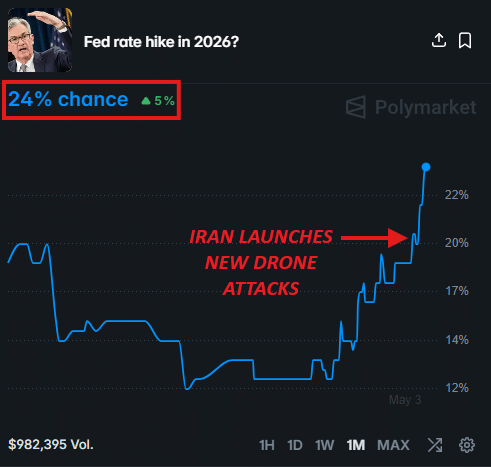
In this context, the chart below carries weight.
According to the Kobeissi Letter, the odds of the Federal Reserve hiking rates in 2026 rose to 24%. In fact, the market-implied base case now prices in no rate cuts until December 2027, reinforcing expectations of a prolonged high-rate regime and elevated macro volatility.
Against this backdrop, corporate conviction in Bitcoin begins to carry greater significance.
As noted earlier, motive matters here.
Corporate demand reflects balance sheet allocation and long-term reserve positioning rather than short-term cyclical positioning. With markets pricing in deeper volatility into H2, Bitcoin’s hedge status relative to gold moves further into focus.
On the technical front, the $BTC/XAU ratio is up 20% in Q2 so far, following Q1’s 28.06% correction. With corporate demand supporting Bitcoin accumulation, the ratio could continue to trend higher if structural flows persist, making accumulation by public companies a key catalyst for Bitcoin’s H2 cycle.
Final Summary
- Corporate accumulation of 50,351 $BTC during a 22% Q1 drawdown signals persistent structural demand despite macro-driven volatility.
- $BTC’s improving $BTC/XAU ratio in Q2 suggests potential rotation dynamics, with corporate flows emerging as a key catalyst for the H2 cycle.