
 coindesk.com

Somebody is buying $2.1 billion of bitcoin through ETFs. Somebody else is using that bid to get out.
U.S. spot bitcoin ETFs have now logged eight straight days of inflows totaling $2.10 billion through April 23, per SoSoValue. That is the longest streak since the nine-day October 2025 run that took bitcoin to its $126,000 all-time high. April 23 alone brought $223.21 million, with BlackRock's IBIT doing roughly 75% of the lifting at $167.49 million and Fidelity's FBTC the one meaningful outflow at $16.93 million.
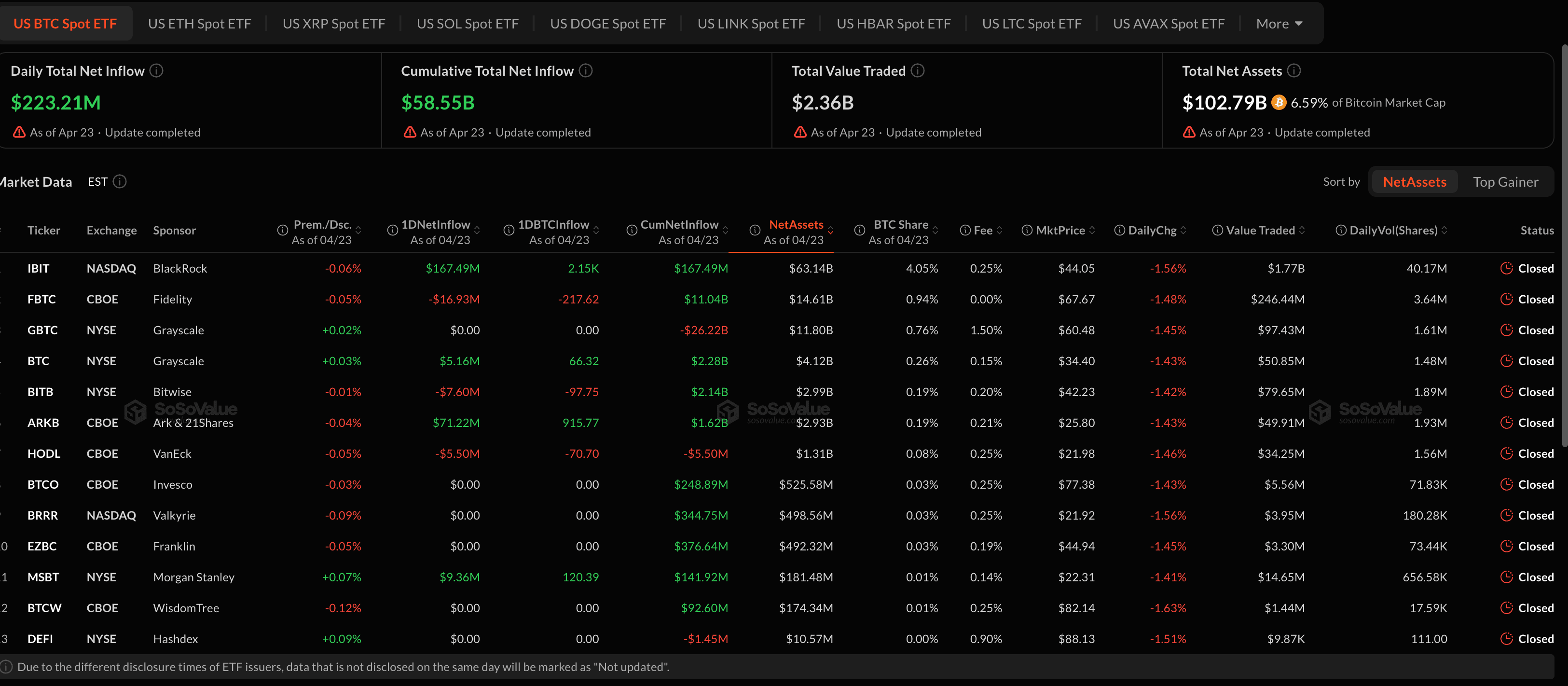
Bitcoin has climbed from $68,000 to $77,000 over the streak, a 12% move that has coincided almost perfectly with the ETF bid returning. Cumulative ETF net inflows since launch now sit at $58 billion, and total assets hit $102 billion, which is 6.5% of bitcoin's market cap.
But here is the part the ETF data does not tell.
A Glassnode report from earlier this week showed that bitcoin just reclaimed its True Market Mean at $78,100, which tracks the average cost basis of actively transacted supply. That is the first time that level has been reclaimed since mid-January, and historically marks the transition from bear-market conditions to something more constructive.
The problem is the next level. The Short-Term Holder Cost Basis sits at $80,100, which is the average entry price for anyone who bought in the last 155 days. A move above it would push more than 54% of recent buyers into profit.
In every prior instance this cycle, that threshold has coincided with local top formation as short-term holders use the rally to break even and exit. This is the second time the structure has set up, and it broke down the first time.
Short-term holder realized profit has already spiked to $4.4 million per hour, per Glassnode. The $1.5 million threshold has preceded every local top year-to-date. The current reading is three times that.
The setup from here is specific. Funding on bitcoin perpetuals is still negative, meaning shorts are paying longs. Saturday's short squeeze took bitcoin to $78,000 briefly before the Hormuz reversal pulled it back.
A second squeeze, stacked on the ETF bid and the spot demand Glassnode has flagged as recovering on offshore venues, is the clean path to $80,000. Whether that break holds against short-term holder distribution, or gets sold into the same way every local top has been sold this cycle, is the trade.
March's seven-day streak broke the same week price tagged its local high. IBIT has carried most of the current run alone while smaller issuers posted mixed flows. The structure is not identical but the pattern rhymes.
The ETF bid is real. The exit liquidity for short-term holders it provides is also real. Which side wins at $80,000 is worth watching.