
 ambcrypto.com

Bitcoin has been here for a long time, and despite its volatility, the leading cryptocurrency has stood the test of time since its launch.
However, the years 2020 to 2026 mark an important year for Bitcoin as it managed to outperform in all crisis.
Bitcoin during 7 big crisis
Starting with the first US-Iran escalation on the 3rd of January 2020, Bitcoin [$BTC] had surged by 20% as compared to gold, which surged by just 6%.
On the contrary, the S&P 500 stock was down by 7%. In the same year, during the COVID-19 outbreak in March, $BTC was up by 21%, whereas the S&P 500 and gold were up by 2% and 3%, respectively.
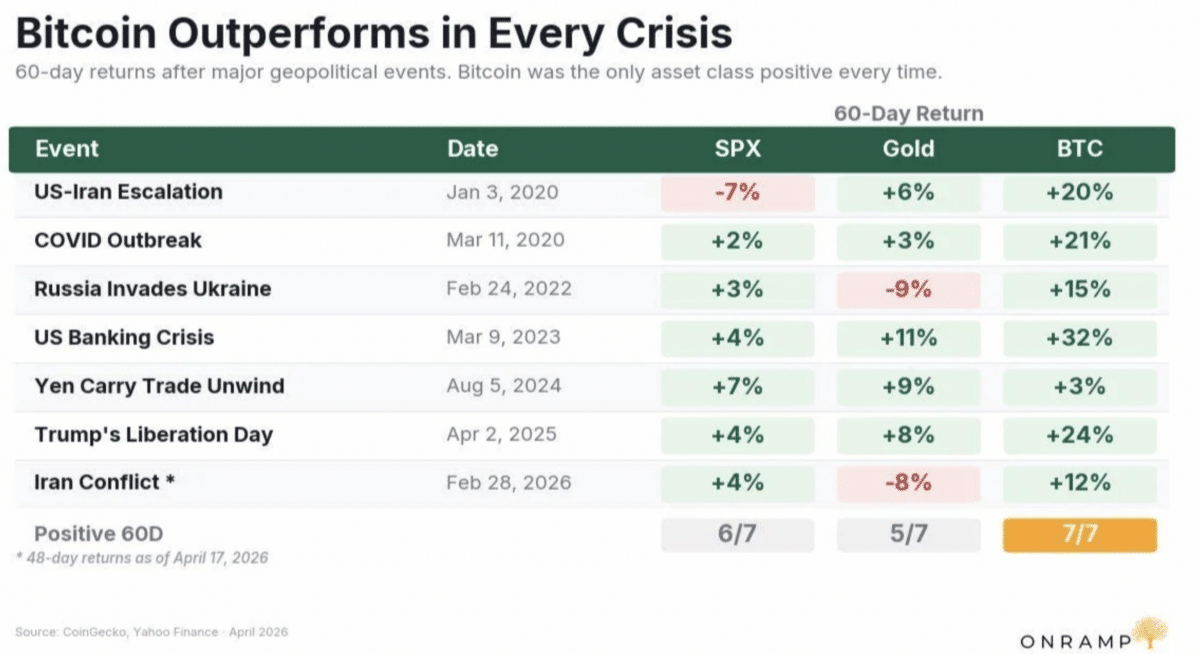
Similar patterns were seen in the Russia-Ukraine war, the U.S.-Iran war of 2026, and also during the U.S. banking crisis.
However, it was only in 2024, when a Yen carry trade unwind led to gold surging by 9% and the S&P 500 surging by 7%, whereas $BTC was up by only 3%.
For context, back then, the Bank of Japan’s rate hike and weak U.S. data led to increased appreciation of the Yen.
The comparison chart of these assets based on 60-day return highlighted how Bitcoin was the only asset to bounce back.
Remarking on the same, the Bitcoin Archive account took to X and noted,
7 out of 7 times. No other asset comes close.
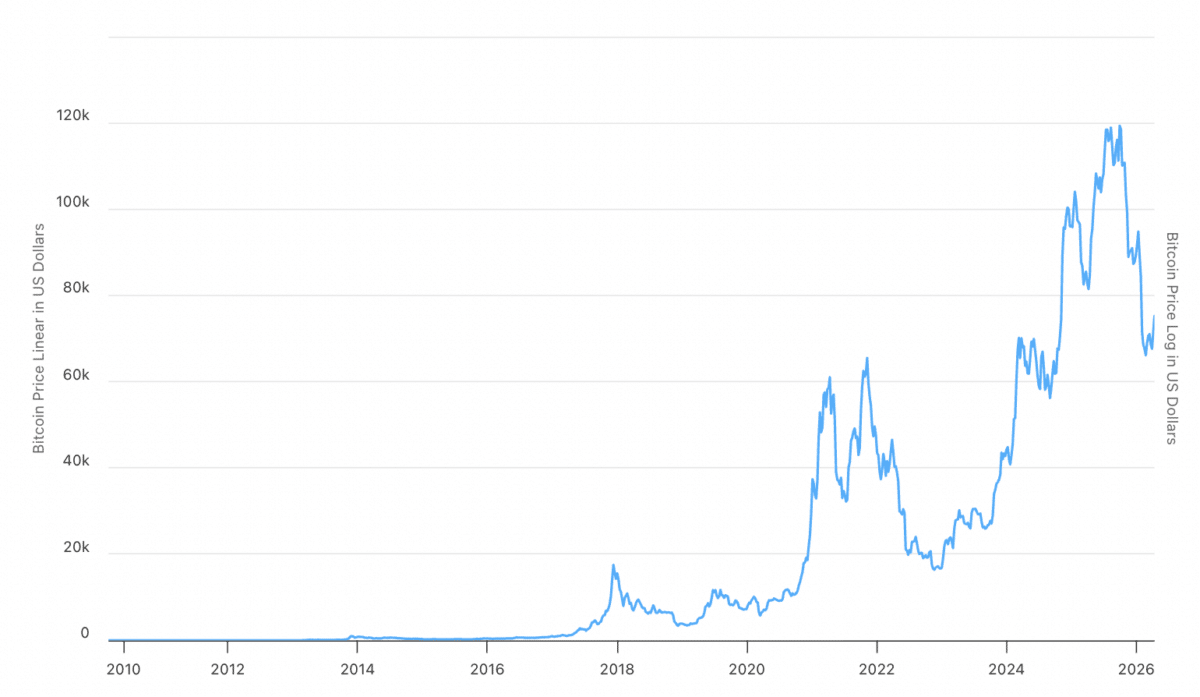
The BitBo’s Bitcoin price history chart (since 2009) further confirmed the sentiment. Zooming out, one can see that the overall graph of $BTC price is moving upwards despite the short-term falls.
Perspectives were different back in 2022, but in 2026…
However, a research paper released by SRNN back in 2022, the year when Russia invaded Ukraine, contradicted the aforementioned view, noting,
Crypto assets primarily show weak safe-haven properties for the commodity market and strong safe-haven properties for foreign exchange currencies.
However, another research paper released by Grayscale in 2026, 4 years later, saw a change in perspective as it added,
Crypto has held up well since the start of the war with Iran.
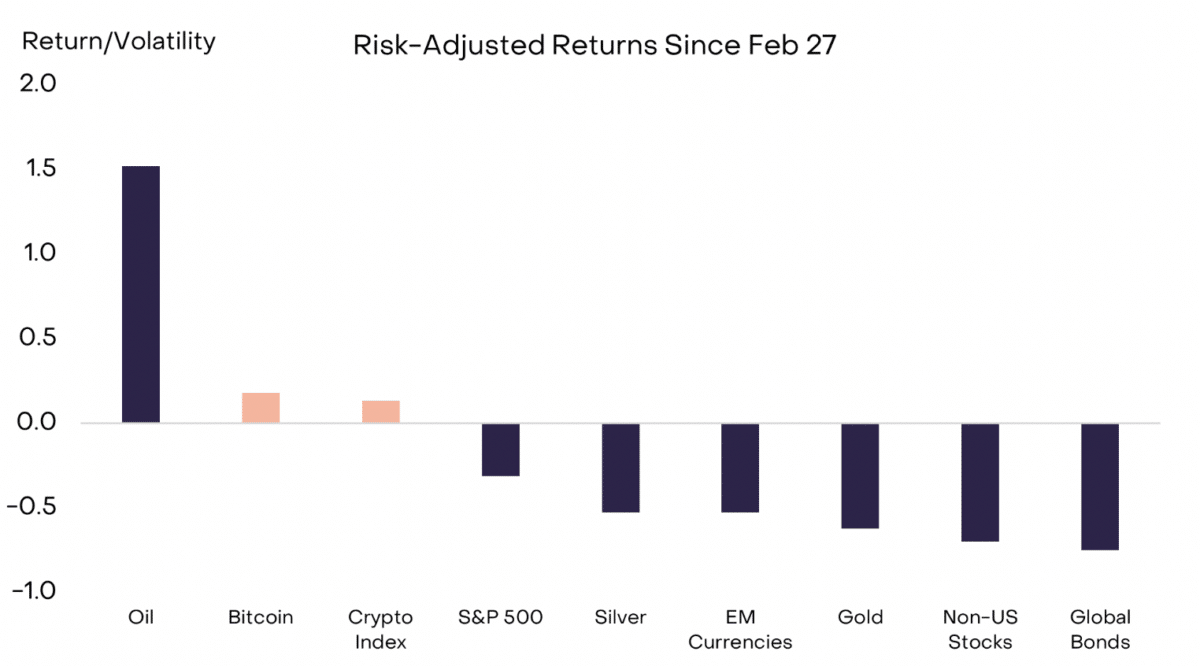
Citing examples, Zach Pandl, Grayscale Head of Research, showed how spot crypto ETPs experienced net inflows. Additionally, Pandl also shed light on how perpetual futures open interest was surging despite the sell-off risk seen from October to early February.
Furthermore, regulatory developments like the CLARITY Act and SEC guidelines on non-securities painted a positive picture of the crypto market.
In fact, during times of war, crypto payments were also escalating, with Iran accepting tolls in crypto from ships that crossed the Strait of Hormuz.
Seeing such activities, AMBCrypto had earlier reported that the toll charged by Iran would weaken the U.S. dollar against $BTC. As expected, this would in turn result in Bitcoin becoming the world’s reserve currency.
Final Summary
- Bitcoin’s 60-day bounce rate is higher than that of traditional assets like gold and the S&P 500.
- Not everyone shares a similar view on Bitcoin being considered the ultimate safe haven in times of war.